
I’ve often seen claims that receiving the silent treatment from someone is the equivalent of emotional abuse – if not abusive itself – and I wondered how it is that doing nothing to someone can be considered abusive?
I once read that what disturbs us is not the disturbance around us, but rather our inability to deal with that disturbance.
The same is true for silence when what we desire are words or communication.
The assumption that we make about the silence from others is that they have reason to believe that their words will have effect, or that it will bring about the understanding that they need or are trying to create.
We also assume that they are capable of articulating what they feel and must therefore be as capable as we are in communicating what they are feeling.
Worst of all, we judge them for being inadequate in their silence because they’re ‘supposed to be an adult’.
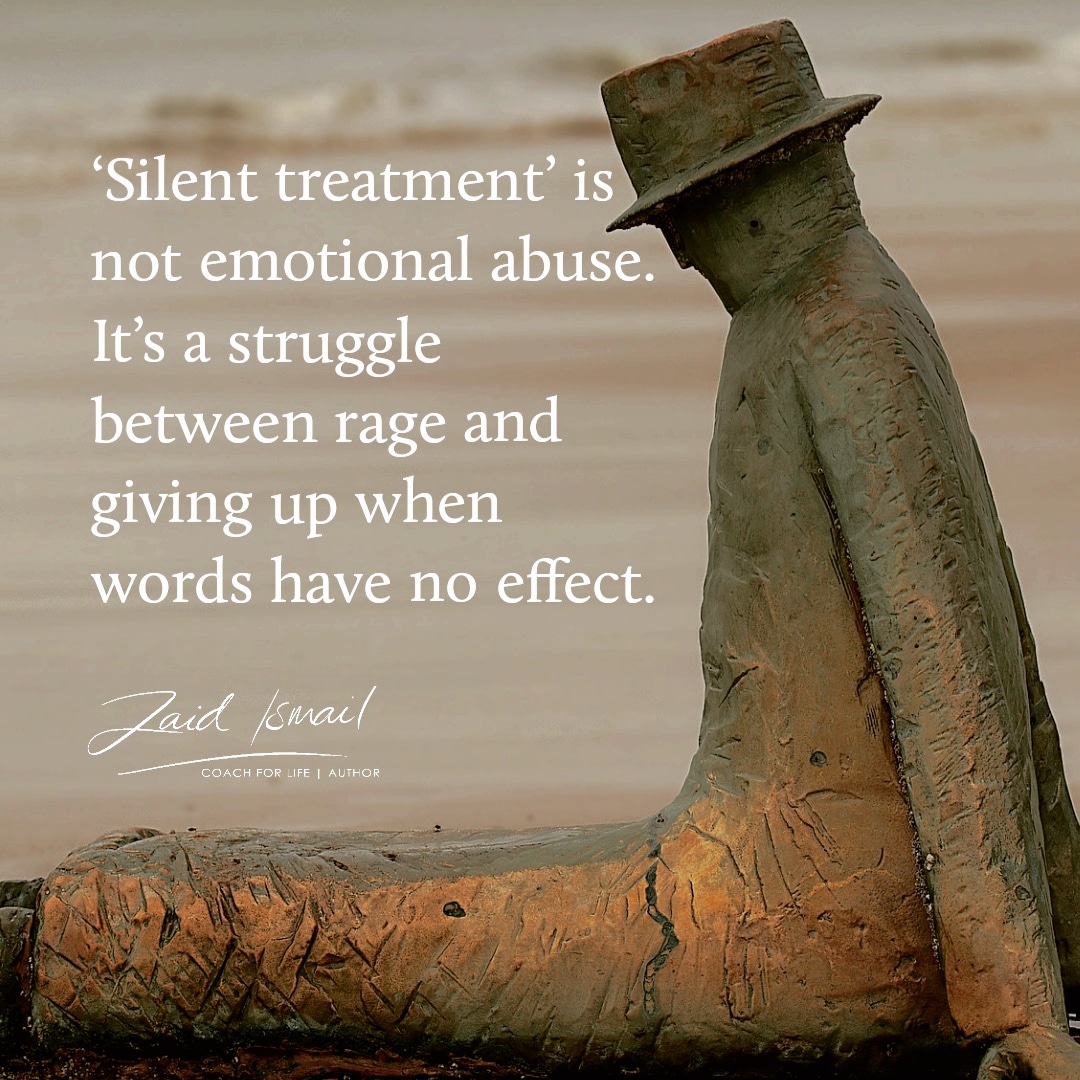
Silence only becomes necessary when we have no hope of getting our point across, but do not want to walk away either.
The silence creates space for understanding. But that space will not be used for understanding if the other person is persisting in demanding that they be communicated to in the manner, and at the time that they need to be communicated to.
The real question that we must reflect on is, “Why are we so impacted by the silence from others that we feel rage instead of seeking to understand instead?”
Rage is our defence against being insignificant.
That’s why silent treatment feels like abuse because it provokes our own feelings of inadequacy or insignificance, and not because the silence itself is abusive.
The assumptions that we make about the motives behind someone else’s behaviour is most often based on what we would be motivated by if we were in their shoes.
Think about that the next time you are inclined towards judging someone harshly before having explored opportunities to create understanding.
#hope #expectation #sincerity #selfworth #selfawareness #mentalhealth #mentalhealthawareness #lifecoaching #zaidismail #loveyourself #lifegoals #motivation #optimism #emotionalabuse #silenttreatment
Silent trauma, or peace?
Discover more from Own your life.
Subscribe to get the latest posts sent to your email.
Comments
2 responses to “Silent trauma, or peace?”
-

It’s withholding and that is abuse! Stop trying to ease the minds of those who choose the silent treatment as a form of punishment. My ex would withhold love and affection and ignore me, giving me the silent treatment! You don’t get to make that universal judgement!
-
The tone of your response suggests that you’re still significantly emotionally impacted by the behaviour of someone who treated you badly, or didn’t reciprocate your investment in the relationship. The biggest mistake that most of us make is assuming that how someone treats us is a reflection of what they think of us, rather than realising that it’s most often a reflection of what our needs trigger in them. That’s, of course, assuming that there are no other material issues with the relationship from a compatibility perspective.
The same universal judgement that you’re accusing me of is being demonstrated by your assertion that your view is correct and that I am incorrect. That’s a double standard.
Dictating how someone must treat you is far more abusive than exercising my agency while realising that it may lead to someone else feeling hurt or betrayed. We have agency to remove ourselves from relationships where we believe we are not being appreciated or treated well. That agency may carry with it some impact that we are averse to, especially when it impacts on the lives of others who are dear to us, like children. But that does not in any way diminish that agency.
The only time it is abusive is if we are prevented from acting with that agency that we have a right to exercise for ourselves. We don’t get to dictate how someone else must behave. We can only exercise our right to respond in a way that we see as appropriate relative to how they treat us, and then we get to accept the consequences of that decision.
We become susceptible to the victim mindset when we abandon this agency and hold others accountable for how we feel about the way that they are treating us. The choice to care or to be impervious to their behaviour is ours. Their choice to care or be impervious to our concerns or needs is the information we must work with towards making healthier decisions about which relationships are worth our investment and which are not.
Witholdiing emotional, physical, or verbal expression is only abusive if I prevent the recipient of my behaviour from exercising their agency to leave or to respond in kind. Abuse is compulsion against our free will. It is not restraint when expression is considered to be impotent. Silence is a form of expression. It’s not abuse.
-


Does this resonate?