How often do you hold back so that you don’t ruffle feathers?
Maybe you hold back because you don’t want to be the odd one out?
Or perhaps you withhold what you’re capable of because you don’t want anyone to think that you are arrogant, or full of yourself, or trying to steal the limelight?
When we focus more on what others think of us, than we do on the value of what we want to create, we surrender who we are, for what we think they want us to be.
Mediocrity is celebrated by those who wish to be included.
It is celebrated by those who want to be liked.
Mediocrity is what maintains the status quo, or worse, allows us to slip into becoming irrelevant.
It is the bold and the courageous.
The ones who challenge conventions with purpose.
The ones who don’t settle for what they have the moment they connect with the real life value of what could be better.
They’re the ones that lead without meaning to.
They’re the ones that uplift without expecting something in return.
They’re the ones that create the fascinating experiences that offer a fulfilling life to the ones who celebrate mediocrity.
Mediocrity is the enemy of progress.
Mediocrity is the enemy of growth.
Be careful of taking joy from being celebrated for what you know is not your best effort. Otherwise you may end up holding on to that accolade, from fear of not being able to achieve it if you push yourself beyond it.
Live curiously. Live purposefully. Live loud. Don’t just exist. Live!
#selfworth #selfawareness #ownyourlife #selfmastery #mindfulness #personalpower #leadership #mentalhealth #mentalhealthawareness #mentalhealthrecovery #lifecoaching #coaching #zaidismail
Tag: leadership
-
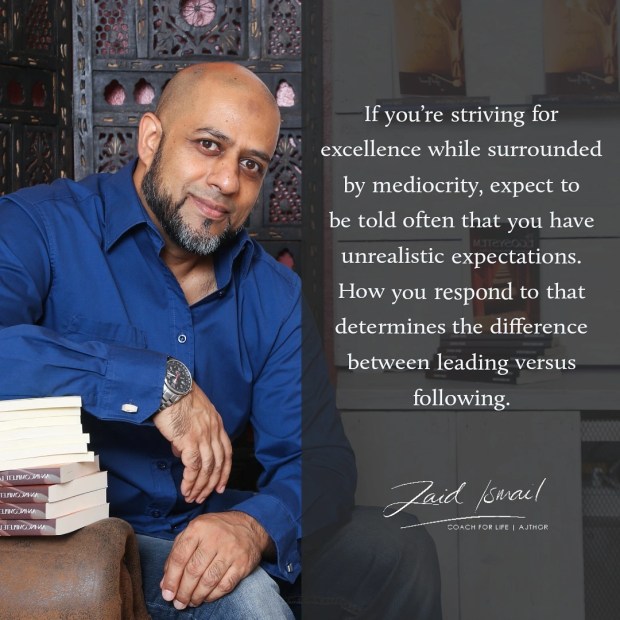
Mediocrity is the enemy of life
-

Be purposeful
Be the one who acts with purpose and conviction, and leave greatness to take care of itself.
The moment you’re focused on who you’re attracting, or how you appear to others, you’re distracted from your purpose.
Be purposeful. And connect with the value of who you are and what you wish to create in the lives of those around you.
The rest will find its own balance.
And the need for control will disappear as you learn to trust in the benefit of living purposefully and with conviction.
Photo credit : Adobe Stock
#conviction #leadership #ownyourshit #ownyourlife #lifecoaching #lifegoals #personalpower #mentalhealth #mentalhealthawareness #mentalhealthrecovery #theegosystem #zaidismail #mindfulness #inspiration #motivation -
A Contaminated Ego
I’ve grown to accept that I am not acceptable by most. I have never been black enough, Indian enough, or Muslim enough, and dare I say pliable enough. I speak my mind without permission because there is none to grant me permission. I don’t intend to give a voice to the voiceless, or a platform to the oppressed. Both are in the state that they are in because of inaction either on their part or the part of the collective to which they actively subscribe.
While I may not be able to resist the physical oppression that overwhelms any physical means of resistance I have at my disposal, it has never been a reason for me to remain oppressed in my mind. Far too many see the shackles on their wrists and assume that to be a denial of their freedom to think and to choose. I may not be able to choose my freedom of movement or association at all times, but I can always choose how much of that oppression defines me or what I am capable of contributing towards its dismantling.
I choose not to be oppressed by the self-serving leaders that I see around me. From government to community to religious structures. The contaminated ego has pervaded all such structures resulting in the stench of moral and ethical decay that I see. Tribal, cultural, and fraternal allegiances define the principles and values by which we live, rather than the common subscription to such principles and values that should supersede such allegiances being the glue that bonds us. As a result, I see leaders serving each other before they serve their subjects, and subjects aspiring to such stations of promise and praise because they wish for such self-serving worship as well. Service to their community rarely factors into that equation.
Everyone wants to believe that they’re the chosen ones. Some claim this through divine appointment, others claim it through association with the divine, but none appear to claim it through serving the divinity that they worship. Instead, they seek to be worshipped for the divinity that they believe resides within them. Their man-made titles convince them that they are morally, academically, and religiously superior while they fail to recognise the irony of using man to proclaim their divinity.
The contaminated ego has convinced many that they are superior by way of association and subscription rather than through action. I claim none of this. As I’m often reminded by the saying of a long forgotten scholar, if you knew me as I know myself, you’d throw sand in my face. A desert of sand. Each time I flirted with the idea that I was better than another I realised that such comparison confirmed that I was worse. The need to compare, even if inspired by a noble endeavour, is arrogance. I either aspire to adopt the ways of those I admire, or I choose to avoid the ways of those that I don’t. Better or worse must never feature because that will be a self-serving notion, not unlike the contamination I see in the leadership that prevails.
Leadership itself is misleading. To aspire to leadership is to court with worship. To have leadership thrust upon you through no effort of your own is a burden imposed by the divine. A burden is never a burden if deliberately chosen. A burden deliberately chosen is a need for validation or acceptance. The true burden is the choice to accept such validation through a rejection of the self. Any subsequent burden is merely a progression of that rejection.
The struggles I have chosen for myself only appeared as struggles when I lost sight of the convictions that I chose to serve. Any hardship or difficulty that resulted was often a result of misplaced expectations or self-pity, both of which faded from view the moment I reconnected with the convictions I held dear. Reconnecting with those convictions was never possible while surrounded by admirers but was only ever realised in the quiet moments where I found myself with no means to placate my failures or shortcomings. It is only through an accepting embrace of the same that I was ever able to rise above it. Denial always only tethered me to that which I hoped to ignore.
The ego itself is neutral. Like the body, it thrives with opportunity and benevolence when sustained with that which humbles it, and it crumbles under the weight of expectations and entitlement when fed with that which makes it gluttonous. Abdication for our choice of spiritual diet leads to the latter and quickly manifests in the unpleasant disposition and appearance that we develop on the outside.
Spirituality and physical wellbeing are not mutually exclusive. The one who professes to be spiritually enlightened will not be physically distorted from their natural proportions, and the one who exerts themselves in being physically attractive are most certainly not spiritually enlightened. It is the consequential balance of the two that reflects the true state of our ego, and not the contemplation of one or the other independently.
[This is an incomplete train of thought]
-
To Lead
The meek assume that you’re a leader the moment you achieve a specific station in life or in your career. The ones who worship the titles do more damage than benefit to the efforts of the ones that rise above the convenience of following others. It is a convenience because it demands less effort to follow a given path than it does to discover your own. If it is true that leadership begins the moment you do more than is expected of you, then every one of us has the ability and capacity to lead. And I believe that to be true.
A fixation on popularity distorts this image of true leadership. I see many toxic personalities being mimicked by others simply because of the title that those personalities hold, or the popularity that they enjoy on social media. Is it really leadership just because you have a following? If that were true, it could be argued that clowns are leaders too. Surely the station of leadership has to be warranted by more than just follower counts, or retweets?
In a time that celebrates celebrities more than it recognises merit, we have a generation growing up with the belief that inspiration lies in verbalising the struggles of weak-minded unprincipled fools because it celebrates their common failings rather than appreciating the need for principled determination. Being able to string together sentiments that celebrate each other’s struggles without recognising how much of those are self imposed has become the latest easy path to fame. But fame is just another way of describing what amuses or pacifies the masses.
One of the dreadful outcomes of social media and this liberal access that we have to a public platform is that it allows for genuinely demented or ignorant beings to organise themselves with like-minded fools that were rejected by the sane ones around them for good reason. Instead of considering why their ignorance was rejected or dismissed, they now have the option to go online and find others with a similar ache from rejection to recruit them into an organised response to demand acceptance, or dominance. That is not as cynical as it may sound.
Before this ease of access to a digital soap box, common sense prevailed in social structures that demanded credibility before accepting someone as a a leader. Such an approach served to quell the stupidity before it became a viral trend. Stupidity would then have less opportunity to survive beyond its immediate social structure and would have to go in search of another social structure in the hope of finding acceptance there instead. But that cycle of moving from one to another required a lot more effort, resources, and personal sacrifice. That in itself dissuaded many from making that move and instead encouraged them to either conform or to adjust their views relative to the challenges that they received in their social circles.
With pervasive access to social media, the less informed can now regroup without any sacrifices to their real life social structures and are entirely capable of leading a double life without any repercussions at all. Responsibility is thus dispersed among the masses because collective accountability means no individual responsibility. The convenience of such a way of life lays waste to social responsibility and instead inculcates a culture of extremism. However, given that extremism is redefined in such a structure, it means that mainstream acceptance of such extremism normalises it because of sheer numbers rather than merit, and suddenly we find ourselves in a state that turns idiots into icons and intellectuals into pyrrhias of society. Hence the greatest failing of democracy.
For this reason, democracy will never be tolerated in a capialist structure. A structure established for the sole purpose of generating wealth will always be focused on the prevalence of opinions that seek to optimise the probability of sustainably acquiring such wealth. Regardless of how popular an opinion may be, those that hold the purse strings will suppress populism in favour of profits. However, this only remains true if the holders of the purse have control over the masses, and are vested in the sustainability of the organisation more than they are in enriching themselves. If they don’t have control over the masses, the masses will organise and prevail in their populist demands despite it undermining the acquisition of wealth, which ultimately undermines the ability of the structure to employ the masses. If their vested interests lie in self-enrichment rather than serving the goals of the organisation, then corruption sets in. Perhaps an over simplification, but I believe that this simple cycle is what defines the probability of success of any organisation or society. The goals that they strive for may be different, but the challenges of meritocracy versus democracy remains true.
Leadership therefore cannot be considered credible if it merely enables the will of the populace without consideration for the sustainability or progress of that group. It also cannot be deemed leadership if it is self-serving and lacks meaningful accountability to the ones intended to be served. Equally so, it is also not leadership if it leads the charge of the masses without due consideration for the long term benefit of the masses. Leadership therefore cannot simply be the empowerment of popular opinion. It must be the tampering of such opinion with an informed view of the long term benefit of the needs of those that have an immediate demand. Being able to shape such opinion and guide it towards a sustainable strategy to not only meet the need but to grow the benefit beyond the immediate need is what will set true leaders apart from figureheads of populist opinions.
When populism drives leadership, it is inevitable that the worst among us will rise to lead, and thus the most corrupt or inept will reflect the selfish whims of the masses when they take office. Those that champion a course that celebrates the selfish dictates of the short-sighted will only serve themselves when in office simply because that is the principles that won them the approval of the people to begin with. Despite this obvious failing in defining leadership criteria, the masses will continue to be enraged by the corruption in public office of those that they voted into power for their ability to create a platform for the uninformed opinion rather than demonstrating true leadership by raising the level of awareness of the masses to recognise that which will result in the long term growth and sustainability of society.
To lead is therefore not to be popular. It is to uphold and strengthen that which the populace is too distracted to notice, but which is central to the upliftment of that very same populace. Plato phrased it beautifully when he said, “No one is more hated than he who speaks the truth.” We do not need proofs to validate this truth. As a natural consequence, it confirms that the ultimate outcome of the populist vote will result in the appointment to stations of leadership of the most deceitful rather than the most truthful among us, and social media plays perfectly into that equation.
-
The Lonely Path (II)
That incomplete thought process is hounding me. It feels as if the main point that I tried to convey in the first take on this subject eluded that entire post. The main point was simply this. Before I continue, I am well aware that me using the term simple when explaining what’s going on in my head is quite the oxymoron. So there is no need to snigger about that.
Anyway, the point is, when we choose to pursue a greater calling in life that stretches who we are and what we stand for, we need to realise that the people that are familiar with who we are will no longer know the person that we are striving to become. Under ideal circumstances they will grow with us. But ideals are most often talked about and rarely implemented. So expect to feel a creeping sense of isolation when you push yourself beyond the norms that surround you.
Understand that when you outgrow the environment that you’re in, those that have grown to be defined by that environment will quickly assume that you are trying to be better than them. Or maybe they will assume that you think you are now better than them. Whether that is true is irrelevant. What is relevant is that you are different. You are hopefully a better version of you. But unless you surround yourself with people that appreciate and grow with you, that’s when the lonely path appears before you.
You’ll find yourself growing uneasy as you feel at odds with what used to be familiar and comforting but slowly grows to feel discomforting and somewhat annoying. The comfort of familiarity will be replaced with the realisation of exclusion. Not the exclusion from social circles because that remains consistent for the most part. But the exclusion that leaves you emotionally wanting while physically accepted. An ambivalence sets in that challenges what you believe to be true against what you think may be an assumption of grandeur.
Believing that you are capable of more borders precariously between confidence and delusion. Choose delusion, and you’ll be delusioned about your dreams and aspirations, resulting in an embrace of mediocrity so that the familiar comfort of fitting in continues to stroke your ego. Choose confidence and expect to be tested each time you take a bold step towards being the better version of you. Each time you break away from the norm you risk ridicule or rejection, or both. More importantly, each time you step up, you face self-doubt about your ability to succeed, and your motivation to want to succeed.
Are you still serving that greater purpose or are you serving your ego? Are you pushing yourself to escape complacency or are you courting the admiration of others? The questions that hold you back never cease while the strength to push on is always just out of reach. That’s when you need to stretch yourself into unknown spaces. That’s when doing what feels comfortable and safe threatens to undo every bit of progress that you made up to that point. Even if no one else noticed that progress, you’ll know it was there after you gave it up. Give it up silently and it will haunt you quietly for the rest of your life as you wonder if you would have been able to pull it off. Protect that progress and nurture it into something greater, and you’ll face the reality of success and the horror of failure every few minutes in the back of your mind as you try to focus on what you feel passionate about while trying to subdue the self-doubt that gave you reason to procrastinate for so long.
At that point you’ll slowly begin to realise that life was never about persevering through trials, it was always about facing the fears of success. By focusing on the trials we have something to raise as a trophy just by surviving. Succeeding in moments that trounced others feels like success, but once the moment passes, once the recognition of our struggles and our bravery fades, we’re back to facing off the same questions that taunted us when we grew restless in the first place when we first looked at our life and saw all the gaps we could fill to make it better and improve it beyond meaningless embellishments. You cannot unsee what you stared in the face. The more you try to ignore it, the more exhausting the effort to distract you from it.
The lonely path is the only path that showed others that there is a better way. It is the sacrifice of one that improves the lives of many. Needing the guarantee of reciprocation or reward before setting out to improve this world feeds the transactional greed that defines too many of our interactions. Be like everyone else and you’ll always feel like you belong, except when you’re taking your final breath, or when you’ve aged beyond your fickle social needs. When your energy and your health no longer allows you to pursue with gusto the passion of your youth, desiring to change the world will be nothing more than self-inflicted torture. Building hope on the empty promises of inclusion by society is a foolish way to burn your candle. If you hope to die knowing that the world is better because of your existence, don’t shy away from the lonely path, embrace it.
-
The Lonely Path
There is comfort in being in a space unoccupied by others. The plague of clichés and the clutter of egos take up residence in crowded spaces. Blending into the crowd always threatened my sanity. Living up to an expectation set against a standard that I don’t subscribe to will always result in disappointment for the one that holds such expectation. Sadly, the fulfilment of our expectations defines the sense of significance for too many.
A simple but defining realisation dawned on me in recent months. There is a conflict of sentiment in encouraging others to own their life. To pursue a path that is unique to what they yearn to see realised in this world places a burden on their shoulders that most are unwilling to bear. It’s much easier to talk about the change that is needed but to recede from the battlefield when the time to act arrives is even easier. Leading the charge against complacency is never a popular role to take.
Spectators are the armchair critics of life. The back seat drivers, or the wall flowers. They observe the most, analyse the most, criticise the most, and do the least. But their time spent gathering information about everything that is wrong positions them well to be the first to point out the shortcomings of those that choose to go to battle. Through nothing more than the momentum contained in their numbers, they become the opinion makers and the advisors, much like the politicians that send everyone else’s children to fight wars that are created around boardroom tables.
The odds are stacked against the ones that set out to make things better. Gaining critical mass for positive change amongst a mass of critics is beyond daunting. It requires a healthy dose of tenacity, resilience, and a dollop of manipulation. The populist leader however chooses to have a healthy dose of manipulation and nothing more. Offer incremental change and deliver only a fraction of it, and the history books will celebrate you for generations to come. All you need to do is give people reason to believe that they were part of a movement that made them feel better about not making progress in life, and then release them to go back into the dreary cycle of their lives.
It’s easy to see why the path of leadership, authentic leadership is a lonely one, especially when you consider that leading does not require a vocal following. It doesn’t even require a conscious one. I once heard that the definition of leadership is to do more than is expected of you. This makes so many sincere contributors leaders despite them feeling like nothing more than burden-bearers.
Step up to take up the slack of the slackers and automatically you take a lead role. Fill the parenting void of absent parents and you become a role model. Assume responsibility for an outcome that everyone needs but no one wishes to own, and you become a rebel. Speak out loud what you know everyone else is thinking but would never utter from fear of inheriting responsibility, and you become the abrasive protestor. The fly in the ointment, or the pain in the butt. Good intention makes no difference. The moment you choose to improve the quality of your life or the life of those around you, prepare to be judged because in stepping up, we automatically make visible those that are sitting down.
It’s that easy to start out on the lonely path of leadership. Not pseudo-leadership that needs a title or a declaration to be established. True leadership. The one inspired by the struggle of the common man, or the aspiration of the unknown dreamer. That is the lonely path, because if everyone recognised the importance of the change that is needed, change would not be needed. Natural progression would happen without disruption. The human condition would improve as a natural consequence of commonly-held values that are actually valued. But they don’t value the values that they profess to uphold. Unless they are the designated leader, it’s not their job to care.
So it rests on the shoulders of the restless ones among us. The ones that see the value of progress and can’t rest until it is realised. The ones that see the gaps and fill it with contributions that uplift the weary souls, or the under resourced. The ones who act, in spite of the critics and the knowledge that they will likely be damned before they are appreciated, let alone celebrated. They are the ones on that lonely path. Despite this, they are also the ones that are most likely to stop and offer a hand to the one whose lethargy finally saw them fall foul of the same system that they once coveted.
Companionship is rare on this path. By implication of their nature, compensating for the selfish embrace of the other is simply a matter of course. Realising that your restlessness is likely to threaten rather than attract the ones that it is intended to uplift, living a life of restrained expression becomes second nature. The smile that never reaches the eyes, or the embrace that feels comforting but is rarely reciprocated are easily overlooked in the haste that accompanies the indulgence of the distracted.
[This is an incomplete thought process…]
-
The Path You Take
Share your story. A prompt that suggests so much. It suggests that we have a story worth sharing, but equally so, it suggests that there is an audience interested in our story. We all have a story to share. So much so that it is an accepted cliché when seeing untoward behaviour from some, or a lack of ambition from others. We remind ourselves and others that we don’t know their story and therefore should not judge them harshly. That has its merits to a point.
Something not so often contemplated though is the story versus the storyteller. I’ve witnessed many times how a great story is dismissed simply for being told by the wrong storyteller. Not because they did a bad job of telling it, but because the audience saw that person as someone other than a source of credibility, wonderment, or inspiration.
The stories of our lives consists of the people and characters that we most often know first hand. Be that online or in real time, our first hand interactions with them shapes their perceptions of who we are and what they believe we are capable of. It is that perception that defines how our story will be received or how our advice may be taken. Good advice is always good advice. It only becomes tainted in our minds because we contaminate it with our perception of the advisor.
True emotional maturity and a healthy self esteem is defined by our ability to accept the truth, or criticism, regardless of its source. That probably speaks as much about the conviction we hold for objective truth (if such exists in normal human interactions) versus our subjective truth regardless of the facts that may challenge our views. But all this is beside the real point, and instead simply alludes to a much more important point that escapes most of us.
When we choose to change the definition of who we are, or how we are preceived (which is a natural consequence of the former), we forget that others are not as invested in the change that we wish for ourselves. For most, it is more convenient for them to maintain their firmly held beliefs about who we are or what we represent, because it gives them predictability and assurance about their views on life and others. They need that predictability or stability especially when their self image is based on how they compare to others. I think this is an important point.
When we realise how much the way we are strengthens the self esteem of others, we’ll realise why it is that the support that we expect is not forthcoming when needed. Their self esteem could be bolstered by believing that they’re better than we are, or by their association with us if we have admirable qualities that they want to be associated with. It is easy at this point to assume that they do not want us to be successful or ambitious, but the truth lies closer to the fact that they are not ready to reevaluate who they are relative to their changing reality.
When we assume that it is about us, rather than recognising that they suffer from their own feelings of insufficiency, we feel deprived or betrayed by their lack of support. Right there is the struggle of leadership. True leadership, not pseudo leadership associated with an office or title. Leading in your chosen field of passion or influence. Following a calling that demands more than just fitting in or complying with the norm. When you choose that path, one of your closest companions will likely be isolation.
Isolation is an inevitable outcome of influencing change. By definition, change means to be set apart from the norm. You cannot lead from within the masses, or by subtly hinting at improvement while maintaining the status quo to avoid disruption. Unless of course minor incremental changes define the limits of the leadership that you wish to provide, or the change you wish to see realised.
I guess it is therefore more accurate to state that disruptive leadership is a courtship of isolation. Only once the value of your vision is experienced by the rest can you hope to feel any sense of inclusion. However, by that time the harm or discomfort of isolation by those you expected to be your staunch supporters often results in so much damage to the fabric of your relationship with them that their inclusion or support no longer holds any merit. Ironically it becomes a reversal of the point of departure. You risk becoming the one not willing to reevaluate your perception of others because of a moment in the past, rather than accepting that they needed tangible evidence to overcome their cynicism or doubt about what you were striving to achieve and the value that it offered them.
Either way, when you choose your path in life, inclusion will leave you constrained and unfulfilled, while conviction will risk disruption that will set you on a collision course with the people that you hope to keep close through the journey ahead. If you have such people in your life, the ones that grow with you on your journey, cherish them. However, on this point I believe that not a lot of cherishing will be done, because not many earn such respect or gratitude through support and encouragement.
Perhaps it is just my jaundiced view based on a jaundiced relationship with a jaundiced society.
-
Where to From Here?
Where do you go when you’re done with the world, but the world is not done with you? The blessing of having a lot of life in your years is that you have a lot of life in your years. While others are playing it safe, treating life like the marathon that it is, I’m the one rushing from sprint to sprint knowing that the marathon could end quite unceremoniously at any moment.
The highs are frequent and exhausting, but so fulfilling. The lows creep up when you pause for a breath between the sprints and you notice that by comparison, you appear a tad crazy to those that are happy to be carried by the trickling current of complacency. Complacency always feels like a threat to me. It threatens to subdue my spirit in favour of a meaningless composure.
Composure is something that is obviously subjective, but also often misunderstood. For me, composure is a sense of quiet confidence and fulfilment about what I’m aware of, what I’m capable of, and what I want from a given moment. When those three things feel balanced, it becomes very difficult for anyone to disrupt that composed state. Of course this ruffles many feathers at times because sometimes people want you to look like you’re in disarray at the news of their challenges or drama.
The more grounded I find myself in a moment that demands a reaction, the more rational I find my response to be. For this reason I defend my personal space aggressively from such external interference that threatens to contaminate it with paranoia and entitlement. I found all of this coming to the fore more than ever in recent months, which resulted in me quitting my job in a corporate to finally pursue opportunities that I am passionate about.
What was important in my decision to quit was whether I was doing it because I felt compelled to, or because I wanted to. I’ve had previous run-ins with big egos in corporate settings that forced me to choose my sanity over my income, and each time my sanity was not for sale. Sanity in this case was not only my grasp on reality, but also my sense of dignity and authenticity. When either was threatened, it brought out a side of me that many found abrasive. The reason they found it abrasive was because they did not share my values and ideals. Before I realised this, I simply assumed them to be dishonest or insincere. Now that I’ve realised this, I simply judge them for not demanding more from themselves, but I refrain from correcting them.
This shift in engagement principles has been a significant change for me to embrace. When I embraced it, I realised that I was starting to compromise on the core of being me, and instead, I was starting to play the political games that make or break careers in the corporate world. That’s when the decision to exit became easy for me. It was no longer in response to a threat from colleagues, or from fear of being maligned or blamed for things out of my control. Instead, it was a solemn realisation that all the fight and passion that I have in me could be better spent in endeavours that had a chance of influencing the change that I wish to see in the world around me.
Emerging from a cocoon-like state in a protected environment and facing the world on your own terms is a daunting experience, especially when your responsibilities extend well beyond just your personal well being. I’ve seen so many feel bitterly entrapped in their jobs because of the responsibility that they have towards their families. I’ve also seen the same people grow distant and abrasive and entitled towards their families because of the self-imposed view that they are tied down to a job that they hate simply because they have responsibilities. That made their supposed sacrifices all the more meritorious, and any action or inaction that did not celebrate that sacrifice was seen as ingratitude. I couldn’t allow myself to get into that state.
Our perception of our options, I’ve discovered, are often informed by our ego. We fill ourselves with self-importance, and then use that self-importance to convince ourselves why we should not take risks. The risk aversion is not always related to the responsibilities that we have. Instead, it is related to our fear of failing at something other than what we are familiar with. When we hate what we’re familiar with, we find reason to defend our decision not to do something decisive about it, and often that defense is based on apportioning blame to others, or to circumstances because once again, it absolves us of the responsibility to act.
Where to from here? I don’t know. What I do know is that if I fail to recognise the value that I contributed to the corporate world over the last twenty odd years of my life, and if I fail to appreciate the re-usable skills that I acquired in that time, I’ll be looking for another hand-out job offer to keep me sane and relevant. My focus now is therefore on everything that I have proven myself to be capable of, and to find ways to apply that in a meaningful way to pursuits that are anything but conventional, while seeking to fulfil the conventional needs of those that don’t realise they have those needs yet.
It is a cryptic space, but not any more cryptic than life has been so far. The only reason we don’t recognise how cryptic life has been is because everyone was facing the same growing pains as we were. So there was collective comfort in knowing that we were not incompetent by ourselves. The cynic in me has returned, it seems. But this is a natural disposition that offers me insights into opportunities that would otherwise be hidden by the monotony of being normal. A return to myself is called for, and leaving a toxic environment on my terms was the first decisive step I needed to take to ensure that my life amounts to more than just a regular pay cheque from an unfulfilling job. There is relevance and significance to be earned outside of corporate. And that is where I’m heading with everything that I am.
Perhaps the world that I was done with, was in fact not the world at all.