Some promises are broken before they’re even sealed.
Some are honoured before they’re even made.
The promises that are sincere will be blessed in their outcomes, well beyond the obligation that they carry.
But the promise made out of obligation or compromise will always be burdensome and restrained in its fulfilment.
Like apologies, promises are often made to avoid an unpleasant moment, rather than to create a beautiful one.
It is this insincerity more than anything else that destroys what could be a beautifully fulfilling relationship.
It is in the nuances and innuendos of how we honour the commitments that we make that leaves the most defining impression, and not just the fact that we kept our word.
No one wants to feel like a burden or an obligation.
When we lack sincerity in fulfilling our promises, or following through on our apologies, that is exactly what our unspoken words scream at those who cherish us.
It tells them that they’re not important, only us keeping our word matters to us because we value our image more than we value them.
Let your unspoken words reflect sincerity and conviction, and not leave room for doubt or ugliness.
Anything less is a lie.
#promises #commitments #principles #obligation #relationshipgoals #sincerity #selfworth #selfawareness #mentalhealth #mentalhealthawareness #mentalhealthrecovery #theegosystem #zaidismail #mindfulness
Tag: Principles
-

Empty promises
-

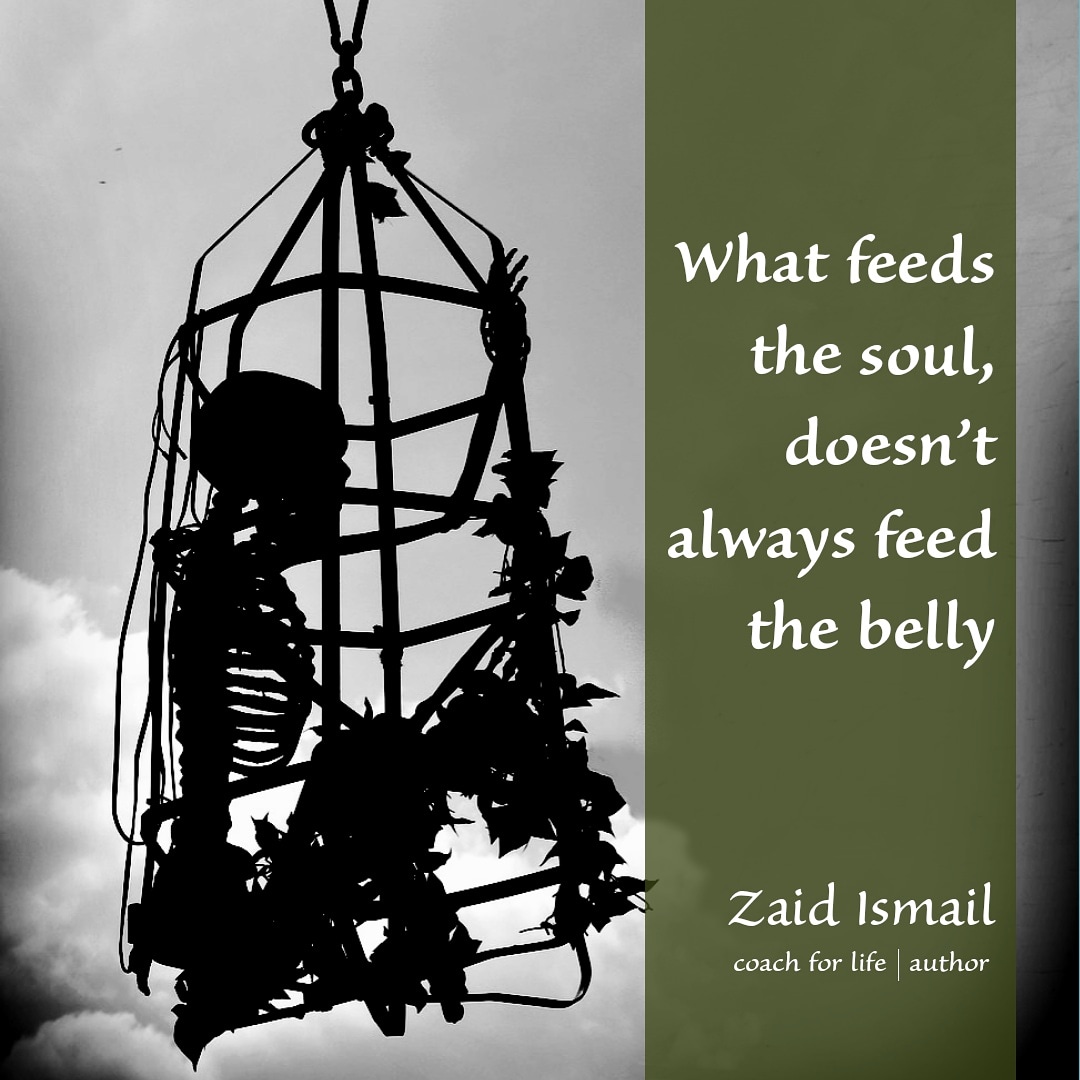
Gluttonous distractions
The utopian ideal for many is to find a line of work that feeds our passion for life, while also earning us a comfortable lifestyle.
Inevitably, the comfort of the material rewards for such a pursuit, for those of us fortunate enough to discover our passion, slowly distracts us from that unadulterated passion that once drove us, only to be replaced by the fear of losing the means that sustains our quality of life.
Similarly, we lose focus on what quality of life really means, and become distracted by convenience of life while assuming that to be the accomplishment worth protecting.
The soul is soon neglected and the belly becomes the master that drives the decisions that shape our efforts.
It sometimes takes years, if ever, for us to realise that we lost our way.
For those that are again fortunate enough to realise this unfortunate shift, gathering the resolve and the courage to redirect our focus to our passion at the risk of downgrading our lifestyle becomes a trial that brutally separates the adults from the meek.
Too many willingly surrender to the system while claiming impotence in their efforts to avoid acknowledging their weakness for the indulgence of their belly.
They’re the ones who grow diseased and bitter, each day needing more distractions than before to keep them steady on the path of servitude that they chose.
Servitude without fulfilment. Thus has this world become tainted with the bitter cowards who would much rather blame the world for their lack of resolve, than accept responsibility for their gluttonous appetite for the trinkets of delusions that parade as success.
Photo credit : Adobe Stock
#hope #expectation #sincerity #resolve #conviction #lifegoals #principles #passion #ownyourshit #ownyourlife #theegosystem #mentalhealth #mentalhealthawareness #mentalhealthrecovery #zaidismail -
Depression is not…
I saw an illustration this morning that showed a man walking with a heavy shadow weighing him down. From one tile to the next the shadow grew bigger and more daunting until eventually it got inside him turning the inside of his body into a dark cave, with a little figure of him sitting helplessly in a corner inside his body. When asked by someone else how he was doing, he simply replied that he was fine, while apparently hiding the darkness inside of him. Many who have experienced, or are experiencing depression can relate to this illustration, but not enough take the more important lesson from it. Park that thought for now.
The good thing about the recent focus on Mental Health is that they are not calling it Mental Disorders as often as they used to. I take hope wherever I can find it because this is one topic that if ever there was profiteering from the misery of others, this would be it. When trying to sell a product we generally appeal to one of three things. We appeal to vanity, we appeal to convenience, or we play on fears. Mental health is very much in the last category and is currently a multi-billion dollar industry worldwide.
The first point therefore is that depression is definitely good for business. Turning every supposedly imperfect emotional state into a disorder was the goal of the American Psychiatric Association as far back as the early 1970’s. It is for this reason that we now even have a pill to deal with shyness or modesty because we have been led to believe that it is a social anxiety disorder. As dreadful as that seems, it is hardly the worst thing about the depression industry.
Buying into this mentality provides the convenience of abdicating accountability for the uninformed or downright poor choices that we make in life. Take that accountability away and replace it with a pill, and you have a patient for life. Worse than this, you give others an excuse to claim that they are victims of an external force and can therefore not overcome this state by making better choices. Instead, medication and psychotherapy is needed. Good parenting and healthy friendships have nothing to do with it, or at least that is what they would have you believe.
We then refocus our goals on individual needs and blame society for stifling us, and in the process once again abdicate responsibility for the contribution to those around us that would build the healthy society that we all yearn for, while complaining about the cruel world that we live in. Cruel world dynamics then create more opportunity for new pills and lifestyle diseases, and suddenly the overwhelming number of health problems related to depression adds weight to the farce that depression is something we suffer from as an illness.
Back to that illustration, what we fail to realise is that the more we nurture the depressive state (that overbearing shadow of darkness) the more it will grow. Again, a choice that we make to either deal with the source of our dissatisfaction, or accept it for what it is if we are unable to change it. Unfortunately, most wait for it to miraculously change without any effort on their part, and in the process convince themselves that the universe hates them which is why they are not getting what they need to be happy.
That was deliberately flippant because if reading that angers you, then you are more likely to be predisposed to depression or feelings of oppression because you see weakness of resolve as being imposed on the individual by society, rather than seeing that the weak resolve of individuals is what allows society to define the self worth of the individual. By showing sympathy and compassion for unhealthy behaviour, we teach people that such behaviour is not their fault.
We teach them that poor choices are not because they were naive, but rather because someone else was manipulative or dishonest. As much as that is true, the resultant impact on us is directly related to what we continue to expect from them, and not what they continue to do to us. Waiting for an abusive parent or partner to be wholesome before we believe we are worthy is like putting a loaded gun in the hands of a psychopath and asking them to have mercy on us.
Our lack of conviction in what is acceptable versus what is intolerable for society to thrive as a collective and not as individual indulgences is exactly what enables the bullies, the manipulators, the deceitful, and the immoral among us. Deferring our accountability for the consequences of the choices that we’ve made in life simply emboldens the toxic ones and vilifies the victims into a state of shame or…depression.
Everyone gets it wrong. Often! But our insistence on viewing the success of others through idealistic lenses because we need to believe that we are unworthy simply provides us with comfort when we fail, because persisting in the face of adversity is only possible with the heroes among us. Like one philosopher so eloquently stated, each time we create a hero, we diminish our own capacity for greatness. Be careful who you create as a hero in your mind.
P. S. If you know which philosopher it was that said that, please let me know because I can’t seem to find the source to give due credit for it. I suspect it was Henry Thoreau but I could be mistaken.
-
Where to From Here?
Where do you go when you’re done with the world, but the world is not done with you? The blessing of having a lot of life in your years is that you have a lot of life in your years. While others are playing it safe, treating life like the marathon that it is, I’m the one rushing from sprint to sprint knowing that the marathon could end quite unceremoniously at any moment.
The highs are frequent and exhausting, but so fulfilling. The lows creep up when you pause for a breath between the sprints and you notice that by comparison, you appear a tad crazy to those that are happy to be carried by the trickling current of complacency. Complacency always feels like a threat to me. It threatens to subdue my spirit in favour of a meaningless composure.
Composure is something that is obviously subjective, but also often misunderstood. For me, composure is a sense of quiet confidence and fulfilment about what I’m aware of, what I’m capable of, and what I want from a given moment. When those three things feel balanced, it becomes very difficult for anyone to disrupt that composed state. Of course this ruffles many feathers at times because sometimes people want you to look like you’re in disarray at the news of their challenges or drama.
The more grounded I find myself in a moment that demands a reaction, the more rational I find my response to be. For this reason I defend my personal space aggressively from such external interference that threatens to contaminate it with paranoia and entitlement. I found all of this coming to the fore more than ever in recent months, which resulted in me quitting my job in a corporate to finally pursue opportunities that I am passionate about.
What was important in my decision to quit was whether I was doing it because I felt compelled to, or because I wanted to. I’ve had previous run-ins with big egos in corporate settings that forced me to choose my sanity over my income, and each time my sanity was not for sale. Sanity in this case was not only my grasp on reality, but also my sense of dignity and authenticity. When either was threatened, it brought out a side of me that many found abrasive. The reason they found it abrasive was because they did not share my values and ideals. Before I realised this, I simply assumed them to be dishonest or insincere. Now that I’ve realised this, I simply judge them for not demanding more from themselves, but I refrain from correcting them.
This shift in engagement principles has been a significant change for me to embrace. When I embraced it, I realised that I was starting to compromise on the core of being me, and instead, I was starting to play the political games that make or break careers in the corporate world. That’s when the decision to exit became easy for me. It was no longer in response to a threat from colleagues, or from fear of being maligned or blamed for things out of my control. Instead, it was a solemn realisation that all the fight and passion that I have in me could be better spent in endeavours that had a chance of influencing the change that I wish to see in the world around me.
Emerging from a cocoon-like state in a protected environment and facing the world on your own terms is a daunting experience, especially when your responsibilities extend well beyond just your personal well being. I’ve seen so many feel bitterly entrapped in their jobs because of the responsibility that they have towards their families. I’ve also seen the same people grow distant and abrasive and entitled towards their families because of the self-imposed view that they are tied down to a job that they hate simply because they have responsibilities. That made their supposed sacrifices all the more meritorious, and any action or inaction that did not celebrate that sacrifice was seen as ingratitude. I couldn’t allow myself to get into that state.
Our perception of our options, I’ve discovered, are often informed by our ego. We fill ourselves with self-importance, and then use that self-importance to convince ourselves why we should not take risks. The risk aversion is not always related to the responsibilities that we have. Instead, it is related to our fear of failing at something other than what we are familiar with. When we hate what we’re familiar with, we find reason to defend our decision not to do something decisive about it, and often that defense is based on apportioning blame to others, or to circumstances because once again, it absolves us of the responsibility to act.
Where to from here? I don’t know. What I do know is that if I fail to recognise the value that I contributed to the corporate world over the last twenty odd years of my life, and if I fail to appreciate the re-usable skills that I acquired in that time, I’ll be looking for another hand-out job offer to keep me sane and relevant. My focus now is therefore on everything that I have proven myself to be capable of, and to find ways to apply that in a meaningful way to pursuits that are anything but conventional, while seeking to fulfil the conventional needs of those that don’t realise they have those needs yet.
It is a cryptic space, but not any more cryptic than life has been so far. The only reason we don’t recognise how cryptic life has been is because everyone was facing the same growing pains as we were. So there was collective comfort in knowing that we were not incompetent by ourselves. The cynic in me has returned, it seems. But this is a natural disposition that offers me insights into opportunities that would otherwise be hidden by the monotony of being normal. A return to myself is called for, and leaving a toxic environment on my terms was the first decisive step I needed to take to ensure that my life amounts to more than just a regular pay cheque from an unfulfilling job. There is relevance and significance to be earned outside of corporate. And that is where I’m heading with everything that I am.
Perhaps the world that I was done with, was in fact not the world at all.
-
Slip Sliding Away
There are far too many mornings when I wake up and find myself searching for a specific inspiration before looking forward to the events or non-events of the day. My inclination to write is dwindling at a pace that is concerning, because it was part of a bigger picture ideal that I held on to for a very long time. ‘Held on to‘ is probably not an accurate way to describe it. It was part of a broader purpose that I willingly subscribed to. Still do, but just not with as much gusto as I did before.
The time when I expressed without restraint has been replaced by a time when I am measured in favour of the absence of drama. That’s not how I envisaged living my life. I still push the boundaries in my own ways, but not nearly as aggressively as I used to. Perhaps this is why I write less often, and my book has stagnated to the point of gathering digital cobwebs. Resurrecting it has its benefits in that I will once again read an old manuscript with fresh eyes. The downside is that I will feel the burden of revising something that has been endlessly revised already. It’s like solving the same problem over and over and over again. That detracts from the sincerity of the text, the rawness of the expression of emotion, and the clarity of thought that inspired the writing in the first place.
Not long after waking up with such a vapid mindset I find myself anxious and restless, with the need to achieve something meaningful with the limited time and resources I have at my disposal once again prompting me to drag my butt out of bed and into a course of action that will satisfy the yearning within me to make a difference. To contribute towards a world that I desired for myself, but was unable to achieve it, so I apply myself in the pursuit of creating it for my children, and for the generations to come. The sowing of my seed in the hope that the shade of its tree will shelter and offer a comforting repose to ones that I will never know or meet, and neither will they ever know or meet me.
I think it is in this anonymous benefit that we feel both part of a greater social cohesiveness, and simultaneously take for granted the social fabric that offers us the comfort and security to be who we are. In other words, if we don’t realise what it is that we get from society, we won’t see reason to pay it forward for others to enjoy the same benefit. In so doing, we end up in the state that too many find themselves in, including me, where we persevere in the establishment of those structures was once available to others, but were eroded to the point of disuse leaving us to establish it once again in the hope that it will one day be available to the ones that come after us.
The cryptic nature of my thoughts appear to be returning, which in essence is a good thing. It implies that I am once again looking questioningly at the world around me rather than enjoying or despising it at face value. Moments between such phases of inquiry in my life feel lifeless and vacuous. Life becomes an empty shell that demands fulfilment in the form of instant gratification and reckless indulgence when such purpose is lacking. That too often seems to explain a lot of what I see around me. Missed opportunities and broken commitments, not promises. Commitments transcend the fickleness of overt promises. Commitments set the expectation of loyalty, trust, honesty, sincerity, and so much more. A promise is merely a contract made either with conviction, or with a sense of responsibility, but not always made with a sense of true commitment to the agreed outcome.
Life slips away when we falter on the path that leads to fulfilment of purpose. That faltering arrives in the form of a distracted emphasis on agreements, and obligations, rather than mutual commitment to the spirit of the outcome of such shared aspirations. That slope is slippery. It starts with a need to take care of numero uno when we have good reason to believe that if we don’t, no one will take care of what we need, and quickly descends into a selfish embrace of life when we discover the joy of finally getting what we want before having to worry about what others need. It starts out as doing something for ourselves for a change and quickly becomes the norm when we realise how many others do exactly the same. This collective irresponsibility somehow justifies the abandonment of responsibility to those around us, and soon thereafter we become part of the burdening masses that burden our souls through their self-indulgent destruction of the lives of those that they once committed to protect and uplift.
Some may interpret this as divorce, some as betrayals of trust, and others as a betrayal of a shared dream. Either way, the betrayal is what lingers, and the selfishness that ensues appears to be the most sane response to an insane world. Our slip into the fabric of that tainted world escapes us when we lose sight of our own purpose that we abandoned in favour of the response to a tainted crowd.
Life slips away when we stop serving something greater than our selfish needs. Once we find ourselves sliding into that abyss that offers gratification without fulfilment, we grow increasingly closer to embracing the animal within, and abandoning the human without. Courage takes on a new form when we find ourselves clawing our way up that slope to break the slide that many others so willingly embrace. Courage is a rare attribute these days. Populism has killed it.
-
Self-serving Subservience
There’s a natural assumption that suggests that those that serve others are selfless in their intentions. It’s not an unfair assumption either, because the visible actions of people lead us to judge the way we wish we would be judged under similar circumstances. It’s that age old wisdom of seeing our faults in others. But age old wisdom is not always true. Sometimes, pervasive ignorance can easily be mistaken for collective wisdom.
Selfless, as a concept, I find to be highly problematic. The hidden motivations of what we want to feel or gain hardly ever makes a selfless endeavour a truly selfless one. However, in the absence of a more noble approach to life, I guess we should be grateful for the fact that the selfish needs we have to feel good, benevolent, or appreciated, results in good for others. Personally, that is as close to selfless as I am willing to assume anyone is capable of being.
But there is a more sinister seeming selflessness that contaminates rather than enriches the lives of others, including the life of the one that is subservient. To live a life focused on serving others is only meritorious if that is grounded in a conviction of upliftment. It is not so commendable when we find that it is the result of a deep self-loathing. So deep is such self-rejection that we define our worth by the acceptance of our contribution to others. Those that find themselves lacking in their personal space find it easier to sacrifice their own needs in favour of acceptance or validation by those around them.
I’ve had many relationships, or more accurately, feigned friendships dissolve into nothing the moment my demands of them to be true to their convictions surpassed their belief in themselves. Holding on to the demons of the past that so effectively defined their space in society created a comfort zone that almost cast their self-image in stone. Shattering that image threatened to shatter their being, and thus it became easier for them to surrender the friendship, rather than to surrender the weakness they had no reason to believe they were capable of overcoming.
Success, within this context, can be paralytic. It’s like the intense fear we feel when our lives are threatened, and we find ourselves caught between helplessness and wanting to flee, but knowing that neither state is helpful, so we remain paralysed with fear wishing away the circumstance until it eventually passes. When it finally does pass, we convince ourselves that prayers made it so, because that’s the only remnant of dignity we have to hold on to in the face of our impotence in that moment. There are many whose perpetual state is reflected in this way.
Pandering to authority because that is where we believe our next paycheck comes from erodes our dignity more than anything else. Collective subservience like this is commonplace. People that pretend that it’s perfectly acceptable to have one moral code in their personal space and different moral code in their public space will rarely amount to anything more than a placeholder in people’s lives. Pawns are the sacrificial lambs needed to achieve someone else’s goals. Strangely though, pawns used in such a fashion feel proud to have been used in a such a way, while the reality of being used completely escapes them.
Not every servant is dedicating their life to servitude. Many of them simply do not have the courage to believe that they have more value to offer this world than to simply serve the whims and dictates of others. Demand that they own their lives and you’ll see a viciousness in them that you never thought possible from a placid servant. Fear yields the fiercest cowards in all of us. We’re selective about when we expose that rage, because it only ever makes sense to expose it to those that we despise or consider to be equal to or lower than ourselves, but rarely (if ever) will we expose such rage to the ones we worship for vaildation or acceptance.
Self-serving subservience is destructive to the human spirit because it creates comfort for the cowards when such subservience is celebrated as humility or servitude to others. Worse still, it becomes ever more toxic when classes of superiority are defined through subscription to these ranks, resulting in society believing the victim to be oppressed, and the one with conviction to be the oppressor.
Reality is a twisted view of a wholesome life. Somewhere in there lies the secret to sanity.
-
When Understanding Goes Too Far
I sometimes watch the wayward behaviour of some while observing the contempt of others that are watching it play out, and wonder who between the two are less aware of their actions or motivations to behave that way. The ones among us that are of a softer nature will look on and seek to understand why someone may be acting out, afraid that judging them for acting out may be too harsh. The world is harsh enough as it is, and only getting harsher each day, so I guess there is merit in such an approach.
At times, when we’ve had enough to deal with in our own lives, we look on with intolerance, demanding that the wayward behaviour be checked, because if no one is willing to accept such behaviour from us, why should we accept it from others? Right? But demanding change without offering a solution helps no one. It only exacerbates the already toxic state of the relationship or the environment around us. It provokes the wayward ones to escalate their protest against whatever it is that they refuse to accept, and it frustrates those that seek to understand.
Moderation in all things is always called for. Demand without understanding, and you lose credibility when the solution becomes obvious later on. Understand without demanding, and you lose credibility when the demands foster the change that was needed to break the cycle. Do either without the other, and you resign yourself to an end of insignificance. Unfortunately, doing both requires purposeful conviction. Not blind conviction. Not the kind of conviction that is driven by a self-belief of what we stand for but for which we are rarely capable of defending when challenged. That belief that we insist on being respected despite not knowing why, but only knowing that through receiving such respect for our beliefs, we feel significant and less threatened.
Purposeful conviction. You’d think it was easy given that it’s a simple matter of cause and effect, but of a different kind. You recognise the cause that you wish to champion, and you put your efforts into effecting the change needed to support that cause. Problem is, most don’t recognise the cause, they only recognise the affiliation. The need to be associated with something meaningful or relevant, rather than establishing meaning and relevance through their own actions and contributions.
It’s all well and good to understand. But the failing of many is that we stop at understanding. We spend much time and energy in achieving that state, but then avoid taking steps to remedy the causes that we now understand leads to that unacceptable behaviour. Being perceived as understanding in nature makes us popular with those that don’t want to change, those that prefer acting out, being rebellious, and refusing to accept accountability for their state because they find it much more convenient and less taxing to blame others, or circumstances.
The ones that act out, and are left to act out, become masters at presenting their tantrums as legitimate gripes or demands. They often end up being the bullies, the type A personalities, and the abusers. They become the oppressors that they grew up whining about. And those that sought only to understand but chose not to curtail such behaviour, or offer healthier forms of expression, they feed that cycle. They enable such outcomes, and they become the liberals. The ones that stand for nothing, understand everything, and fall for every whimper regardless of how incredulous the whimper is.
Understanding is only ever the first step, and never the last. There is no point in seeking to understand if you intend to do nothing more than reflect on that knowledge that you have gained. Understanding must inform our decisions to act. Not acting is a decision in itself, but it’s usually the easy way out. It’s often under the pretense that we don’t want to get involved because we have enough problems of our own, or it’s none of our business. And that’s how the cycles of violence, intolerance, and abuse in society spiral out of control. It’s because those that understand do nothing, while those that do not understand act without guidance.
Prompting someone towards having the courage to take control of their lives, regardless of what came before, is more selfless than it is selfish. Too often we’re distracted by the assumption that by demanding more, we’re behaving selfishly because we don’t understand how difficult it is for that person to be who they are if only we knew what they’ve been through. That is a horrid distortion of the truth. The truth is closer to the fact that leaving them to succumb to their past is in fact selfish, because prompting them to rise above it is often met with resistance and contempt, both of which erode your sense of significance or likeability in that relationship. So when you withhold advice or decide not to take action because you don’t want to be ‘the bad one’, you’re behaving selfishly. Standing up and being counted in a time when guidance and good advice is needed, not necessarily wanted, takes more courage and is much more selfless than shutting up and minding your own business.
We have far too many that shut up and mind their own business, except when they enjoy the anonymity of social media and similar platforms, because once again, there is limited (if any) risk of them becoming unpopular in the relationships that they covet. I suspect that the point of this post has been made somewhere between all the venting, but at the risk of being redundant. It’s simply this. Seeking to understand is a noble first step. But it’s only a first step. Don’t stop there. Take the knowledge that you gained through that process and apply it with conviction in a meaningful way. Don’t be a passive observer of life, or the lives of others. Have the courage to change it for the better.
-
Contaminated (Part II)
We live in times where the inclination to remedy a fall far outweighs any rationale to prevent the fall from happening. We’ll willingly encourage others towards intoxicants or unhealthy distractions, and then form support groups to help them out of that addictive state, while refusing to condemn the bad advice we gave in the first place. Accountability is only celebrated if it doesn’t disrupt the oblivion of the masses. Those that threaten such disruption are spurned for being callous, cruel, or arrogant, often accused of thinking that they’re better than everyone else. In short, we condone that which reflects our own weaknesses not because we believe in its wholesomeness, but because we feel more human in recognising the shared weakness in others. More than this, it makes us feel less inferior when we believe that we share shortcomings with others, rather than falling short of expectation by our solitary selves alone.
It’s not about being better than everyone else any more. These days, it’s simply about not being worse. There was a time in human history that I imagine the focus to have been on competing to excel in human endeavours. People would have exerted themselves to achieve noble goals that served as inspiration to others to want to rise up and pursue even greater heights. It’s quite different today. Today, it seems as if we compete to see who is able to dominate through any means possible, where the level of domination is celebrated, without any concern for the means or methods that achieved such domination, except where those means and methods threaten our ability to actively compete.
I’ve been fascinated by the term ‘fully formed adults’ ever since I first read it a few years ago, but my fascination quickly turns to disgust as I look around and struggle to find specimens that exhibit such qualities. Semi formed adults raise calloused and contaminated children. Children that grow up under semi formed adults face trials and hardships that are entirely avoidable, and fully surmountable, but they often shy away from the challenge of rising above because when they raise their gaze looking for a role model to guide them, they see nothing but more contamination of a society that is full of semi formed adults. It’s therefore little wonder why they themselves succumb to the same cycle.
Regardless of how harsh our childhood may have been, we all reach a point of independence in life where we are able to feed or break the cycles that raised us. Critical thought is spurned as rebellion and disrespect because semi formed adults lack the skills and self-worth to effectively navigate their way through critical thought processes. The stigma associated with failure is so harsh that even in the face of absolute failure we’ll find a euphemism to describe our sorry state. Anything is better than admitting failure. It’s this same insincere and tainted social setting that continues to lay down a path of strife and distraction for children looking for meaning and purpose in life.
In the absence of a critical mass of fully formed adults, those that try to break the cycles are placed with a burden that is tenfold relative to the effort that would be needed to raise a balanced and confident child. It’s a constant struggle of trying to convince or influence the child towards a wholesome standard while they are bombarded with the unhealthy standard of the semi formed adults that they’re surrounded with. Isolation from such a malformed society is not an option. When we disengage, we lose the right to judge, criticise, or cry foul.
We need to stop raising children. We need to start raising adults. This mindset that has contaminated the world in recent centuries that childhood must be enjoyed with abandon so that we can start being adults when we reach a certain age needs to be abandoned. This distinction between childhood and adult life is misguided. It’s not about age, it’s about awareness and accountability. We should expect greater accountability as we progress through the stages of self-awareness and awareness of our surroundings. The same way we expect a child to stop wetting the bed once they have been taught the value of hygiene and the skill of using the toilet, we should continue to hold them to such levels of accountability in action and behaviour as they continue to acquire new skills.
But adults that had a contaminated childhood often project those regrets on the children under their care. Instead of raising the standard against which they raise their children, they embellish the esteem of the child with gestures that convince them, the adults, that they’re doing a better job than the raising that created the flaws that they despise about themselves.
The common undertone and theme in society these days is one of demand, but little supply. We’re all demanding to be recognised for the struggles of our lives, and to be judged based on the gravity of those struggles, while remaining entirely oblivious to the fact that we are merely spawning another generation of victims that will take our efforts and raise it further. Their demands will be ever more destructive and selfish, and the erosion of society that we universally lament will continue on its downward spiral until a group of inspired young souls will look upon the generations that came before them with a sense of contempt and disbelief. The inheritance of wholesomeness that should have been passed down will be absent, and in such total absence they may finally resolve to correct the path that they’re on, rather than continuing the toxic cycle in search of affirmations and validations for experiences that hold no sway over the next generation.
Adults that still place their insecurities and weaknesses before the well being of those that look up to them deserve a special kind of scorn. We all have the ability and the capacity to actively reflect on how we are perceived by others so that we can take steps to embellish our images in ways that would earn us praise. This is regardless of upbringing or value system. It is entirely based on who we wish to view us admiringly, and how we wish to feel about their gaze on us. We therefore cannot argue that such reflection in the betterment of our characters and moral assets is impossible simply because we were raised by a calloused or contaminated society. The resolve and courage exists for us to change the way we live our lives. The motivation however, is lacking, because it is significantly easier to fulfil an expectation of a consumerist society than it is to raise the expectations of the next generation.
[end rant]