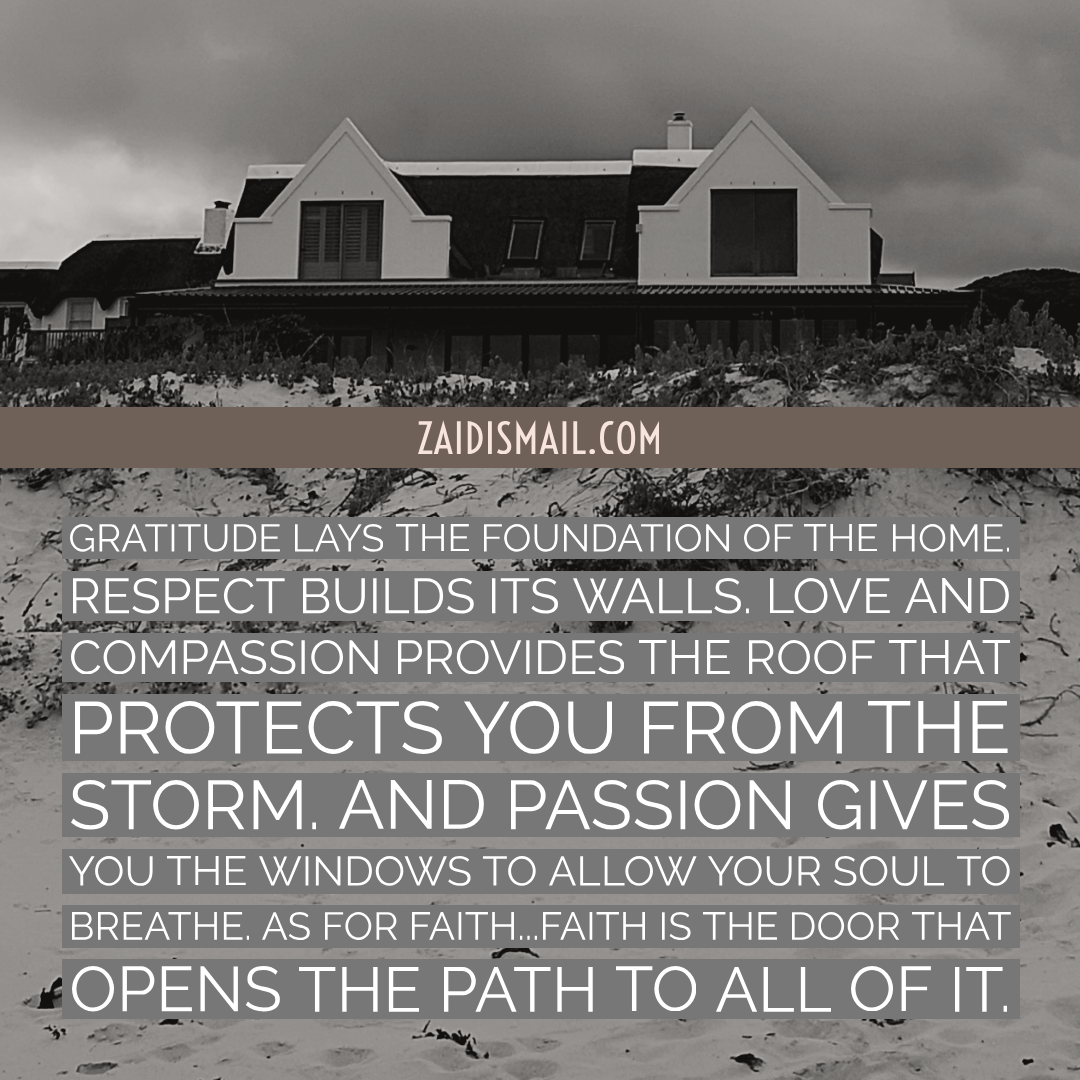
Life creeps up on us. Only teens have yet to recognise this fact because the rest of us that have, are usually distracted by the efforts to hold on to that youth that becomes so elusive the moment we exit that phase of life. Despite the fact that many don’t ever mature beyond that state, being emotionally immature does not in any way stem the tide of entropy that beckons old age.
Coupled with age is responsibility. Sometimes it is thrust upon us, while other times it is willingly courted. Again, our obliviousness to either process does not in any way prevent the process from being established firmly in our lives. All the obliviousness does is distract us from fulfilling our responsibilities, or at the least, fulfilling those responsibilities with due consideration. As we grow, we acquire new things. With each new thing comes the requirement to maintain or improve.
I recall moving into my first place after leaving the family home, and I was fixated on having a sparse setting. In my mind, all I envisioned was a space that had wooden floors, a mini high quality sound system in one end of the room, big airy windows letting the sun pour in as the only source of warmth, both temperature and tone, with crisp white walls and a low futon bed to sleep on. That was it. I didn’t have a need for a TV, fancy furnishings, or anything else to express who I was, or what space I wanted to occupy in this world. To me, that defined me sufficiently.
Then I got married, and the need to make the home more comfortable for more than just me meant additional furnishings, more elaborate items, and colour coordinating embellishments. Even with that change, by most standards, we kept it minimalist, and it worked for us. With marriage comes extended families, and so the furnishings needed to be updated to allow for guests, and to create a welcoming atmosphere in the home. Suddenly, through the gradual evolution of this growth cycle, I went from my sparse setting to what was by comparison, a lot of clutter. Each piece of the clutter carried its own demands for maintenance as it fulfilled its own purpose for being there. Because it had purpose, the maintenance became a responsibility, because in the absence of such maintenance, it became an eyesore, or worse, it detracted from the welcoming atmosphere with which we wanted to greet our guests. That was the state of my life many decades ago.
Jump ahead a few decades later, a few relationships later, kids of my own, and a growing extended family, and all that was needed then is multiplied tenfold now. With all that maintenance, responsibility, and clutter that accumulated, I found myself needing outlets for creative expression so that my space was not only about welcoming others, but so that it also offered a welcoming repose for me. My hobbies in DIY and other similar exploits welcomed its own clutter, and now I find myself having to set aside time to clear the clutter, create order, and make space for thinking so that I don’t feel overwhelmed when I consider doing anything as part of that creative expression that is needed.
And then the pause. Sometimes erroneously referred to as a mid-life crisis, even though it doesn’t always hit you at the requisite age of a mid-life crisis. The pause that is needed to reflect on why all of this is needed, or wanted. The pause that is needed to determine what caused me to veer so far off from that original goal of keeping it simple, minimalist, and clinically practical with an abundance of space and a very small dose of maintenance and responsibility. It didn’t take long before the realisation of those self-sustaining cycles dawned on me. I moved from one reality to the next, to the next, until eventually, responding to new realities with the principles and convictions that I maintained dictated that with each opportunity to contribute towards others, I found myself acquiring stuff, trinkets, comforts, and more, all with the objective of striking a balance between purpose, practicality, indulgence, and expression.
I know I am not unique in this way. I see it with everyone else around me as well. However, most are so caught up in that self-sustaining cycle that they forget what their point of departure was, and what semi-conscious choices they made along the way to arrive at the point they’re at. By losing sight of it all, it’s easy to slide into a state of simply improving what you have under the guise of wanting to maintain or enhance your quality of life. However, what defines that quality of life often escapes us as we respond to triggers that have grown to define our sense of accomplishment, or more accurately, our self worth. How we are perceived, and how well we navigate the self-sustaining cycle becomes our measure of success, and that is how we lose sight of the ambitions and goals of our youth.
The pause that enables that realisation is the same pause that either welcomes old age, or prompts us to reconnect with our youthful passions. Most embrace old age, again through a semi-conscious decision that hides the realities that go with such a choice. Those realities include giving up control, giving up independence, and often most importantly, giving up a passion for life. There is a distinct difference between growing old gracefully, and aging. Most of us age, as we are expected to do so by society. We actively plan to have no purpose by seeing retirement as a final achievement that defines our fulfilment of our promises to those around us. That’s when the entitlement sets in, and the passion and purpose fades.
But none of this was the original intent of this post. Instead, what triggered this post was a discussion with a mutually afflicted individual grappling with the conundrum of caring for a parent that was caught between desiring independence, recognising their dependence, and resisting the reality of both. In contemplating how our parents arrived at this point in life, I pondered over the above cycles and phases of life that we go through as we find our lives taking a shape of their own, and obligation or commitment, or perhaps even neediness guides us to become so entrenched in the cycle, that eventually the cycle defines our purpose in life, rather than being an enabler for a greater purpose.
When that happens, the cycle eventually discards us the moment we choose to exit from it. That is when we grow into a state of dependence while not wanting to be a burden. Not because we are a burden, but because we still desire to be at the helm of the cycle, rather than a recipient of it. But even that doesn’t adequately define the troubled state that we find ourselves in at that point in life.
I always picture life as a baton that we carry until we have to pass it on. Each time we pass it on, we are presented with a new baton that we carry for the next part of the journey. As long as we perceive those points of exchange positively, like moving from being an unemployed youth to an employed adult, to a married adult, to a professional married adult, and so on, we embrace each exchange of the baton because we believe that it defines progress and success. What we fail to notice is that each time we do this, the focus is on how we are perceived relative to the definitions of success to which we collectively subscribe. That not only defines our perceptions of how others see us, it also defines our perceptions of ourselves. Hence the scourge of depression these days. Ingratitude is the only natural outcome of such an unhealthy perspective.
What that means when we reach old age is that the definitions of true success would have eluded us for so long, that when we are faced with the opportunity of achieving the greater goals in life, we’ll find ourselves receding in the belief that our ability to contribute in kind and no longer in cash means that we are no longer of value to those around us. This is when we find ourselves wanting to be a part of the lives of our offspring or our extended families, but restraining ourselves from such participation because we don’t want to impose in what should be their personal space. Not wanting to impose leaves us feeling like a burden, even though such imposition may be desired by those around us. It gets even more complicated when we realise that those two extremes are the only points of reference we have any longer. That is, to be included, or to remain excluded for what we perceive to be the benefit of others. Neither is healthy.
Our consideration should never be about whether or not we should impose or be imposed upon. It should be about value. The value we contribute with our presence, and the value we get from the presence of others. That value must never be measured monetary or materialistic goals. Instead, it is the value of wisdom and compassion that we impart in those relationships that become invaluable in guiding the next generations through the self-sustaining cycle that will drown them if they don’t have a model of wholesomeness towards which to aspire.
And that, in essence, is the crux of our existence. When we become so fixated on material contributions to the comforts and well-being of those around us, we lose sight of the fact that our sincere guidance and good counsel is infinitely more important to inspire others to rise above the drudgery of a materialistic and consumerist way of life. Giving meaning to the self-sustaining cycle in a way that does not feed its materialistic definitions of success is the greatest gift we could ever impart to anyone, be they family or strangers. We deny others the value of such wisdom when we retract from not wanting to be a burden, or we impose from wanting to be significant, because both motivations are centred in the misconception of self-preservation rather than wholesome contribution.
The ugly truth is that we only adopt such a view of our inclusion in the lives of those we assume we are burdening when we begin to believe that we are burdensome. We become burdensome when we stop serving a purpose greater than the fulfilment of our own needs, and instead, seek to have our needs fulfilled by others. This conundrum becomes ever more complex when we contemplate the egos that are at play, both from the aged that wish not to be a burden, and from the young ones that consider them a burden when the expression of gratitude is not forthcoming because the need to feel fulfilled in taking care of the elders in our families feeds our own need for purpose and validation in our lives.
[This has been a very difficult and complex thought process to articulate. Perhaps that is why it has silenced my writing for so long. The bleeding of thoughts at the keyboard has been plagued by blood clots of distraction in recent months. I need to exit the toxic cycle that I find myself in. Convictions to fulfill responsibilities and rights can sometimes deny you the presence of mind to fulfill the greater purpose that contributes more value than the carrying of burdensome responsibilities ever could. And so the rabbit hole of yet another thought process beckons.]