
Appreciation is simply an acknowledgement of what we feel blessed with, while gratitude is reflected in what we claim to appreciate.
The secret to contentment is found in gratitude.
But not in an attitude of gratitude.
It must be more substantial than that.
Gratitude must be a meaningful connection with what we truly value about ourselves and our lives, and not just appreciation for having more than others.
Gratitude allows us to focus on what’s good, and realise how much worse things could be.
It encourages appreciation for what we have instead of envy for what we don’t have.
Most importantly, it recognises the blessings that most take for granted like good health, free time, youthfulness, good relations, and peace of mind.
When we lose gratitude for these things, we take it for granted and stop doing what is needed to maintain it.
That’s when we lose it.
And if we still don’t recognise our ingratitude at that point, our difficulties become a trial rather than a reminder leading us to believe that we’re cursed or being tested by divine decree.
Live with gratitude. Always.
#gratitude #appreciation #happiness #hope #optimism #fulfilment #indulgence #mentalhealth #mentalhealthawareness #mentalhealthrecovery #family #lovedones #opportunity #trials #problems #coachzaidismail #ownyourlife
Tag: trials
-
Be blessed, not entitled
-

Gratitude, the root of peace
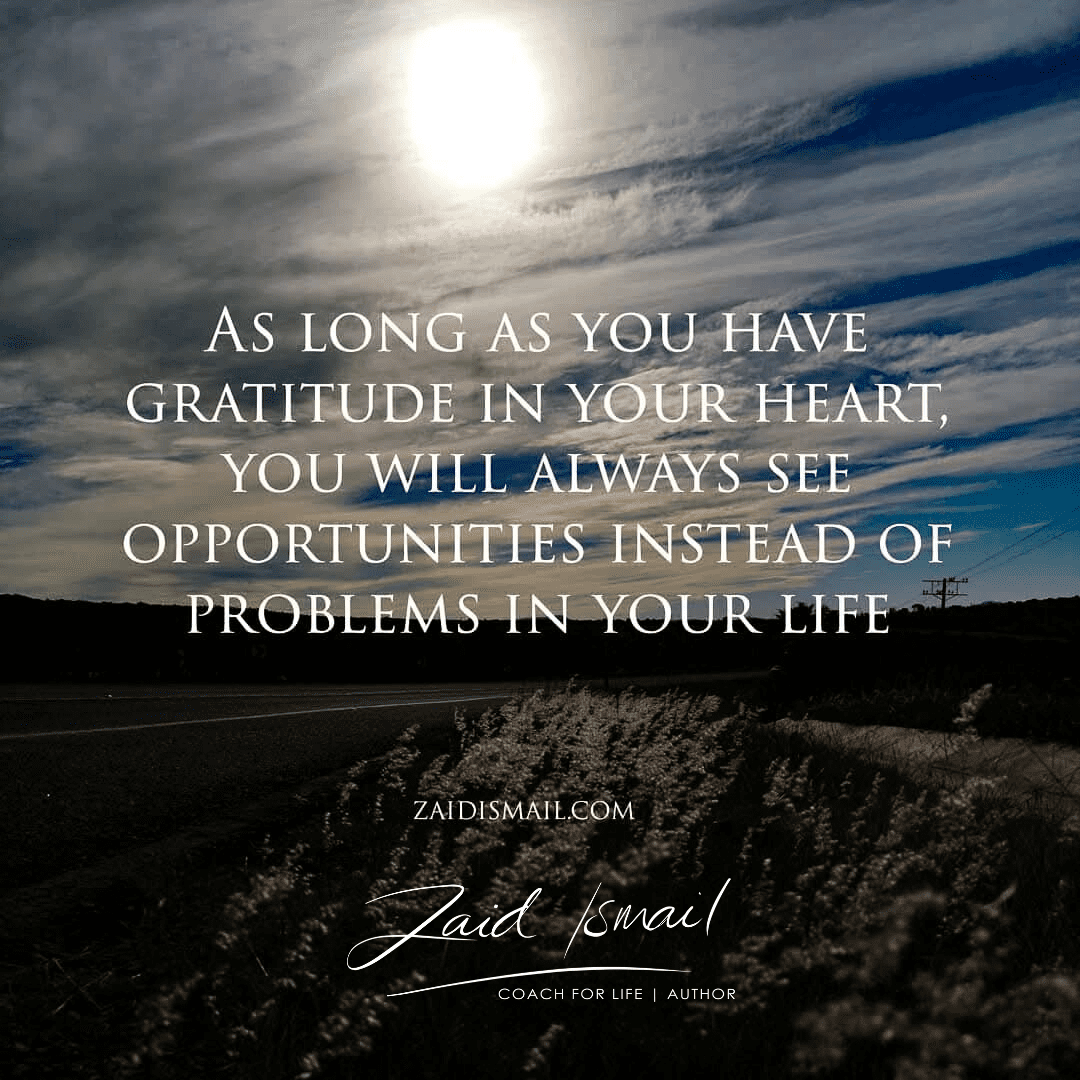
As long as you have gratitude in your heart, you will always find opportunities instead of problems in your life.
Gratitude allows us to focus on what’s good, and realise how much worse things could be.
It encourages appreciation for what we have instead of envy for what we don’t have.
Most importantly, it recognises the blessings that most take for granted like good health, free time, youthfulness, good relations, and peace of mind.
When we lose gratitude for these things, we take it for granted and stop doing what is needed to maintain it.
That’s when we lose it.
And if we still don’t recognise our ingratitude at that point, our difficulties become a trial rather than a reminder.
Live with gratitude. Always.
#gratitude #appreciation #happiness #hope #optimism #fulfilment #indulgence #mentalhealth #mentalhealthawareness #mentalhealthrecovery #family #lovedones #opportunity #trials #problems -
The Iceberg Effect
Resilience is obstinacy in the face of adversity. It relates to our ability to resist being overwhelmed even when we face the storm alone. Facing storms alone is so much more fun anyway. It tests our limits of perseverance in ways that reveal our true strength, or at least it hints at what we are truly capable of. That wouldn’t be possible if we always had someone by our side to face the storms, because then, we’ll grow to learn how much we can bear if only we have someone to bear it with.
We go through life chipping away at icebergs but assume that we’re carving snowmen instead. Each effort is intended to yield a specific and immediate result. Those of us that have progressed beyond our formative years realise that reality has struck no such bargain with us, so we strive a little more after each setback, knowing that success often hides behind a few setbacks, or more accurately, failures. So we give it a try, and another, and another, until eventually we give up in the belief that our energies will be better expended elsewhere.
Giving up though, is rarely that simple. If the goal we courted was important to us in ways that would define our happiness, giving up becomes a bitter pill to swallow. But in the face of inevitable failure, we assume that it’s the only option to save our dignity. That’s when we convince ourselves that we’re building snowmen, rather than chipping away at icebergs.
The iceberg analogy has been used to describe many positive and negative aspects about life. Quite popular in the meme culture of late is the use of the iceberg to demonstrate the pinnacle of success rising above the water, while a huge amount of effort, perseverance, and some failure rests beneath the surface that no one seems to recognise. It is not an untrue analogy either, but there is a different perspective that I believe is equally important, if not more so.
Think of the iceberg as a problem you’re facing, but not just above or below the surface. Instead, the iceberg in its entirety represents the challenges we face in life. Now consider what happens to the bottom of the iceberg as we chip away at what we can see on the surface. Each time we shave away the top, the bottom rises a little more making it seem as if the top is never-ending. So we keep ridding ourselves of the surface layer hoping that nothing more will rise in its place, only to be presented with more each time, until eventually we grow despondent and stop chipping away.
What we fail to recognise in that process of chipping away is that each time the top was removed, even if only a little, it made way for the underlying issues to surface, and each time the underlying issues surfaced, it reduced the weight of what was beneath the surface, out of sight, until eventually so little (if any) remained, that it made the iceberg irrelevant. What once was an iceberg suddenly becomes an ice cube.
Being able to chip away at that iceberg would also be so much easier if we just moved it to warmer oceans instead of remaining anchored in the icy waters that sustained its creation to begin with. And that, simplistically, is how life presents its challenges to us.
The ocean is the environment we find ourselves in, each environment having its own share of toxicity or benefit depending on what we need to take from it. Remain in the surrounds that gave rise to our problems, and our problems will continue to grow larger than we ever will be, constantly overwhelming us and convincing us that trying to prevail is futile. Change environments and suddenly our perspectives are refreshed and solutions become easier. It reminds me of the prophetic analogy of the blacksmith and the perfume merchant. Spending your day with the blacksmith will never leave you perfumed.
Accepting our state may result in us finding comfort in the cold desolation of the confined spaces of the top of the iceberg. For some, a confined space is much more comforting than the horror of having to venture beyond their comfort zone. In their case, icebergs are great, and so is being rooted to the spot. Unfortunately they hold others back because of the company they need on that iceberg. They become masters at making snowmen, as long as that snowman is on their iceberg.
I often wonder how many times did I stop chipping away at some of the icebergs in my life just as the final layers may have been surfacing before I gave up and moved on to new icebergs? It’s a question that could easily test our sanity, because we rarely find out in this lifetime when giving up was the wrong thing to do. The only comfort that I find in such deliberations is in knowing that my choices to leave, to abandon, or to simply stop caring about some icebergs was a conscious choice relative to what I was willing to tolerate at that point in my life. Where I realised later that I may have given up too soon, I accepted that I would have done no differently no matter how many times I could relive that moment, because the sum total of my life’s experiences, my emotional maturity, and my awareness of what was taking place would always be the same. The only thing I could do was recognise what it was that detracted from my decision being more informed, and be sure not to overlook that aspect again in future. I think that’s how icebergs melt without us having to chip as much.
Remaining in toxic settings, or relationships, while chipping away is often an unnecessary test of our resilience. What doesn’t kill us does not make us stronger, it only makes us more brittle. Eventually, we’ll discard opportunities that promise beauty while holding on to the remnants of what may have been simply because we focused on the iceberg, instead of the ocean.
[This is an incomplete thought process that has plagued my mind for weeks now. Hopefully this partial expression will lead to the clarity that escapes me at this time.]
-
Reverse Engineering Life
It seems that I’ve wasted most of my life experiences during the years when I quietly contended with the upheavals in my life and moved silently forward without making a fuss of what I wanted, nor questioning why it always seemed to happen to me. Through no deliberate effort on my part it strengthened me, even though I, and many around me, often perceived that strength as numbness. There were times when I chastised myself for not having a more emotionally grounded response to the suffering or trials of those around me, but I was also often reminded that it was that very same numbness that allowed others to draw strength from my apparent composure at times when they felt overwhelmed.
I think there’s a value in having such an emotionally disconnected person around at times. It’s a reminder that not all is lost when all seems lost. But that’s not how most people viewed me, and fortunately my default demeanour of being oblivious to the perceptions that others held of me meant that it didn’t affect me much either. Despite this awkward sense of comfort I had about being able to deal with my reality in ways that caused many to question my sanity (quite literally at times) I felt a growing dis-ease regarding the fact that my experiences were being wasted because it only seemed to benefit me, and no one else. In doing so, it further distanced me from those around me because not many could relate to me just being me.
I slowly experimented with using my experiences as a point of reference to try to relate to the emotional burden that so many people seem to drag around with them, and each time I tested my observations for accuracy and relevance, I found that it was quite effective in providing others with an alternate perspective as to why their situation was not as grave as it seemed. All this clutter continued to swim around in the back of my mind for many years until I considered it slightly differently recently when someone once again asked me why it is that I am so calm and composed during moments when others are literally overwhelmed or panicked.
My usual response was to dismiss it and smile while telling myself that I’m incapable of feeling such emotion, but that uncomfortable feeling in my gut kept nagging at me because I knew it wasn’t true. I am probably more emotionally sensitised than most people I’ll ever meet. (Note I said sensitised, not sensitive!). However, my innate focus on wanting to emerge from trials rather than how to cope causes me to look behind the emotion and focus on the steps needed to overcome it instead. In doing so, it’s inevitable that I got accused of being insensitive because most people look for sympathy rather than guidance when they’re down and out. I think it validates our weakness when we receive sympathy, while tough love reminds us that we’re being pitiful instead of bold. Victims versus masters. Scarcity mentality versus abundance mentality. They all talk about the same thing. You either want to prevail, or you want to be admired for having persevered when others would understand if you failed.
It’s that unhealthy need to be recognised for our strength in our struggles that often leaves us rooted in our struggles rather than motivating us to overcome it. We find comfort in knowing that others know how much we’re hurting because there’s a natural embrace of compassion or sympathy that often accompanies such visibility. That embrace is often from those that are equally or more weak than we are because they draw comfort from being able to comfort others that are similarly afflicted. This must all sound so cold and dismissive, but it’s not intended that way. I’ll say it again. Sympathy has only ever made someone feel better about being in the state they’re in, while tough love is what pushes them to move forward. Soliciting sympathy in times of weakness is the poison we don’t need.
That’s when I realised the value of being sensitised rather than sensitive. The value of reflection rather than expression. Reflection allowed me to observe what lessons I had learned from past experiences, and what markers were associated with them, while my outbursts, my anger, and my need to make others understand how bad my state was so that they could empathise with me only ever served as a distraction from moving forward and letting go of the past. That’s when I started looking for the tell-tale signs in others relative to what I witnessed in myself when I went through similar experiences, and the more I identified it, the more I was able to accurately interpret what they were experiencing, why they were experiencing it, and what they were contemplating in dealing with it. Not because I knew them well, but because I knew myself well. And that’s how I started consciously reverse engineering my own life experiences with the aim of understanding the trials and struggles of the people around me.
So when we’re told we see our faults in others, we need to go beyond just understanding that it implies that every finger pointed at someone else means there are several more fingers pointing at ourselves. This is more valuable and important than that. If we go beyond the rhetoric and the vilification, we’ll see that every struggle of ours is in fact a resource to alleviate the struggles of others. It’s not the sympathy that matters most, but the compassion coupled with the resolve to raise them out of the depths of despair that we once experienced that will add more value than any amount of sympathy ever could.
However, the irony of helping others out of the dark spaces in their lives is that when they emerge, they’re often inclined to avoid you because you remind them of a time when they were weak. Most people think such weakness is deplorable, they are the ones that remain weak. It is only the grateful that see their moments of weakness as being the source of their strength. They are the ones you should surround yourself with because they will offer the hand of compassion concealed in a glove of tough love when the ingrates will revel in your weakness because it makes them feel better about their own pathetic selves. On that note, don’t expect to be surrounded by too many people at all, because a cursory look around you will reveal that this world is overcome with ingrates who are obsessed with what is in it for them, rather than considering what they need to contribute instead. Incidentally this brings to mind another thought that occurred to me this week. That is, sincerity is rarely reflected at the moment of giving, but most often reflected in the behaviour that follows. And so we should be careful of seeing those that sympathise with us as being sincere, because very often they are the ones that accuse us of thinking that we’re better than them when we let go of what held us back, just because they’re still holding on to it in their own lives.
(This was a particularly challenging post to write, for reasons that I have yet to figure out!)
-
Dua When Desiring Death
Anas (May Allah be pleased with him) reported that: The Messenger of Allah (Sallallahu álayhi wa sallam) said, “Let not one of you wish for death because of a misfortune which befalls him. If he cannot help doing so, he should say: ‘O Allah, keep me alive as long as You know that life is better for me, and make me die when death is better for me”.
Al-Bukhari and Muslim
