
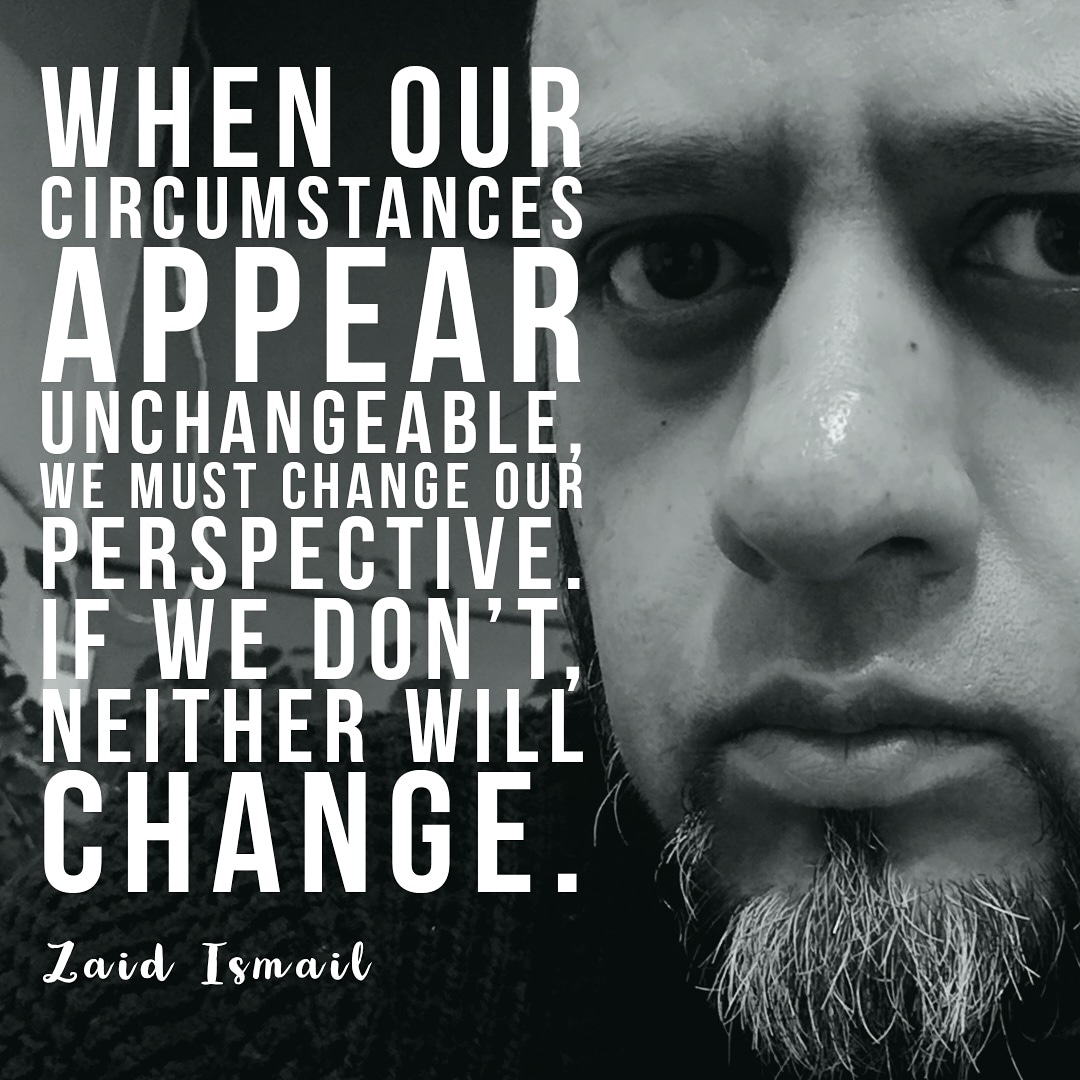
When our circumstances appear unchangeable, we must change our perspective. If we don’t, neither will change.
Perception shapes our reality, because we can always create an alternate reality, but we can never change reality itself.
When we look at something and feel overwhelmed by it, we generally find ourselves choosing between two things.
We either try to find someone to blame for it and hope that we’ll be miraculously saved in the process, or we’ll try to understand it better so that we can identify a way to overcome it.
The former is a victim mindset. The latter is simply being sensible.
We need more sensible people. And sensible people are those who are aware of their contribution towards the outcomes that they experience in life.
Sensibility starts with self awareness, and emotional mindfulness is at the heart of it all.
#selfawareness #selfrespect #mindfulness #inspiration #ownyourshit #ownyourlife #theegosystem #embracingME #21daystolive #mentalhealth #mentalhealthawareness #mentalhealthrecovery #lockdown #covid_19 #corona #coronavirusmemes
Tag: perception
-
Choose your reality
-

Mindfully Distracted
Mindfulness seems to be the next big binge for self help gurus. I don’t consider myself a self help guru by any stretch of the imagination. However, this does not prevent me from being critical about those that claim to guide others towards self improvement when in fact their guidance merely encourages distractions, or coping mechanisms instead. In its most basic form, mindfulness can be described as the ability to observe while suspending judgement or bias. In other words, don’t jump to conclusions just because what you’re observing or witnessing appears to be a familiar sight relative to a previous experience.
The easy bit of advice would therefore be to suspend judgement and bias. Do that, and suddenly you’re mindful. Right? No. Not so easy. Judgement and bias are innate qualities that guide us through life. Even if we try to be non-judgmental about something, we need a frame of reference as to what being judgemental would be. Once we have that frame of reference, we then consciously choose to subdue parts of it in favour of exploring the possibility that something may be different about what we’re witnessing in that moment. The parts we don’t subdue are the limits of boundaries that we define for what is acceptable in that circumstance. In other words, we encounter a moment of willingness to be informed of something we didn’t previously consider while recognising that some things remain non-negotiable. Take that to the extreme, and it means that we acknowledge that there is a possibility that we may not be fully aware of the circumstances and nuances of what we’re experiencing. This forces us to be more alert and more adaptable because we realise that the outcome is potentially unpredictable, but not necessarily a threat to us.
However, if we recognise that we may not be fully aware of the circumstances and nuances but have a greater desire to appear to be authoritative or in control, we’re more likely to grow aggressive, defensive, or simply obnoxious about how we deal with the situation at hand, often undermining the rights and feelings of others in the process. This response is grounded in insecurity about how we see ourselves, versus how we want others to perceive us. Unfortunately some people are so entrenched in their beliefs about themselves, that considering that they may be wrong about something completely disrupts their composure, which makes them aggressive, passive aggressive, or evasive. At the root of it all is a desire to be significant in that moment.
When we desire significance, we adapt our approach towards that which we believe would encourage acceptance and admiration from those we’re interacting with. If we believe we are capable of winning such admiration and respect, our confidence grows and we become more bold and charming in our presentation of our views or the delivery of our message. However, if we doubt our ability to be convincing in that regard, we feel threatened because a show of incompetence may lead to an erosion of significance. If the audience we’re with could meaningfully influence the quality of our life, we’ll restrain the aggression and put more effort into appearing amenable to alternate perspectives. Stated differently, we try not to be offensive in our response because we believe that their acceptance of us is core to our wellbeing. This induces stress which then demands an outlet if not handled well.
Take the above scenario and change the audience to one that we do not view as being influential on our quality of life, and suddenly our response is very different. Instead of restraining ourselves, we speak our minds, go on the attack to demand significance, and disregard any concerns about how they may view us. Incidentally, we do the same with those that we believe are less likely or unable to reject us if we behave in such an abrasive manner. That could be because of our belief in how reliant they are on us, and therefore would be forced to agree with us. This similar to those times that we felt compelled to be amenable with those characters that we didn’t agree with, but who had authority over us that could significantly affect our quality of life. For example, a boss that could fire us if we spoke openly about what we didn’t like about our job or how they were running things. Of course, sometimes we behave abrasively because the subconscious boundaries that we set for ourselves are being breached.
But how does all of this tie into mindfulness? Each time we get a sense of dread or elation, we’re automatically distracted by the assumption we hold of the probability of the outcome, be it negative or positive. Whether we’re proven right or wrong, in that moment, we lose mindfulness and instead assume a disposition relative to a preempted outcome. It’s for this same reason that we sometimes get hit from out of the blue when something is going so well, but without warning, turns sour. At other times, something that we expect to turn out badly goes really well. In both instances, the hints at how things are going may be so subtle that unless we’re open to observing them, they’re easily missed.
The reality is, we’re human. Our emotional make up is more complex than we could possibly imagine which is why we’re each so unique, even when we try to mimic others. There is always something that sets us apart, sometimes in ways that we like, but often in ways that we don’t. Hence the masses that incline towards fandom rather than defining their own unique path.
The trick therefore is to find the balance between being mindful to the point of being mechanical, versus being emotionally responsive to the point of being irrational. When we recognise and accept our humanness, we’ll be less inclined towards feeling threatened and instead, we’ll find it easier to be accepting of the humanness of others. Developing a habit of reining ourselves in during those moments of dread or elation will allow us to savour the good moments and learn from the bad, without feeling whimsical or threatened in the process.
In between all that a creative outlet is needed to allow for the freedom of expression that does not restrain us relative to the views or expectations of others, because if you look back at all you’ve just read, you’ll realise that everything is about how we are perceived or how we want to be perceived by others. That’s why it gets complicated. That’s why we search for soul mates and kindred spirits. Without them, we find ourselves slowly depleting our energy reserves without getting that boost of inspiration because we have a lack of safe spaces for free expression that defines us based on our convictions and desires, rather than on what we believe we are expected to do for others.
Meditation or prayer is what gives us retrospective pause to realise where on that treadmill of life we find ourselves. Mindfulness is what reduces our need for such deliberate reflection. And sometimes, without realising it, we become distracted in our efforts to be mindful, while allowing moments of excitement, joy, or exasperation to escape us because we are too busy observing the individual components that make up that wholesome experience.
Welcome to the pit of quick sand we often refer to as the human condition.
-
Seeping Arrogance
No one simply decides to be arrogant, even though the obnoxious nature of some may convince us that such a deliberate decision was taken at some point. Arrogance is one of those under estimated traits that contaminate our character as we progress in our efforts for success in this life. The more correct answers we have for the struggles of others, or for that matter the assistance we are able to render to those less fortunate, or even the spirituality that we manage to garner in our efforts to be detached from worldliness, all lead us a step closer to growing pompous about our achievements or the value that we believe we add to the lives of others.
Having anything to share is a step towards arrogance, especially if the motivation to share it is forgotten. I find myself grappling with what was once, in the not too distant past, easy concepts and principles to apply in my life. Being patient with those less grounded, or having a kind word to follow some tough love used to be easy. But this year has seen all that and more being taken for granted as I found myself immersed regularly into situations where my willingness to contribute was being abused, and my due rewards were being dismissed or denied. Rewards are not always material in nature. Sometimes it can be as simple as seeing our contribution appreciated, implemented, or shared further. Our egos require such fickle affirmation otherwise it becomes that much more difficult to subdue.
At some point, it becomes easy, and understandably so, to justify why endless sacrifice is not a worthy strategy to bring about the change we wish to see around us. A touch of arrogance, or perhaps narcissism is needed to maintain a balance of sanity. That touch relates to the belief that we indeed have something of value to share. Some could argue that this is confidence and generosity of spirit, rather than arrogance, but if we consider that such a notion is based on how we perceive our self worth, then I could easily counter argue that it is a belief that we have regarding our skill or attribute being superior to that of another. Arrogance follows very closely behind such a belief. The difficulty lies in recognising what value we are capable of contributing so that we give back to the society from which we took, versus assuming that the level of success we achieved was exclusively a result of our own efforts. Dismissing both and believing that we have nothing of value to contribute is an exercise in ingratitude, and an unhealthy ego, which in this context would be the antithesis of arrogance but equally destructive. And of course is the leading cause of depression and anxiety.
If I look at someone and wish that they were more like me because I think that I’ve achieved something noble or impressive that others will admire, then I’m simply feeding my ego by seeking opportunity to validate the value that I have placed on my own achievements. The more grateful recipients I find for my contributions, the more superior my contribution can be perceived, by others and myself.
However, the fact that arrogance is largely a perceived trait rather than a practiced one adds its own complexity to the debate. As just one example, I can’t count the number of times when I was perceived and accused of being arrogant simply because I chose to actively resist common wisdom. For me, it was an attempt at convincing others to reconsider something that I believed was flawed even though they believed that it was a widely accepted truth. I felt a need to resist the common thinking because accepting it would not only compromise my principles about not following blindly, but also my desire to improve on almost anything and everything that I encounter. Of course to them, I was simply being argumentative because they assumed that my motivation for such a challenge was driven by a need to be right, or a need to be different.
This makes me wonder if arrogance is ever truly arrogance in intent, or is it in fact a reflection of the arrogant nature of the one observing the so-called grand behavior? I’ve previously stated that arrogance is a defence mechanism. It’s a tool employed to distract attention away from a weakness or vulnerability, or to demand significance when we feel threatened. But within the context of this discussion, it’s that weakness it vulnerability on the part of the ones passing the judgement of arrogance, or on the part of the one perceived as being arrogant? I’m inclined to believe that it is the former.
Perhaps arrogance is never one sided? Perhaps it only comes into play when the observer refuses to look beyond the obvious in order to understand what is driving the apparently arrogant behaviour so that we first seek to understand before we judge, rather than assuming that we’re better without even trying?
-
Trinkets of Distraction
As I walked through the ‘sacred relics’ chamber of the Topkapi Palace, I was mesmerised by the melodious recitation of the Qur’an. At first I thought it was a recording because of the consistency of the tone and pitch of the recitation, until I walked past the booth where the reciter set and continued reciting as if there was nothing around him that mattered. It was just him and his recitation of those beautiful verses. But as I walked through those chambers my attention was drawn to the common trend I noticed on so many artefacts. These artefacts comprised of various personal effects of the prophet (peace be upon him), his closest companions, and immediate family. It was a collection of impressively ornate pieces alongside some really rudimentary looking items.
The embellished ones had two dates indicated, whereas all the more simplistic items that included actual garments worn by some of the earliest luminaries of Islam had only a single date. The difference was painfully clear. In its original state, all those items were plain and practical. They weren’t embellished in gemstones, or silver mouldings, nor gold detail. For example, the drinking bowl of the prophet (pbuh) was a regular wooden drinking bowl that he used for water. The second date I noticed confirmed the period during which the silver embellishment on the outside was attached to the bowl. The differences between the two dates were generally 7th century for the original item, and 13th to 17th century for the embellishment.
The 7th Century was when the prophet (pbuh) lived, and the 13th Century was when many recognise the end of the Golden Age of Islam. Whether or not that was a coincidence, I don’t know. But what is striking for me is that it does coincide with a period that marks the eventual slide of the Muslims from being at the forefront of progress across almost every sphere of human development. While my views are largely conjecture (since I lack any inclination to conduct a formal study of the subject) the important point that stands out for me is that the embellished and ritualistic way of life that we see among Muslims today was not evidenced in these early artefacts of the greatest personalities of Islam.
At some point, being so accomplished, we lost our grounding and became obsessed with demonstrating to the world, internal and external to the Islamic empire, the extent of our success. The substance of what we knew or practiced was no longer sufficient. It’s almost blasphemous in my mind.
I find it difficult to process the arrogance that would go along with the decision to take a humble water bowl of the prophet of Islam and turn it into an ornate mantel piece presumably out of love for its owner? Surely such love should be the preservation of the way of life of the prophet himself, rather than to indulge in excess that he specifically and boldly opposed in everything that he did? But this was no longer the case. Even their swords we encrusted in jewels and gold. Why?
I found this disturbing to the point where I worked my way hurriedly through the chambers and left. My longest pause was at the display that contained two simple garments, one that belonged to the daughter of the prophet, and another that belonged to one of his companions (may peace be upon them all). These remained in their original humble states, with visible patchwork where it was mended, and a natural wear from its use. This resonated with me. This reflected the simplicity that epitomises the humility with which they lived, despite having the resources of an empire at their disposal.
Ostentatious displays of religiosity has become the hallmark of many Muslim communities. This is not an echo of the origins of Islam, but rather of its downfall. But this is not a flaw limited to Muslims. Every religion, and every culture I encounter these days has similar failings. The world is full of indulgence and selfish promotion. Even in charity we find ways of promoting ourselves or our businesses. Sincerity comes a distant second place to self-promotion.
The same is true for life in general. We’re so easily distracted by how we’re wanting to be perceived that we spend more time developing that appearance than investing in the substance that makes the real difference in our lives and the lives of those around us. Islam and Muslims are under attack because we’ve largely departed from this path of simplicity and sincerity in our application of Islamic principles and practices. The same is true for those that are more ostentatious than they are sincere. They are also despised by the people that don’t subscribe to such elitism, so it stands to reason that the same would be true for religious zealots. It’s just a pity that those zealots are the ones defining the perception of a way of life that offers immense peace and moderation for a world steeped in self-indulgence and excess.
-
Don’t Judge Me
I’ve re-typed this first sentence more times than I care to count, and each time, like this time, I felt the inclination to delete it because it seemed to talk to an audience, rather than a simple expression of what is on my mind. But I can’t keep deleting because it only increases the anxious clutter in my head relative to what needs to be expressed. The fact that I have forgotten how to express my thoughts without considering how I want my words to be received is beyond debate. I’ve got to embrace the whore in me that seeks such attention or engagement, despite my good intentions.
At some point I convinced myself that sharing my thoughts with a receptive audience would be the only circumstances under which I would find it easy to pour forth my ramblings. I guess that’s what happens when you repeat a lie to yourself for long enough. Eventually, you believe it. I’ve never needed an audience before. The outpouring of thoughts and emotions were entirely for selfish relief and not to garner attention or affirmation of any sort. Somehow, it was more therapeutic that way as well. Again, the feeling of wanting to delete these thoughts is threatening to guide my hand to dump this post in the trash.
I am on the outside as I am on the inside, albeit slightly more composed. But my apparent composition is not an untrue reflection of my true state because despite being conflicted, it is a perpetual confliction rather than a fluctuating one. Therefore, considering the constant, composed is a disposition that easily disguises perpetual perturbation. Perhaps there is no difference.
My apparent annoyance with my surrounding circumstances is often assumed to be a lack of appreciation for what has been achieved due to my focus on what remains to be achieved instead. I guess that is the judgement that is most often passed by those that celebrate mediocrity. They are the ones that easily judge my restlessness to be inflexible expectations that are supposedly unrealistic, while failing to see how my anxiety escalates at the realisation of how much more I could have achieved instead. It’s the curse of the realisation of death, although many times that realisation escapes me as well. However the more my capability grows, the more I find myself identifying ways in which I should be benefiting others instead of laying lethargically on the couch feeding my brain with interestingly useless information.
Don’t judge me for my incoherency in this post, or in my life. There are simple things that are daunting for me. My point of reference is very different to most. I walk into a room of unfamiliar faces and my senses are overloaded with the new, and often disruptive energies of people I have never met before. It numbs my conscious mind for the time I am in their presence, until I eventually get a moment to myself when I am able to wade through the muck of their pretences that they maintain simply to avoid being seen.
People do that as a matter of course. We defend ourselves in front of others but feel no regret or guilt for the unwarranted defence because it is the norm. Society is composed of a necessary insincerity in light of the dishonesty that we’re faced with. But it seems the dishonesty is what warrants the insincerity as a defence mechanism, although the defence is what feeds the dishonesty. I’m exhausted just contemplating this cycle of insanity. I wonder what came first, the need to defend from fear of being vulnerable, or the vulnerability that resulted from a broken promise? Regardless, it is the norm, and living idealistically like I tend to do so often, it is inevitable that I will be faced with recurring disappointments, and just as likely, I will disappoint those that live realistically instead.
My perspective is no less sane than yours. While mine is fuelled with naivety, yours is fuelled with the distrust that wreaks through this world. I choose to be the stranger to that filth, at least consciously so. However, I’m quite certain that when I’m lacking in mindfulness, I am as much tainted by that wretched stench as much as those whose insecurities and mediocrity I despise.
My head hurts. It’s a dull familiar ache. One that has no beginning, but promises to only end when the inevitability of death finally provides it with the assurance of reality that it seeks. Until then, it will hurt, I will be distracted, and the chasm between me and the world will only continue to widen, until eventually I step into the abyss created by my own gluttonous appetite for that which others do not see. That is, the truth of me.

