There is often an unintended entitlement that sets in for those who are trying to make up for the impact of their behaviour on others.
The entitlement comes through in how we expect our efforts to be received.
If we apologise, we expect it to be accepted.
If we comfort, we expect them to feel comforted.
If we hug them, we expect them to hug us back.
The one who causes the offence does not get to decide how the offended must forgive or understand.
Until we connect with this reality, we will continue to downplay the impact that we have on others while believing that they just don’t understand or don’t care about how difficult it is for us.
When we caused harm, it stops being about us and starts being about those we harmed.
If we are sincere in our convictions to make right what we did wrong, we won’t feel entitled to our efforts being accepted. Instead, we’ll be focused on being more effective in our efforts to make things right.
That test of our conviction is what many fail, resulting in the offenders parading as victims and the offended being painted as unreasonable or cruel.
Check yourself when you apologise or try to make up for something you did wrong.
If you don’t, you will sour important relationships for all the wrong reasons while blaming them for your actions.
#coachzaidismail #gratitude #lifecoaching #mentalhealth #mentalhealthawareness #mentalhealthrecovery #ownyourlife #selfawareness #selfworth #theegosystem #zaidismail #narcissisticabuse #toxic #emotionalabuse
Tag: coachzaidismail
-

Your intentions are never enough
-

Good intentions are not enough
Believing in the universe waiting to serve you is no different than believing that the world revolves around your every need.
Good intentions do not automatically result in beneficial outcomes. In fact, it too often results in harm.
There’s a reason for the popularity of that old proverb that says that the road to hell is paved with good intentions.
Understand why your methods may not be effective in achieving what you intend to achieve, and you’ll find yourself less reliant on whispering to the universe and more confident in owning your life.
Good intentions are never enough.
Never have been enough.
Never will be enough.
Until you are willing to own the methods, the behaviours, the actions that you carry out to fulfil your intentions, you’ll always have reason to believe that life is working against you, or that others don’t appreciate you. Etc.
Own your life before it owns you.
#coachzaidismail #gratitude #lifecoaching #mentalhealth #mentalhealthawareness #mentalhealthrecovery #ownyourlife #selfawareness #selfworth #theegosystem #zaidismail #narcissisticabuse #toxic #emotionalabuse -
Do you remember your dream?
What will you be when you give up?
Sadly, too many live their lives this way resulting in them imposing their expectations on their children to fulfil the dreams that they abandoned.
Every generation complains about the generation before them and loses sight of such behaviour giving the next generation reason to complain about them.
We’re a strange bunch.
We distract ourselves with emotions and abandon practicality, then distort our practical efforts to reclaim our emotions.
If you lose sight of what is magical in the present moment, you’ll eventually convince yourself that you’re just a dreamy romantic when you find yourself speaking longingly of all the amazing opportunities that you sacrificed to create some life for others.
Meanwhile, it was an effort to protect yourself from failure or rejection that caused you to sacrifice your dreams, and not any purposeful duty.
Dreams will remain dreams if there is no purposeful conviction behind it.
It’s possible to integrate your efforts towards your dreams with the practical life that you must live.
In fact, it’s essential. How else are our children supposed to experience such conviction about the value of this single life that we have if all they ever witness is the drudgery of labour and duty?
Can you even recall what dreams you abandoned in favour of acceptance or validation from those around you?
Strike a balance before the imbalance ravages your peace.
#coachzaidismail #gratitude #lifecoaching #mentalhealth #mentalhealthawareness #mentalhealthrecovery #ownyourlife #selfawareness #selfworth #theegosystem #zaidismail -
Authentic gratitude
This is for the ‘attitude of gratitude’ crowd.
It’s for the ones who believe that gratitude is an act.
A gesture.
A token word of appreciation.
A polite mannerism.
A show of acknowledgement.
A gift prompted by an event.
It’s not.
Authentic gratitude is what you do and how you show up for those whom you claim to appreciate on those special occasions.
Gratitude is about valuing what is important to those whom you claim to value.
It is about what you do with the privilege and favour enabled by those who serve and/or support you.
Gratitude is a state of being.
It is a way of life.
It is a way of living without deliberately trying.
It is a consequence of the belief in the virtue and the goodness of what benefit you are capable of being to those around you, not because they deserve it but because you’re capable of it.
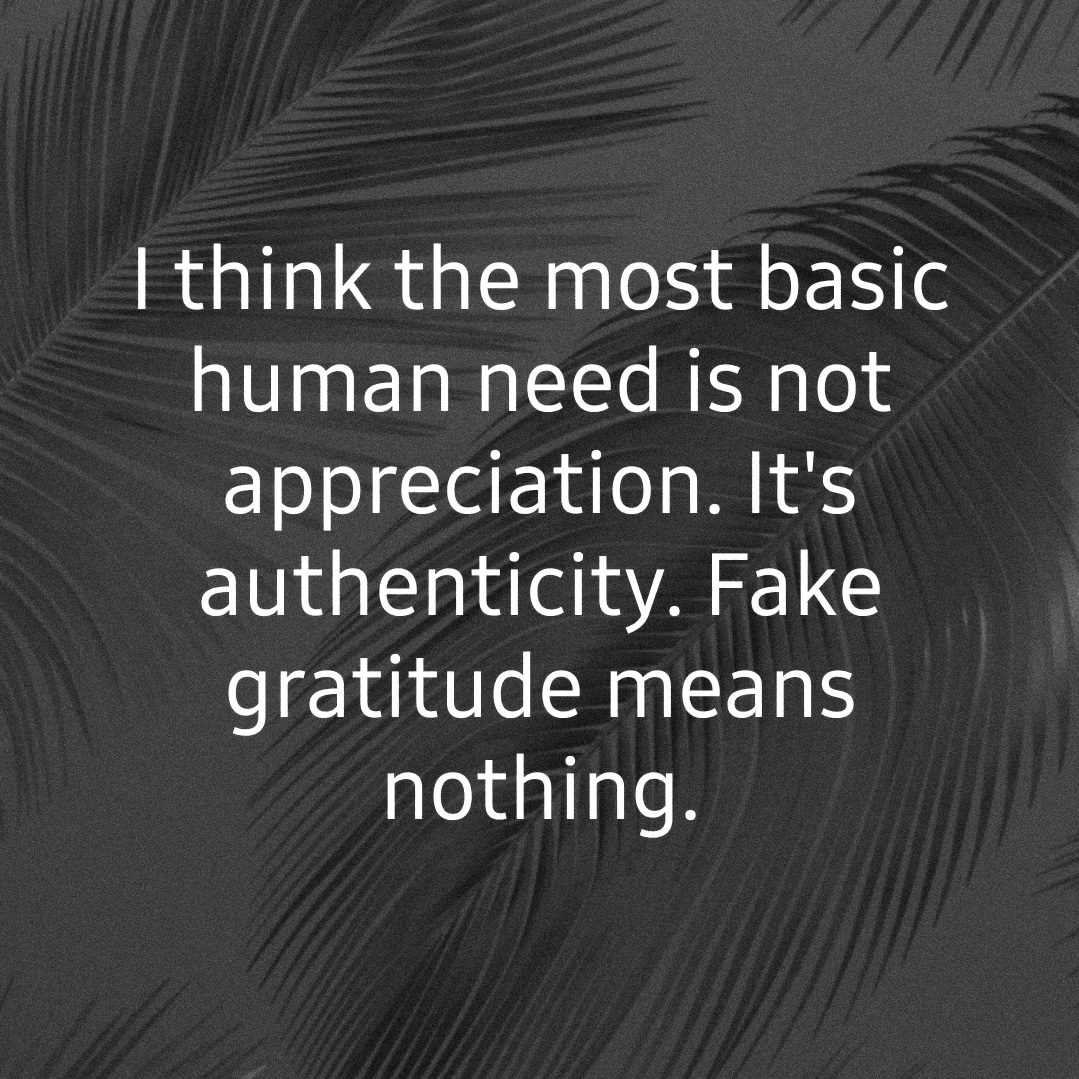
Authenticity is rare.
That’s why most use gestures and expressions of gratitude as a commodity with which to transact for significance.
Appreciation is not gratitude.
Gratitude is reflected in what you do with, or about what you claim to appreciate.
You cannot be truly grateful for others if you take yourself for granted.
#ownyourlife #mentalhealth #zaidismail #theegosystem #mentalhealthawareness #lifecoaching #coachzaidismail #selfworth #zaidismail #gratitude #appreciation -
Do you really love yourself?
What does ingratitude towards yourself look like?
I think it looks like this…
You focus on your aesthetic to feel better about your internal conversation.
You live loud with everything you do and possess because you’re concerned about how others perceive you.
You beat yourself up in private, but present yourself as confident and bold in public.
You over compensate to make space for people who treat you as an option, but go out of your way to exclude people who have high expectations of you.
You comfort yourself by preempting how others may judge you by telling yourself that they don’t know what you’ve been through.
You withhold your contribution of support or assistance if you don’t think others deserve it.
Your internal conversation is harsh resulting in health issues that you then use to seek pity from those around you for your self-imposed struggle.
You try to save others from your opinion of their lives believing that you’re doing it because you’re a good person, while not realising that you’re projecting your struggle onto them so that you can feel valued.
You take your time and your comforts for granted, always procrastinating on your own goals but over investing in assisting others to achieve their goals.
You see self-sacrifice without healthy boundaries as a virtuous way of life, and lose sight of the impact of such behaviour on your health and wellbeing, and on those who care about you.
If you find yourself growing angry or agitated at this list, chances are, you are feeling judged or attacked.
That’s a clear sign of how much the opinions of others about you holds more weight than your opinion of yourself.
A healthy self-worth is not a narrative. It’s not an internal dialogue. Nor is it a set of tools or methods.
A healthy self-worth is a state of being, and is only recognised in hindsight.
It is only through reflecting on how we handled situations that we are able to consciously determine if that is true to who we are or not.
If not, we focus on understanding what drove us towards such behaviour so that we become aware of the reasons for our behaviour rather than simply judging ourselves for behaving in that way.
Awareness is the critical step towards self improvement.
And self improvement is impossible if every piece of criticism or negative feedback makes you defensive. -
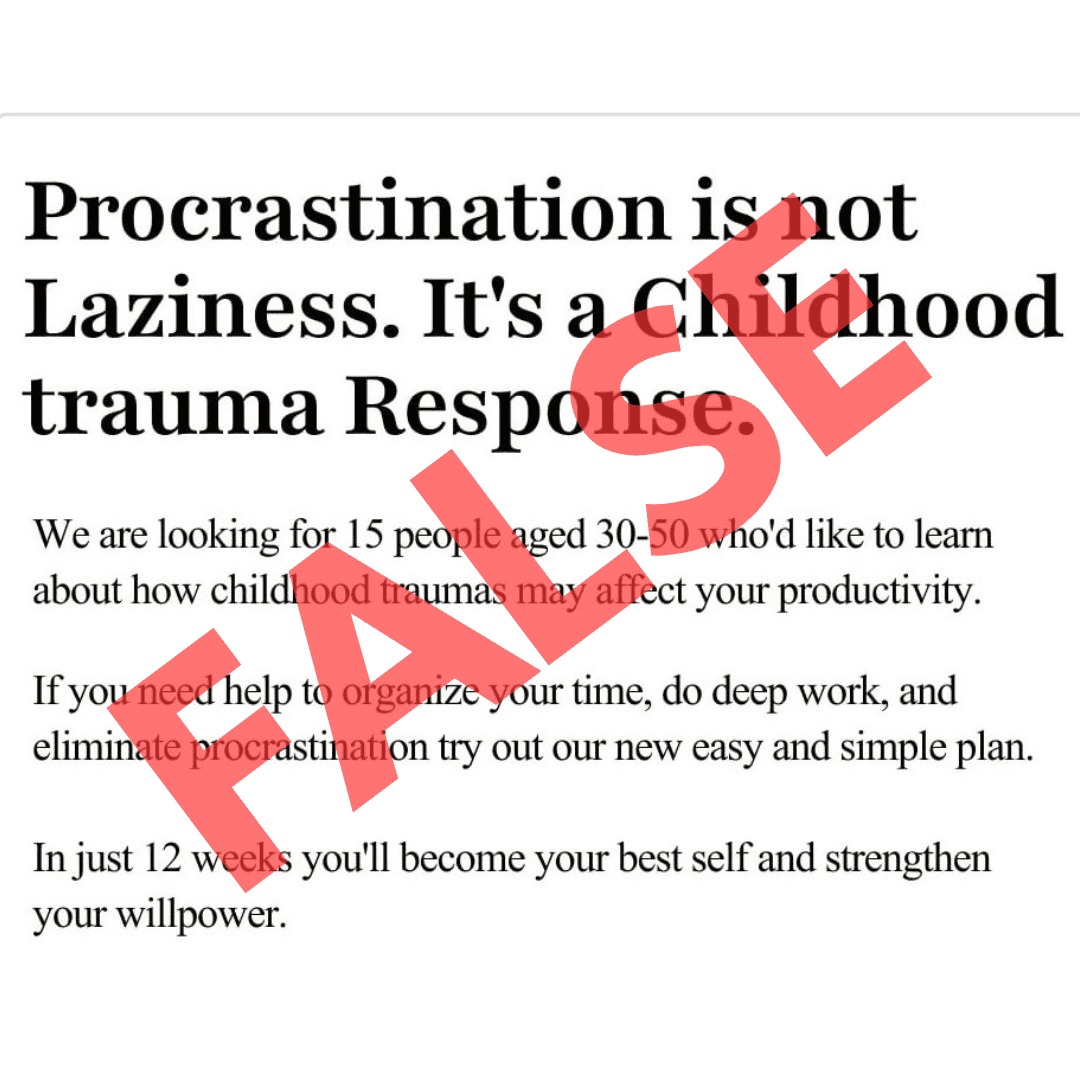
Procrastination is not a mental illness
For the sake of your sanity, do not buy into this extremely flawed way of thinking.
If you were to believe the mainstream tripe about mental health, you’d be running back to your childhood for everything and blaming your parents for all your failures in life.
The irony of this claim about procrastination and laziness is that they both have a very simple, yet easy to overcome root cause.
You either believe in the value of what you’re doing, or you don’t.
If you don’t, the only reason you will do it is because there will be unpleasant consequences if you don’t do it. That’s why we leave things until we have no choice but to do it when we approach it as if it’s a punishment for living.
It’s this same reason that inspires us to look forward to our day, or to drag ourselves out of bed, regardless of how much sleep we got the night before.
The reasons for struggling to see the value in doing something requires self awareness and mindfulness.
But given that both are lost when we blame our past for our present failings, we further sabotage our efforts to connect with life in a more meaningful way.
Please, for the love of sanity and common sense, stop buying into the mindless crap presented as research about mental health.
Give yourself a fighting chance by simply understanding why you have good reason in your own mind to be averse to doing things that you know will be beneficial for you.
We’ve overcomplicated life and then reframed that complexity to be mental health.
We need to reclaim our humanness and the very real human experiences that give us reason to feel emotional duress from time to time.
It’s all part of being human.
#justsaying #ownyourlife #zaidismail #mentalhealth #mentalhealthawareness #lifecoaching #coachzaidismail #parenting #relationshipgoals #procrastination #laziness #theegosystem -
Reclaiming Peace: A Rabbit Hole of Reflection
Reclaiming yourself in a vacuum of support is probably the most challenging part of mindfulness. I say mindfulness because it demands a focus on what is, rather than what should be, or could be, or must be. That, I have found, to be the most deflating distraction of all.
The thoughts and the lamentations of everything that you have a right to, everything you deserve, and everything that is fair but is absent from your life or your relationships with those you value most denies you the composure or the absence of distraction needed to be mindful. Thus, the struggle for mindfulness is exacerbated by the struggle to quell the distractions. It therefore demands that it not be a struggle but instead, a quieting of the mind. But what quiets the mind?
The regrets of the past that fuel the angst of the future occupies the mind in the present. Mindfulness is therefore the result of reconciling the past so that it does not prompt fears of the future leaving your mind blissfully unoccupied in the present except with which you choose to busy yourself.
The test of self-worth is revealed in how you treat yourself when you are being neglected by those around you. Self-deprecation becomes an unhealthy expression of need in the hopes that someone will want to save you from yourself. If that someone is unfamiliar with your journey to that point, approach with caution.
I’ve found that naivety has exacted the heaviest tolls on my life. Moments of blind trust, maybe optimistic trust, resulted in tears of regret and struggle because of the residual mess left behind after trusting the wrong people. Sometimes, that residual lasts a lifetime, although it doesn’t have to. We choose what we value, including the value that we place on what has been and is no longer true. Understanding why we willingly surrender peace for what is no more further peels away the layers that reveal the source of our self-loathing, or our discontent.
To prevent a dulling of the spirit in the face of such upheaval, we must sharpen our resolve for what we claim is important in life. Clichés about life being short reveals the hypocrite in us when we use that short life to lament the past, or to exhaust ourselves in trying to demonstrate to others how badly it still affects us. Too many place life on hold while waiting for their struggle to be revered. They are the ingrates. The ones who chant about appreciating the beauty of life while being defined by its bitterness or its losses.
Poetry is most often written by the broken hearted. The rest of the time it is written by the euphoric victim who never expected goodness after their last torment. I have not seen poetry written by one who is content, because the contented ones have no need for such expression. It is only the forlorn or the euphoric that have such desires to be heard, or seen. This I have found to ring true of my experiences too.
Mindless meandering leads to pointless prose, akin to romantic poetry that calls out to the life we court, but rarely reflects the life we have. The journey through life is not life itself. Perhaps life is what is created by that journey while we presume to be pursuing life in our struggles during that journey. It’s a conundrum that the meek think to be obviously uncomplicated, but the troubled see it confounded beyond comprehension.
The philosopher in me has been dulled by the elusive balance of reaching into the hearts of those dear, while accepting that such reach is not mine to have. In that, I believe, is born the struggle that we value long after it no longer holds promise because the values that we live by dictate that such struggles cannot be abandoned. My ramblings isolate me further in the space in which is thrive. It seems that a journey like this holds only the promise of fascination but not companionship, nor an understanding gaze from one who believes themselves to be too simple for such contemplations. If only they saw themselves through my eyes, perhaps they would see beyond the horizon of their despair.
-
Find your peace
Gratitude lays the foundation of the home.
Respect builds its walls.
Love and compassion provides the roof that protects you from the storm.
And passion gives you the windows to allow your soul to breathe.
As for faith…faith is the door that opens the path to all of it.Virtues have limited effect or value if practiced in isolation.
It sometimes has a detrimental effect when one is practiced in excess compared to the others. Balance, as always, is what leads to harmony.
Harmony is the throne on which peace resides.
Find your balance.
Find your peace.
Your peace.
Not what works for someone else.
What works for you. For those who have rights over you.
That’s the harmony you need to find.
A balance between their rights, your responsibilities, your dreams, and your practicalities.
Don’t wish away the not-so-good parts of your life. That will only create stress over things that are out of your control.
Instead, find a way to incorporate it into the life that you have, so that you can consciously and deliberately mitigate the impact that it has on all the good that you have in your life.
Live purposefully, not fearfully.
The rest will take care of itself.
#mentalhealth #selfworth #coachzaidismail #ownyourlife #theegosystem