
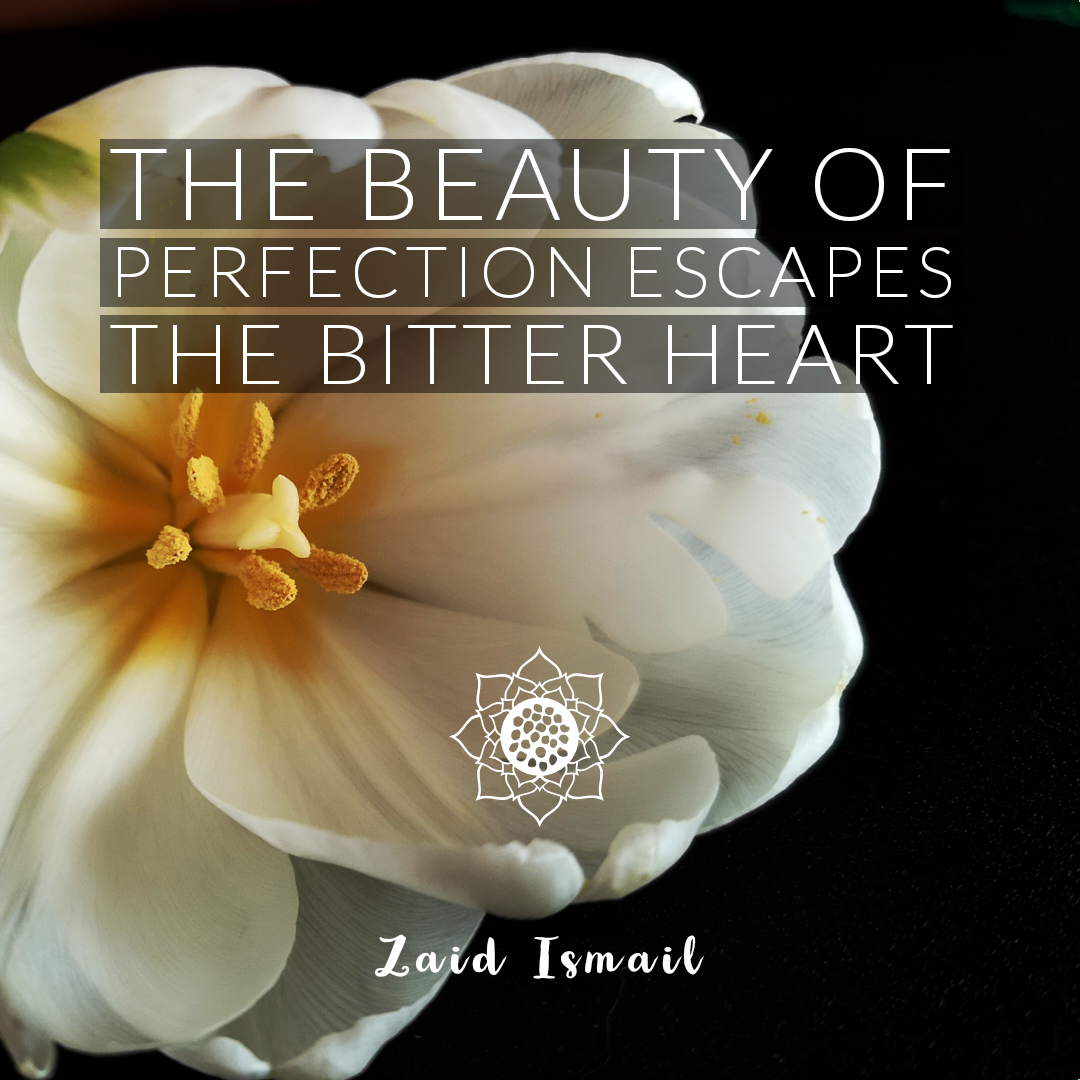
The beauty of perfection escapes the bitter heart.
Bitterness is the toxin that we hold on to after we experience a betrayal of our trust in another.
Sometimes that trust is so dear, that we hold on to the poison of its mishandling to protect ourselves from ever being vulnerable to such hurt again.
Sadly, in doing so, we also deny ourselves the opportunity to experience the beauty that may be the remedy to heal the wound of that unkind betrayal.
Thus, we anchor ourself in the same past that we wish we could forget, or undo.
Inevitably, the ones who offer the beauty that we need to breathe fully again are the ones who receive the caustic treatment intended to protect us from such future pain.
Without realising it, we pay the pain forward, and become part of the cycle that stole our innocence by destroying the innocence of another.
Break the cycle, beautiful soul. Break the cycle. It will raise your station above the toxic one so that you won’t find yourself looking at the world from their vantage point any longer.
#hope #expectation #sincerity #love #lovestory #lostlove #anincompletelovestory #seizetheday #selfdoubt #selfworth #selflove #relationshipgoals #zaidismail #mybeloved #mentalhealth #betrayal #beauty #perfection
Tag: perfection
-
The beauty of perfection
-
Perfectly Distracted
There was a time when I judged the character of others by the number of times they would use terms like existential, nihilism, fatalism, and the like. Often, the words of Einstein echoes in my head reminding me that if I can’t explain it simply enough, it’s because I don’t understand it well enough. And that’s how I viewed those pretentious ones that used large words to explain simple concepts of hope, struggle, or despair.
One of my challenges in life has been my inability to articulate my thoughts in ways that made it relatable to others. From a young age I was recognised as the kid on a different wavelength. I was the one the bullies generally ignored because my response was unpredictable, while they picked on the ones that were somewhat ordinary, because ordinary, for all its merits, is predictable.
Without any fanfare or deliberate effort, I found myself trying to polish my grasp of the English language so that my thoughts would tumble out of my mouth or keyboard with at least a vague similarity to what was going on in my head. The more coherent I sounded, the more confident I grew, and seemingly, the more I found that people were willing to interact with me. I guess people generally do avoid the unpredictable or misunderstood.
The buoyancy I felt from these simple little milestones of inclusion pushed me to hone my skills further. My innate need to simplify a complicated life contributed to this by driving me towards reducing the effort needed to achieve simple outcomes. After all, why do in ten steps what can be done in two? It would be such a waste of energy to continue the ten step way.
Equally so, I found myself growing more succinct, or as some would assume, terse in the way in which I expressed myself. To me, I was improving my skill for clear communication without being flowery or longwinded about it, but for everyone else, I was cocky and presumptuous because I apparently didn’t have the patience to work through things with them or explain myself properly. What I saw as saving them the monotony of a longwinded explanation, they saw as an arrogance on my part for assuming that they’re not worthy of such an explanation. Or worse, they assumed that I found joy in making them look stupid.
And that’s how I’ve found efforts at effective communication can become defective communication. An innocent assumption on my part which suggested that others had a similar level of understanding or appreciation of the topic at hand, meant that I didn’t see my knowledge as superior. However, that was automatically misconstrued by others as me being arrogant and aloof. Of course, every assumption we make, correct or incorrect, is a reflection of how we view ourselves relative to what is going on around us, but that was hardly an effective point to make in such a situation. Although I did make it from time to time, depending on how keen I was to annoy the audience I was with.
The point is, it’s easy to be distracted by our pursuit of perfection in any field that we’re passionate about, to the point where the purpose of the pursuit is forgotten, and all that remains is our sights on perfection. Most often, we seek to perfect in order to be more effective at achieving something, but along the way we become distracted by how our perfection is perceived and lose sight of what we set out to achieve in the first place.
When that happens, perfectionism takes centre stage and purpose or meaning becomes a secondary consideration. I think it’s possible to achieve perfection relative to purpose, although true perfection is unattainable. There is merit and virtue in pursuing perfection, but both are undermined when the purpose or value of such efforts are discarded in favour of being perceived as perfect in that regard. Our efforts, if left unchecked, will result in us allowing our proficiency of practice at what we’re pursuing to define us, rather than remembering that our proficiency was intended to enable us to define something else in a more valuable way.
Life is lost in moments of distraction, but we grow distracted in moments of pursuing a better life. Being surrounded by a social standard grounded in escapism doesn’t help either. And labeling people that use big words without appreciating why they choose to communicate the way they do reflects a superficiality and insecurity on our part, more than it does on theirs.
-
The Desire For Excellence
Achieving a state of excellence in at least one sphere of our lives, I believe, is a universal yearning. It allows us to leave our mark or establish a legacy so that we may believe that we won’t be easily forgotten when we’re gone. It also feeds a need to constantly improve where we’re at in life. Aspiring to a new level of achievement in at least one sphere in which we believe we have a unique talent often gives us reason to face a new day.
Some start out in search of fame and focus their efforts on doing what they believe will be admired by others. So focused are they on what their intended audience wants, that they easily forget where their passion lies. The old adage of not going out in search of your love, but instead doing what you love and letting your love find you echoes through the air. But again, we’re so lacking in self-worth that unless there is visible acknowledgement and appreciation for what we do, we often abandon important pursuits because we thought no one cared.
The pursuit of excellence cannot be relative to the whims or dictates of others. It has to be more sincere than that. The conviction to achieve that excellence must be grounded in a heartfelt passion to improve the state of something that you personally experienced and wish to improve for others. If such a pursuit is directed at an outcome that benefits only you, you will be left wanting when you’ve achieved it, only to lament the time wasted in getting to a point that promised fulfilment but instead only fed your ego.
The ego. We keep getting back to that thing that robs us of so much. What could be wholesome is often discarded if we don’t see a benefit in it for us. Worse than this, we sometimes discard efforts simply because it may benefit someone that we believe is undeserving of such benefit. When we do this, we need to realise that it’s not excellence that we pursuit, but gratification.
Gratification is the outcome of a pursuit, not the purpose. Like I mentioned before about humility and happiness being an outcome of something else, so is gratification. The moment we enter a cycle looking to get something out, we lose sight of our true potential to contribute towards something that is larger than ourselves. Live with conviction, and ensure that your conviction is well-informed, and you’ll find that every outcome, no matter how insignificant it may seem, will leave a legacy of benefit for everyone that came into contact with you during your lifetime.
We all desire excellence, and to be associated with excellence, but we’re often too distracted to notice how our chosen path detracts from that excellence that we desire. We must be willing to contribute selflessly towards the outcome of something that won’t benefit us directly before we can hope to benefit indirectly from the fruits of such an effort. The irony is that we lose both when we start out with a selfish end in mind.
The moment we demand to be served with excellence, a moment’s reflection on the motivation of the one that serves us will reveal that they do so out of obligation or perhaps even fear. That leaves empty the need for significance as a human being. It only fulfils the desire for authority or the imposition of our will. But imposing our will on others is never fulfilling because we know that without such authority or power, we will be neglected or discarded because the value of our contribution will be insignificant. For this reason, among many others, the need for acceptance and appreciation as a human being, independent of any authority or political influence that we may yield, has driven many to do dastardly deeds in moments when they gave up hope of being appreciated simply for who they are.
The desire for excellence has to begin with the desire to perfect our contribution to this world. If it is tied to a clearly envisioned higher purpose, it makes it that much more powerful. However, many struggle to see their contribution as relevant within a context beyond their immediate lives. If this is true for you, then start by ensuring that you do not leave anyone or anything in a state worse than what it or they were before you touched them. Excellence is the habit that prompts us towards the elusive goal of perfection. It’s the pursuit of it that inspires us to be more, while its attainment (if indeed it can be attained) makes us complacent.
Seek to ensure that whatever you touch, or whoever’s lives you impact, you leave it in a better state than it was before you got there. And if you are unable to do so, then at least do not incur harm instead.
-
No More Than Me
The above thought has morphed in meaning for me over recent months. I used to think of it within the context of kids with prince or princess syndrome and recall how we were never raised to consider ourselves to be anything more than we were. We were always smacked in line when we got ahead of ourselves, and we were always reminded that we weren’t the most important people in the world either. Sometimes that felt grounding, and at times it felt as if something was lacking from my childhood. But neither one of those inclinations of interpretation defined me. It simply was a truth of my life that I reflected on from time to time.
More recently, I find myself veering towards seeing it as a validation of my contribution. It reminds me that all I am capable of giving is all I will ever be capable of giving, and in reflecting on this more deeply, it seems to be a definition that can easily ground me. Of course, the nagging danger of complacency rings true with it as well, which means that its definition of me remains qualified and not absolute.
Strolling through the surf today, I was visited with a familiar feeling that I experienced too seldom in my life. It was that feeling I got on occasions when I felt like I was truly taking care of me. While I’ve seen the need to serve others as being a legitimate calling of mine in life, I have become acutely aware at times of my neglect of my own needs in the process. Not in a self indulgent way, but simply taking care of the vessel that I leverage in my desire to serve. I remember one winter afternoon many years ago, I walked some distance from my car and felt the icy highveld wind of Johannesburg stinging my cheeks. I wore a knitted polar neck jersey, and a comfortably padded jacket. It felt as if it hugged me and for a very fleeting moment, I felt taken care of. It was a strange sensation then, and an even stranger realisation now. But it was a simple fleeting moment like that that made me aware of the type of care that I deserved from myself for myself.
Due consideration and reasonable investment. Not over indulgence or extravagance. The former defines the value I place on myself while the latter defines the value I place on myself over others. It was a fine line that I’ve seen too many cross, and my revulsion at their behaviour always taunted me when I even approached that limit. How I see myself is most likely a distant cry from the way others see me. Their reflections of me only hold sway if their credibility commands respect. Like me, the credibility of most comes into question, especially when viewed through ill-informed lenses.
Knowing this to be true, I dwell very little on how others see me. I acknowledge their right to an opinion, and the need to express that opinion, but if it stops at being an opinion without substance, it stops being important to me even before they’ve completed expressing it.
No more than me. That idea dictates that in knowing the truth of it, I need to know the truth of me. It will anyways be an incomplete truth, but like it is with life, all endeavors for perfection will remain incomplete. However, just because the goal itself cannot be fully attained does not mean that there is no merit in its pursuit. And so I continue the journey of discovering me, while being careful not to over indulge or under invest in the process.
-
Another Vicious Cycle
Man is incapable of perfection, yet I expect it of others, and demand it of myself. Even in the latitude that I allow myself and others around me, I expect perfection in their compliance with such boundaries all the while fooling myself that my flexibility flies in the face of my perfectionist tendencies. Nonetheless, I strive for perfection in pursuit of efficiency because any inefficiency irks me with the realisation that energy is being consumed on something that could be avoided. I’m lazy like that.
The circular debate that rages in my head leaves me exhausted enough not to be able to fulfil my expectations of myself. It’s a tedious cycle. Feeling too tired to do what I know needs to be done, then feeling disgruntled by the fact that I’m not making the progress I’d hoped for, followed by the disillusionment at the realisation that I’m too tired to maintain the presence of mind required to complete the tasks at hand.
Feels like a dog chasing its tail, or the donkey in hot pursuit of the dangling carrot. I pray I’m not the only one with this affliction, because there is much comfort that can be gained by witnessing our shortcomings in others. It suddenly makes us feel human and less than incompetent.