Tag: novel

  • My echo chamber

    My echo chamber

    For what feels like an eternity, I’ve been grappling with whether I have anything of substance to share beyond my first novel. Will it be an indulgent rant of self-pity, or will it honour the human struggle? Am I invested in it the way I was with the first novel? Or is the tedious repetition of adult themes in my life that inspires my writing just too much adulting for most who encounter its narrative?

    Such thoughts have plagued me for a long time now. Some inspired by genuine self-doubt, but most spawned by the weight of a colourful life that most could not bear. Thinking aloud reinforces the imposter syndrome, and speaking into a void reminds me that I’m my only echo chamber.

    Being cryptic is a natural disposition. A disposition that I expended every effort in my life to decode so that I could convey a coherent thought to any who would listen. My efforts appear to have resulted in an over achievement. Where once my challenge was in articulating my thoughts, I now stand accused of communicating in ways that are too complex. In my efforts to be as succinct as possible, it seems I’ve grown too dense in a single expression to the point of fatigue for the listener.

    Balance between the two is what I’ve sought through my writing. Being able to read within the perceived mindset of the reader has offered me the opportunity to develop depth to my echo chamber. But, it’s still my echo chamber, manned by me, and occupied by none else. My objectivity is therefore subjective, and my perspective unreliable.

    Therefore, I must dig deep into any snippet of feedback that I receive, trying to understand what is meant in the restrained or lethargic feedback that is spilled, almost hesitantly, as if a burden. Analysing and unpacking, decrypting and translating, finally leaving me with a glimpse of the truth behind the vague words offered as a description of how my writing may have been experienced. But I’m painfully aware that it’s still my echo chamber, manned only by me. Therefore none of its contemplations provide certainty or confidence. It only provides entry to yet another rabbit hole of doubt and over thinking.

    Will I write again? I think I may. Will it be more impactful than the first attempt? I’m not sure. But I’m curious to know. And that curiosity can be satisfied in one way only. I must write, and I must share. My echo chamber is an indulgence of self-pity that holds little value and no promise.

    The uncertainty of life must be celebrated, if not honoured. Without it, we’d be complacent beings disconnected from our souls, and each other. It is our collective fears that create the greatest moments of connectedness when we rise above those uncertainties, rather than surrendering to it.

    The answer, I guess, is clear. I should (must?) not abandon my story now. There is still much to be told, and if I truly believe that it is more important to tell my story than it is for my story to be heard, then it’s clear that the sequel to my novel is not to be doubted. Instead, it must be embraced with more grit and tenacity than the first.

    I may not have a soul to honour in the sequel, but I do have a narrator to respect, if not appreciate. This is more difficult than honouring another. It demands that I find that elusive balance between confidence and conceit, or self-worth and arrogance. In a world that defines the victim as the hero and the critical thinker as the oppressor, finding balance grows ever more elusive.
  • An Incomplete Love Story – Author’s note

    An Incomplete Love Story – Author’s note

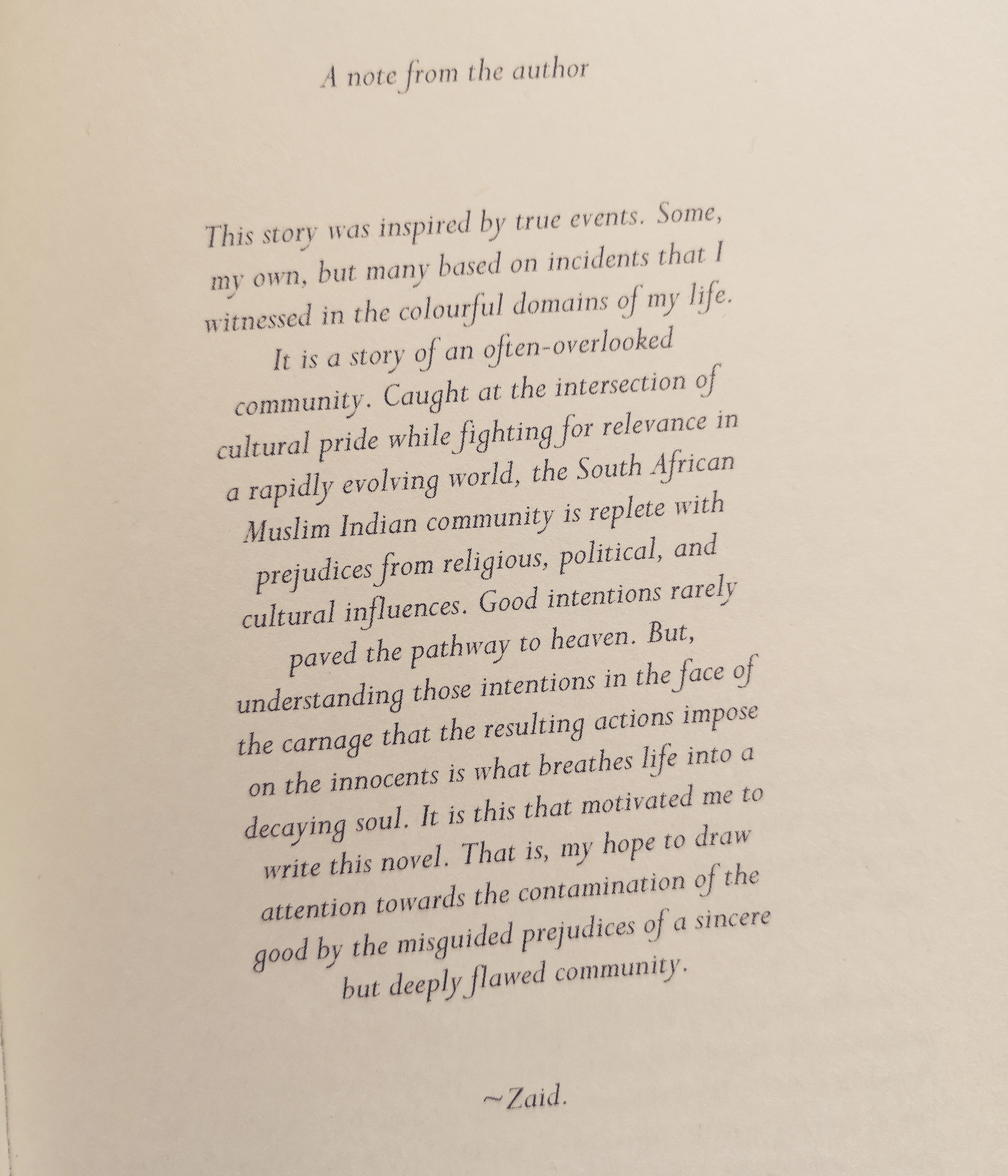
    A note from the author for my novel, An Incomplete Love Story

    This story was inspired by true events.

    Some, my own but many based on incidents that I witnessed in the colourful domains of my life.

    It is a story of an often-overlooked community.

    Caught at the intersection of cultural pride while fighting for relevance in a rapidly evolving world, the South African Muslim Indian community is replete with prejudices from religious, political, and cultural influences.

    Good intentions rarely paved the pathway to heaven. But, understanding those intentions in the face of the carnage that the resulting actions impose on the innocents is what breathes life into a decaying soul.

    It is this that motivated me to write this novel.

    That is, my hope to draw attention towards the contamination of the good by the misguided prejudices of a sincere but deeply flawed community.

    ~ Zaid.


  • To give up silently

    To give up silently

    “When you give up on something, it becomes a weighty silence that you carry within you for the rest of your life.

    It’s a quiet acceptance that what once was the centre of your being will never be a part of your being again.

    The silence is the only gesture that will honour such loss, such surrender.

    And when anyone asks, if they even know to ask, all you can muster as a response is a sheepish grin and an involuntary shrug, hoping to appear nonchalant enough to hide the pain and the shame that you struggled with in the tortured darkness all those lonely, distraught nights.

    That’s how the light fades, and the dullness replaces the enthusiasm that once defined your spirit.

    Only, there’s no one looking close enough to notice. So your shame remains safe, and your heart, incomplete.”

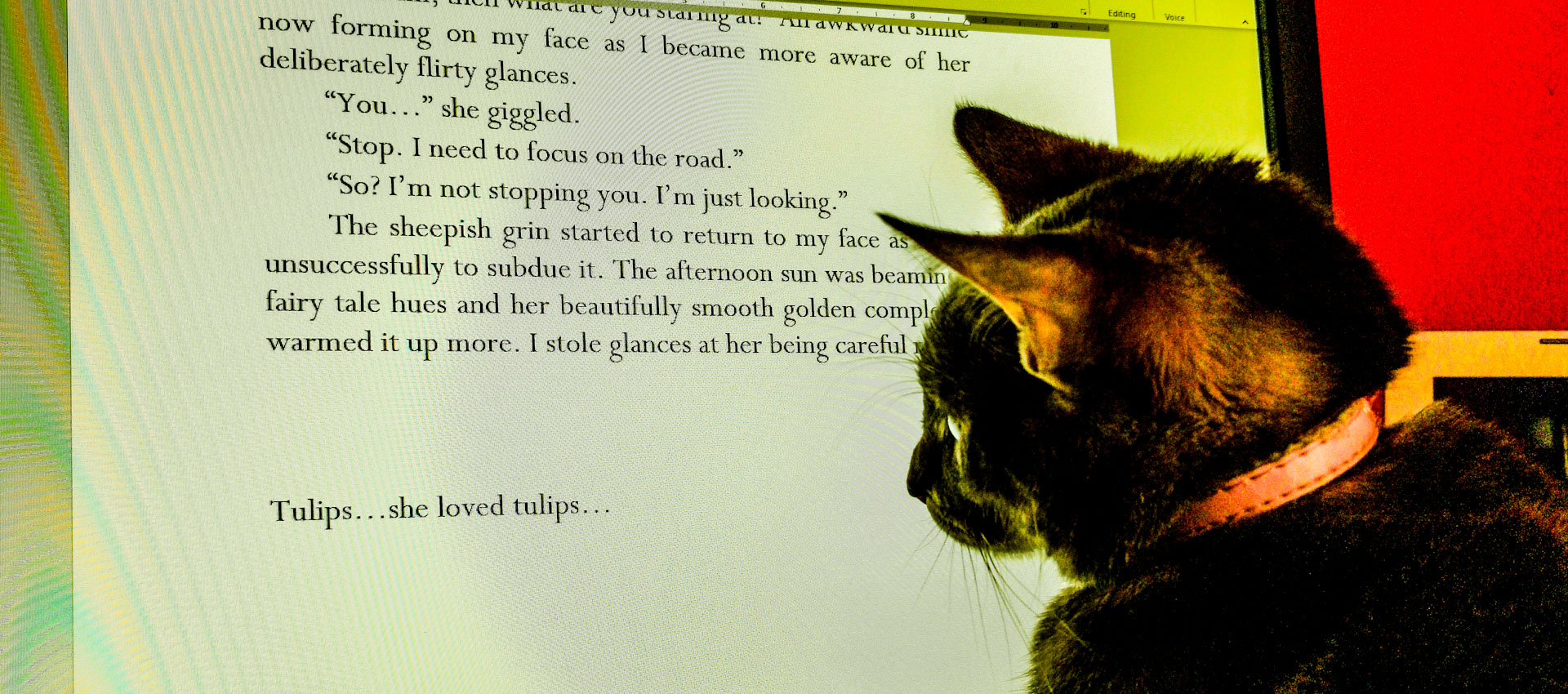
    Another excerpt from the manuscript threatening to bleed out of my heart and onto the keyboard.

    From the sequel to my novel, this is a piece that may make it into my next novel titled, Taqdeer: A dance with destiny.

    Photo credit : Adobe Stock

  • Tears

    Tears

    Tears hold no value if left to dry on their own.

    It’s the gentle touch that wipes it away

    That fulfils its yearning

    Be gentle with yourself, beloved

    The world mocks the extraordinary

    Because ordinary is safer for meek souls

    (a snip of things to come in my new novel, Taqdeer, A Dance With Destiny)

  • Smashing Writer’s Block

    Smashing Writer’s Block

    I always advised others to get over writer’s block by writing about it. This morning seems to demand that I take some of my own advice. Fair warning then that this post may appear incoherent and nonsensical, but only to you. To me, it will probably be a perfect reflection of the madness that stirs within. We all have such madness, but I think the surrounding of friends or family, or just familiar recognition of who we appear to be subdues the madness because when we feel recognised, we have less reason to demand recognition of what stirs beneath the surface. Most of us hide it, some over-emphasise it, and some of us, the odd few, try to leverage it to feed our passion without appearing totally insane.

    I’m not quite sure which category I fit into this morning. Writing this novel that is inspired by true events from my life makes for some interesting introspection. Regrets threaten to surface as I find myself looking with fresh eyes at incidents from many years ago that I always assumed to have played out differently. Catharsis has nothing to do with it, nor does an indulgence of the ego. It’s the stark realisations or a gentleness of judgement that is possible now but felt unreasonable or unjustified then. Trying to understand the most disruptive influences in my life often leads to realising that they were also the most constructive. Not because they meant to be, but because of what about me was forced to grow because of who they were .

    We leave things behind because we find them unpleasant, not because we find them endearing or cherish-able. The same is true for relationships. Perhaps this is why it is more difficult to recall the good times when you focused on the bad times for so long. Idealism can taint judgement and spawn good intentions that are disastrous at times. Good intentions don’t always result in wholesome outcomes. Sometimes it causes more destruction than any bad intention ever could.

    Speaking of idealism, I am reminded about my own quote recently that claimed that there are no bad intentions, only poorly informed decisions. This is more true and real for me this morning than it was when I wrote that a few weeks ago. Even when we go about deliberately wanting to cause harm or pain, the motivation to do so is grounded in a need to avenge a wrong, or to teach a lesson, both of which are inherently good intentions. Understanding and compassion will probably improve the method we use when setting out to teach someone a lesson, but understanding and compassion are seldom traits that we court during moments of despair or disappointment. Reclaiming our significance is all that seems to matter, which is why regrets only follow after destroying the significance that we fought so hard to claim.

    Being an anomaly of society has its romantic connotations but only until the moment that human connection is needed, or desired. It’s impossible to connect with normal when you’re an anomaly. Normal appears boring and shallow, or distracted at best, and being anomalous feels dysfunctional in a society that is normalised by tradition, culture, or social standing. Each time I thought I found a place for myself in this world, I discovered that I was simply a placeholder for someone else instead. I hate tokens and trinkets because they rarely have any inherent value other than the sentiment that we endow on them. Being anomalous feels like that on most days.

    Self-pity is pitiful, and it also assumes that there is something worthy of pity. Therefore, true self-pity can’t exist, and any appearance of self-pity must therefore be a desperation for attention or affection, or both, rather than any sense of remorse or regret. No one truly believes that they are pitiful, or useless. Any professions of the same is nothing more than a desire to find someone to disagree with them.

    Writer’s block is for writers. But we’re all writers of our own story, with some of us having the requisite level of narcissism to believe that our story is worth sharing. Narcissism itself is not a bad thing. We all have it in us. It starts out with believing that we’re worthy, and gets out of hand when we believe that we’re more worthy than others. Believing in your worth is a healthy form of narcissism, because anything less would be self-deprecation which is a sign of ingratitude. Therefore, it suggests that a narcissist is potentially more grateful than one who appears humble. Now there’s something to ponder on cold nights and warm hearths.

    My reasons for writing and sharing what I write sways between wanting to contribute towards improving the world we live in, and wanting to point out the obvious to the oblivious so that I can see the a-ha moments on their faces as I feel significant in knowing that I caused it. The truth is probably somewhere between those two ideals. I’d rather continue rambling than facing that novel again right now. It feels like much ado about nothing, personified.

    Similar to the first book that I wrote. Great feedback from those that found the tenacity to read it to the end, but dismissive remarks of its complexity from those that lack the conviction to look closer, at themselves more than at me. Perhaps the greatest lesson that I’ve learnt from my journey towards becoming a writer in my own right is that unless you come from a family with a strong tradition in a similar field, you will be the odd one out that no one else gets. Chances are therefore also good that writers are most often middle-children or an only child because those with familiar or kindred spirits have less reason to articulate their soul’s desires or aspirations in their search for peace.

    The madness must abate. Alas, I have deadlines and bills to pay. The cynic in me must rest so that the demands of a practically boring and slavish existence can prevail in order to maintain the semblance of sanity that society pretends to hold.

  • There was never an absence of criticism, or name calling. I was always the butt end of taunts and mockery and isolated, not by choice. If it wasn’t my slim physique that was being ridiculed, it was my nose for being too big, or my hair for being styled strangely, or my teeth for being crooked. I maintained amicable relations with most in my family, but my elder brother despised me for as long as I can remember. So trying to find something to be positive about in life was never an easy task. If I asked for a second helping of food I would be verbally abused. If I spent time with the very few friends I had from school, I would be ostracised for not having time for the family, and therefore deliberately excluded from family activities when I got home.

    I recall times when I walked through the streets at night until very late, listening to the laughter and noises from the homes in the neighbourhood of families and friends doing what families and friends do. It was alien to me. The reason I was walking the streets at that time of the night when I was in my very early teens, if that old even, was because for reasons that I can’t recall, I did not accompany my family to a visit to some or other extended family. As a result I had to loiter outside until they returned because I was locked out of the house. One night I was literally kicked out of the house when I was barely 6 or 7 years old. He grabbed me by the scruff of my neck and sent me flying out the front door to go searching for a jacket that he had hidden away to teach me a lesson for forgetting to take it in the house when I was done playing. It worked. I never forgot that lesson.

    Excerpt from the book I never wrote

    Ramblings of a Madman