Tag: Islam

  • Engage, Not Just Condemn

    partytilfajr:

    It is great to identify problems, but the issue I have is that, especially in the West, we have fallen into a “culture of condemnation,” in which in order to be exempt from criticism, we simply must condemn “Issue X” or “Issue Y,” and therefore, we have shown, through mere words, that we are “acceptable” or “good” through our condemnation.

    I am sorry, I think that is terrible and lazy; it is easy to condemn something, it is far more difficult to change something. Great, you identify a problem, but the larger question is: are you prepared to take the necessary steps to change it?

    This is also true for the behaviour by many Muslims that profess to be on a rightly guided path compared to everyone else, then promptly go about condemning others because that’s easier than engaging meaningfully around the specific issue at hand.

    It’s also easier to dismiss everything a recognised scholar says just because of where he comes from, or who he may be affiliated with, than it is to understand that scholar’s perspectives and focus on unwrapping that.

    The easiest of all is to assume that your level of piety, your level of understanding, or your level of sincerity in practice is greater than anyone else that does not subscribe to your exact school of thought or interpretations, while emphasising the advice about hating for the sake of Allah, and completing neglecting the advice of good manners in speech and moderation. 

    When faced with the arrogance, condescension, and inconsideration of the majority of Muslims I see these days, both on Tumblr and in real life, my heart sinks, not only because of how steeped we are in our individual piety without any consideration for our collective responsibility, but also because I see more effort applied towards forming divisions and intolerance rather than establishing understanding and unity amongst all who profess the Shahadah. 

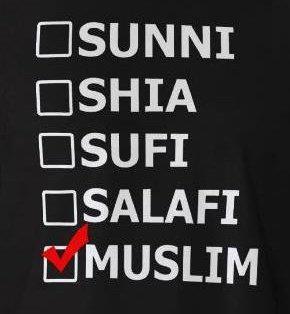
  • What Kind of Muslim Are You?

    verse2verse:

    Everytime this comes on my Dashboard, I WILL REBLOG!!! 🙂

  • The conversation between Allah SWT and a muslim when reciting Al-Fatihah

    Muslim: Praise be to Allah, The Lord of the Worlds.

    Allah SWT: My servant has praised Me.

    Muslim: The Most Gracious, The Most Merciful.

    Allah SWT: My servant has extolled Me. (praised enthusiastically)

    Muslim: The Master of the Day of Judgement.

    Allah SWT: My servant has glorified Me – and submitted to My Power.

    Muslim: You alone we worship and from You alone we seek help.

    Allah SWT: This is between Me and My servant, and My servant shall have what he asked for.

    Muslim: Guide us to the straight path, the path of those whom you have favoured, not of those upon whom is your anger, nor of those who are astray.

    Allah SWT: This is for My servant, and My servant shall have what he asked for.

  • Question – The Distracted Ummah

    naziafk answered your question: The Distracted Ummah

    🙁 you know, i just went to makkah and came back a month ago alhumdullillah. i was one of those people who took a pic there. i felt hesitant.

    Alhamdulillah. I know how tempting it can be. To put my post into context, that was my experience more than 10 years ago, so it’s expected that things have gotten progressively worse since then, let alone the indulgence in materialism around the precinct of the Ka’aba. So I guess squeezing off a single photo with hesitation will hopefully earn you Allah’s pleasure for resisting the temptation to succumb to the urge completely. Insha-Allah your efforts have been accepted. Ameen. 🙂

  • The Distracted Ummah

    A few more memories surfaced after my last post about my visit to the Haramain in Makkah and Madinah, leaving me somewhat disillusioned about the state of Muslims today. Here’s a few experiences from that same first visit of mine that you may or may not find disturbing. 

    I was making tawaaf one evening with a surprisingly small crowd, when I passed by two young ladies also making tawaaf. Only difference is that they were taking a leisurely stroll around the Ka’aba with designer handbags slung fashionably over their shoulders. I don’t recall clearly if they were also absorbed in conversation or not, but focused on tawaaf they definitely appeared not to be.

    Before I could fully absorb this scene and while trying to turn my gaze away from them, a young man passed me by. He was tall, very well groomed, sporting a really fashionably shaped beard, gelled up hair, and had his cell phone firmly pressed against his ear while also performing his tawaaf. That just seemed wrong on so many levels, it left me really sad.

    Fortunately this was set aside by the sight of a woman in full niqab performing tawaaf, and suddenly jerking to a stop at the fear of accidentally touching a male that was walking in front of her. The man was obviously oblivious to others walking around him, but the motion of her hand that clearly indicated her concern and restraint remains clearly imprinted in my mind whenever I think about that moment. It had all the hallmarks of piety and modesty captured in a single gesture. Whether that reflected her true character or not is really irrelevant to me. But if I had to choose between the three incidents, the latter is definitely the one that reminded me of Allah, while the other two made me cringe.

    Then there was the time that I was walking through the souk in Madinah just after Dhuhr salaah, gaze firmly fixed on the ground in front of me as is my habit when walking in public (mostly out of shyness rather than modesty). Suddenly, from the side of me, I heard this deep throated grunt, quickly succeeded by this gob of discoloured mucus being spat out in front of me in the middle of the walkway, followed by a single flowing motion of the culprit stepping on it and spreading it wafer thin into the pathway as if that eliminated its disgusting presence. It was art in motion. Disgusting art at that.

    I won’t even go into the details of the woman that defecated on Mount Arafat at the time of Hajj a few years ago, as described by someone I knew that attended Hajj that year. Or so many other disgusting images and actions of impiety and filth practised openly by Muslims of all walks of life, and of all nations that I have no doubt that this is not restricted to any specific sect, or madhab, nor do I have any reason to believe any group is immune to this behaviour either.

    I look at many posts on Tumblr where people are sharing intriguing photos, often in real time, about their visit to the Ka’aba, and I wonder how far gone we really are that we can be standing in the single holiest place on earth, and instead of taking advantage of that nearness to Allah by focusing on dua and istighfaar, instead we’re thinking about looking cool and sharing cool photos with others, and wondering where we’re going to find that really cool gift for ourselves or someone back home. 

    The point I’m trying to make is that if we bothered to step away from our social networks for long enough, we’ll realise that the problems with the Ummah run far deeper than differing opinions about rituals, or sects formed by misguided zealots in the name of some innocent scholar. The real problem with the Ummah is that we’ve lost our self-respect, let alone the respect of what is sacred in Islam. We’re so distracted that we assume that our ability to focus on a single distraction at a time is in fact meritorious, forgetting that we’re actually still distracted from what’s important. 

    Look closer to home. Look in the masjid and see how many men of all ages engage in laughter, loud conversation and worldly distractions while waiting for salaah. It’s gotten so bad that at the place where I regularly perform Dhuhr salaah close to the office, some elderly men continue talking right through the Iqamah and only stop when the Imam begins the salaah. 

    So we really should stop trying so hard to focus on rectifying everyone else and convincing everyone else that we’re the only rightly guided ones because we ascribe to the sect that is closest to the correct path, while completely forgetting our manners, modesty, respect, dignity and so many other basic virtues that far outweigh our ability or responsibility to refute the opinions of the ill-informed in ways that expose our own arrogance and pride. 

    This post drips of the same condescension, rhetoric and generalisations that I despise hearing in the Friday khutbahs. But it’s not intended that way. It really is just reflective of how overwhelming the reality of this is when I consider the futile debates about theoretical perspectives while we’re holding on to our faith through token reference points that appease our conscience only, leaving us wondering in agony why our duas rarely appear to be answered. 

  • Knowledge vs. Action

    So aspire, O Muslim, to know your Islaam from your Lord’s Book and your Prophet’s Sunnah. And don’t say, ‘So and so said.’ For verily, the Truth is not known by the men–nay, know the Truth, you will recognise the men.’

    Shaykh Albanee (rahimahullah), As-Saheehah, 5/350. (via understandislam)

    This very clearly and concisely describes my view about those that insist on choosing a label for their iman versus choosing to recognise the merit of individual actions. If we focus on understanding the truth and the true method of the Sunnah according to the way of the salaf, we will be able to recognise such good in any Muslim, regardless of madhab, sect, or other grouping that we have created. Being able to recognise this good without the unfortunate bias of negativity associated with sectarian elitism is the only chance that this Ummah has for uniting against a common enemy.  

  • How I Came to Love the Veil

    As most of you know, I have a separate blog to reflect my views on Islam, but this post, despite presenting the views of a Muslim woman, is a very important description of the naivety of the West in understanding the context and widsom of Islamic injunctions. If we had more willingness to understand these concepts and practices, it would very quickly erase the ignorantly vile attitude that Muslims are subjected to on a daily basis.

    Personally, in my daily interactions with non-Muslims, it always, without exception, becomes apparent that cultural (read religious) ignorance is much more prevalent in non-Muslims than in Muslims. Ask the average non-Muslim about Islam, and you’ll get media-biased views and opinions. Ask the average Muslim about Christianity (or even Atheism) and you’ll get a relatively informed view of the tenets or fundamentals of the faith, an understanding of their sects, and an appreciation for what is common and what are differentiating factors between the religions. I won’t hazard any guesses just yet as to why this is true, but from my experiences and engagements so far, it simply is.

    ammarmali:

    SubhanAllah, my tears refuse to stop flowing. This is everything I’ve ever felt regarding hijab; everything I’ve always wanted to say.

    I used to look at veiled women as quiet, oppressed creatures — until I was captured by the Taliban.

    In September 2001, just 15 days after the terrorist attacks on the United States, I snuck into Afghanistan, clad in a head-to-toe blue burqa, intending to write a newspaper account of life under the repressive regime. Instead, I was discovered, arrested and detained for 10 days. I spat and swore at my captors; they called me a “bad” woman but let me go after I promised to read the Koran and study Islam. (Frankly, I’m not sure who was happier when I was freed — they or I.)

    Back home in London, I kept my word about studying Islam — and was amazed by what I discovered. I’d been expecting Koran chapters on how to beat your wife and oppress your daughters; instead, I found passages promoting the liberation of women. Two-and-a-half years after my capture, I converted to Islam, provoking a mixture of astonishment, disappointment and encouragement among friends and relatives.

    Now, it is with disgust and dismay that I watch here in Britain as former foreign secretary Jack Straw describes the Muslim nikab — a face veil that reveals only the eyes — as an unwelcome barrier to integration, with Prime Minister Tony Blair, writer Salman Rushdie and even Italian Prime Minister Romano Prodi leaping to his defense.

    Having been on both sides of the veil, I can tell you that most Western male politicians and journalists who lament the oppression of women in the Islamic world have no idea what they are talking about. They go on about veils, child brides, female circumcision, honor killings and forced marriages, and they wrongly blame Islam for all this — their arrogance surpassed only by their ignorance.

    These cultural issues and customs have nothing to do with Islam. A careful reading of the Koran shows that just about everything that Western feminists fought for in the 1970s was available to Muslim women 1,400 years ago. Women in Islam are considered equal to men in spirituality, education and worth, and a woman’s gift for childbirth and child-rearing is regarded as a positive attribute.

    When Islam offers women so much, why are Western men so obsessed with Muslim women’s attire? Even British government ministers Gordon Brown and John Reid have made disparaging remarks about the nikab — and they hail from across the Scottish border, where men wear skirts.

    When I converted to Islam and began wearing a headscarf, the repercussions were enormous. All I did was cover my head and hair — but I instantly became a second-class citizen. I knew I’d hear from the odd Islamophobe, but I didn’t expect so much open hostility from strangers. Cabs passed me by at night, their “for hire” lights glowing. One cabbie, after dropping off a white passenger right in front of me, glared at me when I rapped on his window, then drove off. Another said, “Don’t leave a bomb in the back seat” and asked, “Where’s bin Laden hiding?”

    Yes, it is a religious obligation for Muslim women to dress modestly, but the majority of Muslim women I know like wearing the hijab, which leaves the face uncovered, though a few prefer the nikab. It is a personal statement: My dress tells you that I am a Muslim and that I expect to be treated respectfully, much as a Wall Street banker would say that a business suit defines him as an executive to be taken seriously. And, especially among converts to the faith like me, the attention of men who confront women with inappropriate, leering behavior is not tolerable.

    I was a Western feminist for many years, but I’ve discovered that Muslim feminists are more radical than their secular counterparts. We hate those ghastly beauty pageants, and tried to stop laughing in 2003 when judges of the Miss Earth competition hailed the emergence of a bikini-clad Miss Afghanistan, Vida Samadzai, as a giant leap for women’s liberation. They even gave Samadzai a special award for “representing the victory of women’s rights.”

    Some young Muslim feminists consider the hijab and the nikab political symbols, too, a way of rejecting Western excesses such as binge drinking, casual sex and drug use. What is more liberating: being judged on the length of your skirt and the size of your surgically enhanced breasts, or being judged on your character and intelligence? In Islam, superiority is achieved through piety — not beauty, wealth, power, position or sex.

    I didn’t know whether to scream or laugh when Italy’s Prodi joined the debate last week by declaring that it is “common sense” not to wear the nikab because it makes social relations “more difficult.” Nonsense. If this is the case, then why are cellphones, landlines, e-mail, text messaging and fax machines in daily use? And no one switches off the radio because they can’t see the presenter’s face.

    Under Islam, I am respected. It tells me that I have a right to an education and that it is my duty to seek out knowledge, regardless of whether I am single or married. Nowhere in the framework of Islam are we told that women must wash, clean or cook for men. As for how Muslim men are allowed to beat their wives — it’s simply not true. Critics of Islam will quote random Koranic verses or hadith, but usually out of context. If a man does raise a finger against his wife, he is not allowed to leave a mark on her body, which is the Koran’s way of saying, “Don’t beat your wife, stupid.”

    It is not just Muslim men who must reevaluate the place and treatment of women. According to a recent National Domestic Violence Hotline survey, 4 million American women experience a serious assault by a partner during an average 12-month period. More than three women are killed by their husbands and boyfriends every day — that is nearly 5,500 since 9/11.

    Violent men don’t come from any particular religious or cultural category; one in three women around the world has been beaten, coerced into sex or otherwise abused in her lifetime, according to the hotline survey. This is a global problem that transcends religion, wealth, class, race and culture.

    But it is also true that in the West, men still believe that they are superior to women, despite protests to the contrary. They still receive better pay for equal work — whether in the mailroom or the boardroom — and women are still treated as sexualized commodities whose power and influence flow directly from their appearance.

    And for those who are still trying to claim that Islam oppresses women, recall this 1992 statement from the Rev. Pat Robertson, offering his views on empowered women: Feminism is a “socialist, anti-family political movement that encourages women to leave their husbands, kill their children, practice witchcraft, destroy capitalism and become lesbians.”

    Now you tell me who is civilized and who is not.

    By Yvonne Ridley