Category: Self Worth

  • Mandela Day – A Day of Conviction

    Mandela Day – A Day of Conviction

    From the archives in my time in corporate. I had this quote from Madiba on my office wall as a reminder never to settle for less than what I am capable of achieving, or at least contributing in life.

    “There is no passion to be found in playing small – in settling for a life that is less than the one you are capable of living.” (Nelson Mandela)

    The biggest mistake we make is when we wait for others to validate the value that we see in something before we pursue it. When we do that, we forget that we’re in fact pursuing what they see as valuable more than what we see as valuable. That denies the world our unique contribution, and more importantly, it denies us the sense of purpose that makes life rewarding.

    Conviction is found when we connect with the value of an outcome. If we insist on that value being judged by the opinions of others, the only conviction we’ll experience in life is the conviction of chasing acceptance in society, or validation from others. And that is not only a torturous way to live, it’s also a recipe for chronic illness and bitterness.

    Own your life, and let the rest of the world own theirs. That’s the only way in which you’ll create opportunities to attract those that are as passionate as you are, about the causes that are close to your heart.

  • Own Your Sh!t Released!

    Own Your Sh!t Released!

    Just be happy. It could be worse. Don’t take life so seriously. Are you tired of hearing this? Well-meaning friends and colleagues tell us to stay positive, but it often has the opposite effect.

    Don’t be misled into thinking that happiness is just a choice. If it were, there would be no sad people. Getting a grip on your emotions is crucial for recovery from heartbreak, trauma, abandonment, and many other trials. Break the cycle of feeling overwhelmed by what happens to you.

    Own Your Sh!t is a book that helps you to understand why you feel sad, depressed or angry about life. It doesn’t tell you to overcome it by asking you to do what worked for someone else, because you’re not someone else.

    So, stop judging yourself so harshly, or allowing others to do the same. Let this book guide you out of that toxic space and into a better version of you. It’s time to own your sh!t.

    The book is available on Kindle, and Kindle Unlimited, and will soon be released on Amazon for paperback orders. Readers in South Africa can order directly from me at a special launch price of R149 which includes free shipping to any major city in the country.

    Watch my blog for snippets from the book in the coming days and weeks.

  • Imminent Release of Own Your Sh!t

    Imminent Release of Own Your Sh!t

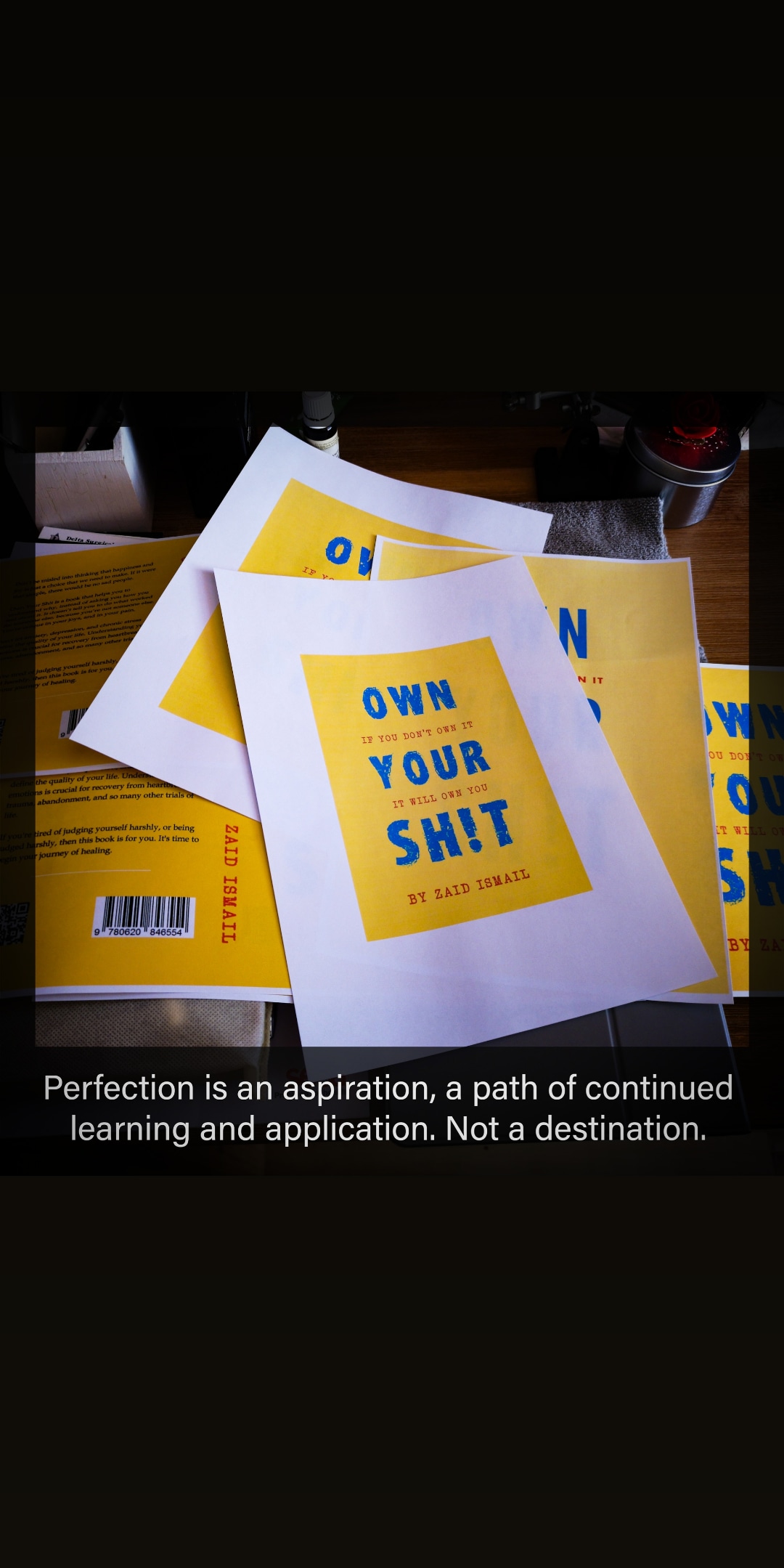
    Perfection is an aspiration, a path of continued learning and application. Not a destination. Almost at the finish line, for getting it to market, at least. Then the real work starts with getting it out there. My little dent in the universe of overbearing emotions… Watch this space for Amazon listing info soon.

  • The Value of Sanity

    The Value of Sanity

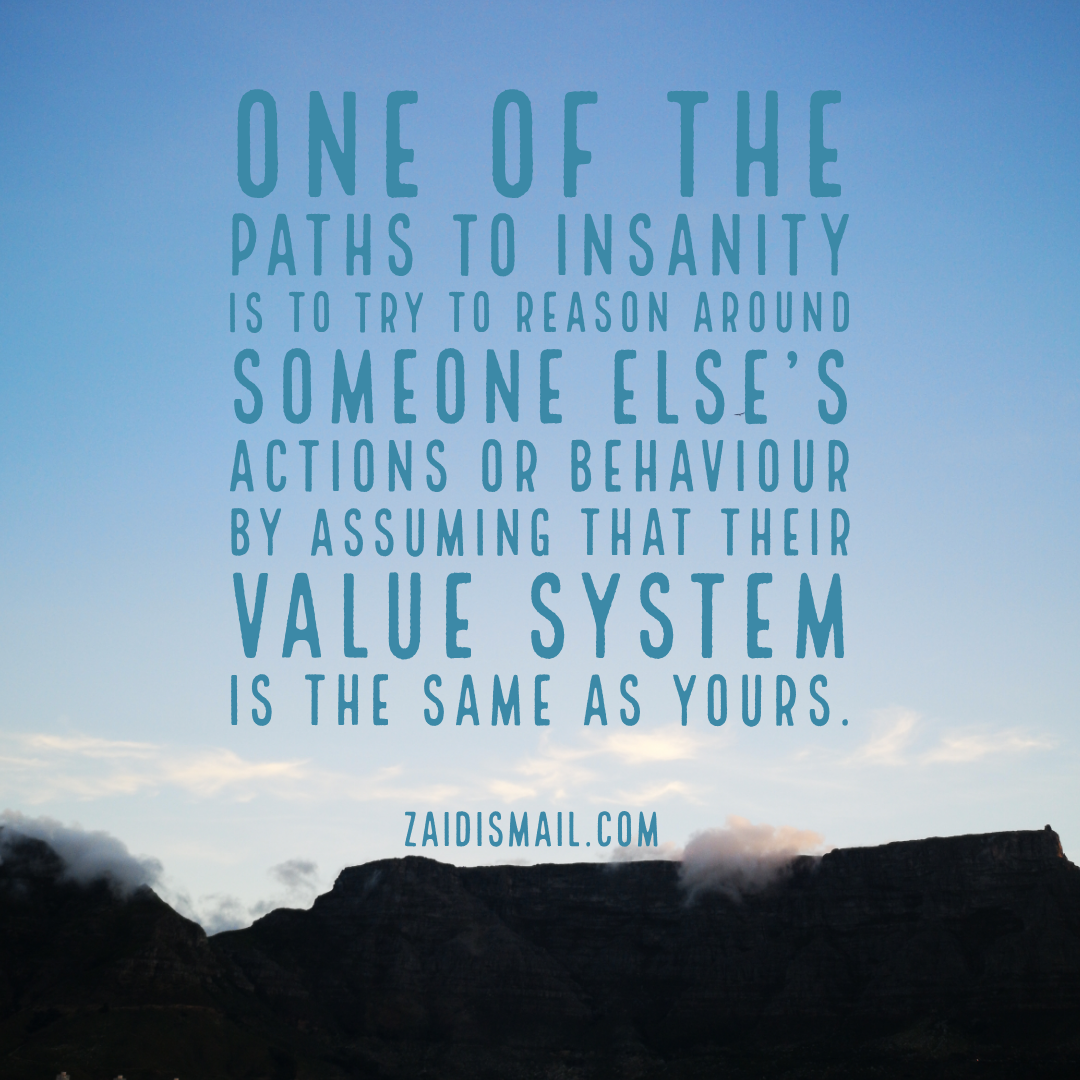
    One of the paths to insanity is to try to reason around someone else’s actions or behaviour by assuming that their value system is the same as yours. When you find it difficult to get through to someone, step back and consider two things. Are they genuinely interested in hearing you? Do they respect the same value system that you do? If the answer to both questions is Yes, consider a different approach. If No, walk away.

  • Why we sometimes despise hope

    Why we sometimes despise hope

    There is a concerning trend in the self-help world that appears to be getting stronger. Life coaches are sprouting out from every troubled soul, ignore that irony for now, and motivational speakers are plentiful. Clinical psychology is supposedly more advanced than ever with better understandings of the working of the human brain through complex and sophisticated scanning technologies, and psychiatry with a pill for every mood. Given this very elaborate range of therapies and interventions that are available, you’d be forgiven for wondering why the world is still in such a state of dysfunction and only getting worse.

    If you didn’t wonder about that, then perhaps you’re one of the many that seem to be distracted by the sea of movement in the doctors of the soul while not noticing any meaningful shift in the souls being doctored. Perhaps the message, the intervention, and the feel-good therapy is not reaching the soul. What if the collective wisdom of them all is misguided in its point of departure?

    Mainstream medicine denies the existence of the soul, and by implication, denies the possibility of intelligent design in the created world, humans being a very core part of that creation. If this were merely a philosophical point of interest, there’d be no harm in it. It would be each to their own and life goes on. Unfortunately, when it becomes the basis for defining physical and emotional health, it’s no longer just philosophical, it’s physical, and it’s dangerous.

    What has the existence of a soul got to do with health, you might ask? Let’s avoid the distraction of religion or spirituality before answering that question, and instead of the soul, let’s just assume that there is a higher seat of intelligence that is not bridled nor defined by the chemicals in your brain. Instead, consider that those chemicals in fact respond to that higher intelligence. But why? Why is it important to consider this? The more important question is why is it detrimental to dismiss this as an option?

    In the absence of this belief of a higher intelligence, not at a universal level, but simply in our individual lives, we’re confined to studying the state of the brain as being a result of itself. Apart from the logical challenge of this idea, we create a very curious chicken and egg situation. Does the thought shape the brain, or does the brain shape the thought? If the brain shapes the thought, then we are compelled, by human nature no less, to question to what end would the brain be motivated to spawn a thought. Apart from physically maintaining the state of the body in a healthy or balanced condition, why would the brain have any reason to need to go beyond that absolute minimum? In fact, why would the brain have a need to maintain even that much? What is the consequence of it not fulfilling that purpose apart from death, beyond which it simply ceases to exist? 

    Back to the alternative based on the absence of a higher seat of intelligence. If the thought shapes the brain, what then is the origin of the thought? Chemicals, you say? But that would again suggest that the brain is spawning and shaping itself since those chemicals are an intrinsic part of the brain function. However, science tells us differently. According to science, a smile generates feel-good hormones even if the smile is forced or based on a manufactured state of happiness. Even Psychology Today  agrees:

    Each time you smile, you throw a little feel-good party in your brain. The act of smiling activates neural messaging that benefits your health and happiness.

    The idea that chemicals in our brain are influenced by our thoughts and experiences is not new, nor new age-y in origin. This is what Nobel Laureate Eric Kandel has to say about the way the brain works:

    “You could double the number of synaptic connections in a very simple neurocircuit as a result of experience and learning. The reason for that was that long-term memory alters the expression of genes in nerve cells, which is the cause of the growth of new synaptic connections. When you see that at the cellular level, you realize that the brain can change because of experience. It gives you a different feeling about how nature and nurture interact. They are not separate processes.”

    Science has also confirmed that through a process called neuroplasticity, which is basically what the above quote from Kandel confirms, changes in the brain result from experience, and not the other way around. The choices we make influences the chemical balance and the neural pathways in our brains. Keep making bad choices, like choosing to be ungrateful, or seeing the worst possible outcomes and ignoring the good of what you’re faced with, and your brain will reflect that balance. Smile in the middle of it all and suddenly the clouds part and there’s a chance to see things more optimistically rather than pessimistically. Having the mental fortitude to force that smile on your face, well, not so easy because it is directly related to how entrenched you are in your choice to be bitter at the world, or optimistic about what it still offers. 

    Optimism or pessimism are both choices. The trials we face can be unending or brutal with barely any space between them to just pause and take a breath, but succumbing to them is still a choice. Allowing our spirit to be broken is also a choice, even though it isn’t a choice taken lightly, nor one that should be made light of.  Depression is a state we achieve after persisting in pessimism or losing hope in what we assume the future to hold for us. None of us knows with absolute certainty what the future holds, so again, assuming the worst of the future is based on trends of negative outcomes in the past. But the moment you recognise even a single moment in your life when your projections about the future, or even the next moment turned out to be wrong because of a surprise occurrence that benefited you or gave you hope when you were expecting life to continue being bad, you know that it requires a deliberate effort to ignore such hope. 

    But why would anyone want to ignore hope? We ignore or even actively resist hope if we are deathly afraid of being hurt again, or betrayed, or failing at something that has grown to define us in the eyes of others, and so much more. We avoid hope because we are afraid of getting it wrong, again, and then losing face with the people around us. At the core of this fear is our need to be significant, or to feel significant. The moment that significance is threatened, we find reason to protect ourselves from losing any shreds of credibility that remain in what little significance we feel. Thus, we find people holding on to struggles, bad relationships, horrible jobs, or toxic family members because their perseverance under such circumstances defines their strength, which in turn defines their sense of significance, and often, their sense of purpose. 

    There is much camaraderie and solidarity in being victims. Support groups, if poorly facilitated, feed such a victim state of mind and result in victimhood becoming a badge of honour, or a statement of strength. 

    But back to the question of the soul, or the seat of higher intelligence. Does it exist? Well, we already confirmed that the brain responds to what we choose, and what we experience. Choose to smile, and the state of your brain will reflect that choice. Similarly, choose to lose hope or to give up your right be happy, or to pursue happiness, and your brain will reflect the state of one given to depression. Depression is the absence of hope, and as stated above, sometimes we find good reason to spurn hope because its absence carries more certainty and a sense of familiarity than what hope has to offer. When we’re fearful about failing, spurning hope or denying opportunities by holding on to past events is all that gives us that sense of significance that we so desperately need in our effort to respond to a harsh world, without placing at risk the little significance that we already have. 

  • A Contaminated Ego

    A Contaminated Ego

    I’ve grown to accept that I am not acceptable by most. I have never been black enough, Indian enough, or Muslim enough, and dare I say pliable enough. I speak my mind without permission because there is none to grant me permission. I don’t intend to give a voice to the voiceless, or a platform to the oppressed. Both are in the state that they are in because of inaction either on their part or the part of the collective to which they actively subscribe.

    While I may not be able to resist the physical oppression that overwhelms any physical means of resistance I have at my disposal, it has never been a reason for me to remain oppressed in my mind. Far too many see the shackles on their wrists and assume that to be a denial of their freedom to think and to choose. I may not be able to choose my freedom of movement or association at all times, but I can always choose how much of that oppression defines me or what I am capable of contributing towards its dismantling.

    I choose not to be oppressed by the self-serving leaders that I see around me. From government to community to religious structures. The contaminated ego has pervaded all such structures resulting in the stench of moral and ethical decay that I see. Tribal, cultural, and fraternal allegiances define the principles and values by which we live, rather than the common subscription to such principles and values that should supersede such allegiances being the glue that bonds us. As a result, I see leaders serving each other before they serve their subjects, and subjects aspiring to such stations of promise and praise because they wish for such self-serving worship as well. Service to their community rarely factors into that equation.

    Everyone wants to believe that they’re the chosen ones. Some claim this through divine appointment, others claim it through association with the divine, but none appear to claim it through serving the divinity that they worship. Instead, they seek to be worshipped for the divinity that they believe resides within them. Their man-made titles convince them that they are morally, academically, and religiously superior while they fail to recognise the irony of using man to proclaim their divinity.

    The contaminated ego has convinced many that they are superior by way of association and subscription rather than through action. I claim none of this. As I’m often reminded by the saying of a long forgotten scholar, if you knew me as I know myself, you’d throw sand in my face. A desert of sand. Each time I flirted with the idea that I was better than another I realised that such comparison confirmed that I was worse. The need to compare, even if inspired by a noble endeavour, is arrogance. I either aspire to adopt the ways of those I admire, or I choose to avoid the ways of those that I don’t. Better or worse must never feature because that will be a self-serving notion, not unlike the contamination I see in the leadership that prevails.

    Leadership itself is misleading. To aspire to leadership is to court with worship. To have leadership thrust upon you through no effort of your own is a burden imposed by the divine. A burden is never a burden if deliberately chosen. A burden deliberately chosen is a need for validation or acceptance. The true burden is the choice to accept such validation through a rejection of the self. Any subsequent burden is merely a progression of that rejection.

    The struggles I have chosen for myself only appeared as struggles when I lost sight of the convictions that I chose to serve. Any hardship or difficulty that resulted was often a result of misplaced expectations or self-pity, both of which faded from view the moment I reconnected with the convictions I held dear. Reconnecting with those convictions was never possible while surrounded by admirers but was only ever realised in the quiet moments where I found myself with no means to placate my failures or shortcomings. It is only through an accepting embrace of the same that I was ever able to rise above it. Denial always only tethered me to that which I hoped to ignore.

    The ego itself is neutral. Like the body, it thrives with opportunity and benevolence when sustained with that which humbles it, and it crumbles under the weight of expectations and entitlement when fed with that which makes it gluttonous. Abdication for our choice of spiritual diet leads to the latter and quickly manifests in the unpleasant disposition and appearance that we develop on the outside.

    Spirituality and physical wellbeing are not mutually exclusive. The one who professes to be spiritually enlightened will not be physically distorted from their natural proportions, and the one who exerts themselves in being physically attractive are most certainly not spiritually enlightened. It is the consequential balance of the two that reflects the true state of our ego, and not the contemplation of one or the other independently.

    [This is an incomplete train of thought]

  • The Lonely Path (II)

    The Lonely Path (II)

    That incomplete thought process is hounding me. It feels as if the main point that I tried to convey in the first take on this subject eluded that entire post. The main point was simply this. Before I continue, I am well aware that me using the term simple when explaining what’s going on in my head is quite the oxymoron. So there is no need to snigger about that.

    Anyway, the point is, when we choose to pursue a greater calling in life that stretches who we are and what we stand for, we need to realise that the people that are familiar with who we are will no longer know the person that we are striving to become. Under ideal circumstances they will grow with us. But ideals are most often talked about and rarely implemented. So expect to feel a creeping sense of isolation when you push yourself beyond the norms that surround you.

    Understand that when you outgrow the environment that you’re in, those that have grown to be defined by that environment will quickly assume that you are trying to be better than them. Or maybe they will assume that you think you are now better than them. Whether that is true is irrelevant. What is relevant is that you are different. You are hopefully a better version of you. But unless you surround yourself with people that appreciate and grow with you, that’s when the lonely path appears before you.

    You’ll find yourself growing uneasy as you feel at odds with what used to be familiar and comforting but slowly grows to feel discomforting and somewhat annoying. The comfort of familiarity will be replaced with the realisation of exclusion. Not the exclusion from social circles because that remains consistent for the most part. But the exclusion that leaves you emotionally wanting while physically accepted. An ambivalence sets in that challenges what you believe to be true against what you think may be an assumption of grandeur.

    Believing that you are capable of more borders precariously between confidence and delusion. Choose delusion, and you’ll be delusioned about your dreams and aspirations, resulting in an embrace of mediocrity so that the familiar comfort of fitting in continues to stroke your ego. Choose confidence and expect to be tested each time you take a bold step towards being the better version of you. Each time you break away from the norm you risk ridicule or rejection, or both. More importantly, each time you step up, you face self-doubt about your ability to succeed, and your motivation to want to succeed.

    Are you still serving that greater purpose or are you serving your ego? Are you pushing yourself to escape complacency or are you courting the admiration of others? The questions that hold you back never cease while the strength to push on is always just out of reach. That’s when you need to stretch yourself into unknown spaces. That’s when doing what feels comfortable and safe threatens to undo every bit of progress that you made up to that point. Even if no one else noticed that progress, you’ll know it was there after you gave it up. Give it up silently and it will haunt you quietly for the rest of your life as you wonder if you would have been able to pull it off. Protect that progress and nurture it into something greater, and you’ll face the reality of success and the horror of failure every few minutes in the back of your mind as you try to focus on what you feel passionate about while trying to subdue the self-doubt that gave you reason to procrastinate for so long.

    At that point you’ll slowly begin to realise that life was never about persevering through trials, it was always about facing the fears of success. By focusing on the trials we have something to raise as a trophy just by surviving. Succeeding in moments that trounced others feels like success, but once the moment passes, once the recognition of our struggles and our bravery fades, we’re back to facing off the same questions that taunted us when we grew restless in the first place when we first looked at our life and saw all the gaps we could fill to make it better and improve it beyond meaningless embellishments. You cannot unsee what you stared in the face. The more you try to ignore it, the more exhausting the effort to distract you from it.

    The lonely path is the only path that showed others that there is a better way. It is the sacrifice of one that improves the lives of many. Needing the guarantee of reciprocation or reward before setting out to improve this world feeds the transactional greed that defines too many of our interactions. Be like everyone else and you’ll always feel like you belong, except when you’re taking your final breath, or when you’ve aged beyond your fickle social needs. When your energy and your health no longer allows you to pursue with gusto the passion of your youth, desiring to change the world will be nothing more than self-inflicted torture. Building hope on the empty promises of inclusion by society is a foolish way to burn your candle. If you hope to die knowing that the world is better because of your existence, don’t shy away from the lonely path, embrace it.

  • When an act of charity becomes business

    When an act of charity becomes business

    If I do good, it will come back to me in unexpected ways. No. It won’t. The streets are full of homeless bodies and souls that have done good, but it wasn’t returned. Or are we suggesting that those that are in a bad state have done no good? This transactional view of life is becoming more popular each day, and it does nothing good for the one that holds this view.

    We do good because we want others to experience less hardship than we did, not because we want to be repaid in some way with another good. Well, at least that is why we should be doing good. Not to earn a reward, but to reduce someone else’s pain or suffering, or simply to enrich their life. If enough people do this, inevitably it will lead to someone doing good for you as they seek to enrich your life out of sincerity, or they may wish to alleviate your burden because they know what it is like to be in a similar position when they may have had less. But that is something that we have no control over. The way that cycle of paying it forward plays out is entirely dependent on the generosity of every soul involved in that cycle. It is not business. It is not a tit-for-tat exchange of deeds. The moment it becomes an expectation of receiving something in return for what you do, you are transacting for gain. That is not charity, nor is it generosity. It is self-serving.

    The selfish motivations that prompts us to give charity so that we can be seen as charitable, or doing good so that we can be seen as benevolent is nothing more than food for the ego, not for the soul. And it’s a poisonous meal as well. Eventually we will find ourselves measuring the value of people in our lives based on what they do for us, rather than how they enrich our lives. The sad part is that most don’t know the difference.

    When someone enriches your life, they don’t necessarily contribute directly to your personal needs, but they make a meaningful contribution to how you experience your world. A simple example would be a spouse or family member that expresses love and appreciation for your children. That is not something that replaces your contribution to your children, but it is something that improves your child’s self-worth. That in turn improves the quality of life that you have with them. Although their act of kindness was not directed at you, it enriched your life, so you should not have reason to withhold kindness from them.

    The irony is that the ones that perpetuate this myth about the universe returning the good that you do are the same ones that would typically believe that integrity is doing the right thing even when no one is looking. While that may be true about the definition of integrity, it loses its authenticity when we find reason to shout out to the world how much integrity we have.

    One lesson that has served me well in life is that you should always be weary of someone that finds every gap to mention their own virtues. They are looking for validation, and people that require validation that badly almost always compromise principles and values to get it. Such people will not think twice about betraying your trust or confidence if it means getting that validation from others. Choose your company carefully.