Category: Life

  • Mandela Day – A Day of Conviction

    Mandela Day – A Day of Conviction

    From the archives in my time in corporate. I had this quote from Madiba on my office wall as a reminder never to settle for less than what I am capable of achieving, or at least contributing in life.

    “There is no passion to be found in playing small – in settling for a life that is less than the one you are capable of living.” (Nelson Mandela)

    The biggest mistake we make is when we wait for others to validate the value that we see in something before we pursue it. When we do that, we forget that we’re in fact pursuing what they see as valuable more than what we see as valuable. That denies the world our unique contribution, and more importantly, it denies us the sense of purpose that makes life rewarding.

    Conviction is found when we connect with the value of an outcome. If we insist on that value being judged by the opinions of others, the only conviction we’ll experience in life is the conviction of chasing acceptance in society, or validation from others. And that is not only a torturous way to live, it’s also a recipe for chronic illness and bitterness.

    Own your life, and let the rest of the world own theirs. That’s the only way in which you’ll create opportunities to attract those that are as passionate as you are, about the causes that are close to your heart.

  • Own Your Sh!t Released!

    Own Your Sh!t Released!

    Just be happy. It could be worse. Don’t take life so seriously. Are you tired of hearing this? Well-meaning friends and colleagues tell us to stay positive, but it often has the opposite effect.

    Don’t be misled into thinking that happiness is just a choice. If it were, there would be no sad people. Getting a grip on your emotions is crucial for recovery from heartbreak, trauma, abandonment, and many other trials. Break the cycle of feeling overwhelmed by what happens to you.

    Own Your Sh!t is a book that helps you to understand why you feel sad, depressed or angry about life. It doesn’t tell you to overcome it by asking you to do what worked for someone else, because you’re not someone else.

    So, stop judging yourself so harshly, or allowing others to do the same. Let this book guide you out of that toxic space and into a better version of you. It’s time to own your sh!t.

    The book is available on Kindle, and Kindle Unlimited, and will soon be released on Amazon for paperback orders. Readers in South Africa can order directly from me at a special launch price of R149 which includes free shipping to any major city in the country.

    Watch my blog for snippets from the book in the coming days and weeks.

  • Imminent Release of Own Your Sh!t

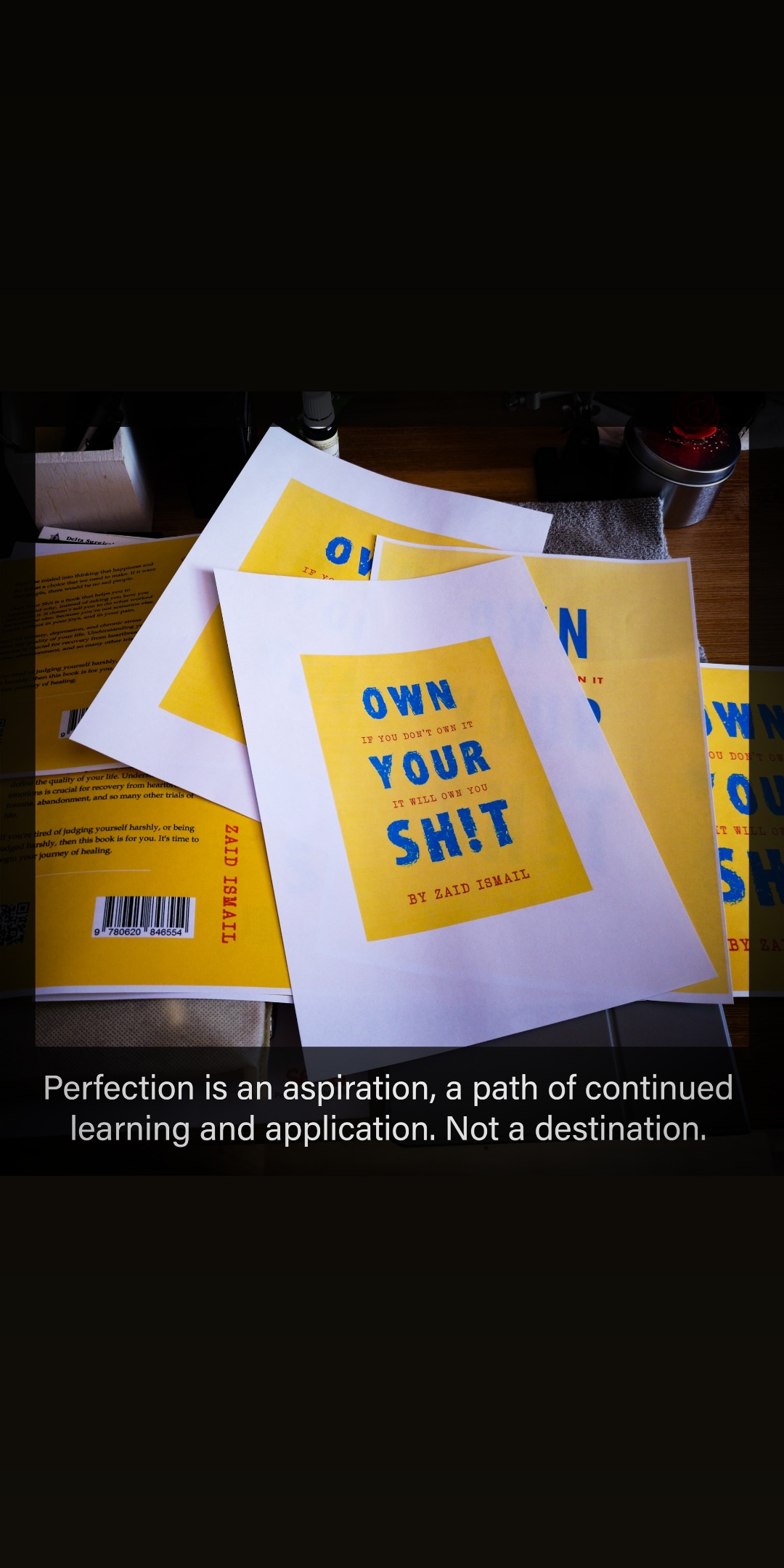
    Imminent Release of Own Your Sh!t

    Perfection is an aspiration, a path of continued learning and application. Not a destination. Almost at the finish line, for getting it to market, at least. Then the real work starts with getting it out there. My little dent in the universe of overbearing emotions… Watch this space for Amazon listing info soon.

  • Smashing Writer’s Block

    Smashing Writer’s Block

    I always advised others to get over writer’s block by writing about it. This morning seems to demand that I take some of my own advice. Fair warning then that this post may appear incoherent and nonsensical, but only to you. To me, it will probably be a perfect reflection of the madness that stirs within. We all have such madness, but I think the surrounding of friends or family, or just familiar recognition of who we appear to be subdues the madness because when we feel recognised, we have less reason to demand recognition of what stirs beneath the surface. Most of us hide it, some over-emphasise it, and some of us, the odd few, try to leverage it to feed our passion without appearing totally insane.

    I’m not quite sure which category I fit into this morning. Writing this novel that is inspired by true events from my life makes for some interesting introspection. Regrets threaten to surface as I find myself looking with fresh eyes at incidents from many years ago that I always assumed to have played out differently. Catharsis has nothing to do with it, nor does an indulgence of the ego. It’s the stark realisations or a gentleness of judgement that is possible now but felt unreasonable or unjustified then. Trying to understand the most disruptive influences in my life often leads to realising that they were also the most constructive. Not because they meant to be, but because of what about me was forced to grow because of who they were .

    We leave things behind because we find them unpleasant, not because we find them endearing or cherish-able. The same is true for relationships. Perhaps this is why it is more difficult to recall the good times when you focused on the bad times for so long. Idealism can taint judgement and spawn good intentions that are disastrous at times. Good intentions don’t always result in wholesome outcomes. Sometimes it causes more destruction than any bad intention ever could.

    Speaking of idealism, I am reminded about my own quote recently that claimed that there are no bad intentions, only poorly informed decisions. This is more true and real for me this morning than it was when I wrote that a few weeks ago. Even when we go about deliberately wanting to cause harm or pain, the motivation to do so is grounded in a need to avenge a wrong, or to teach a lesson, both of which are inherently good intentions. Understanding and compassion will probably improve the method we use when setting out to teach someone a lesson, but understanding and compassion are seldom traits that we court during moments of despair or disappointment. Reclaiming our significance is all that seems to matter, which is why regrets only follow after destroying the significance that we fought so hard to claim.

    Being an anomaly of society has its romantic connotations but only until the moment that human connection is needed, or desired. It’s impossible to connect with normal when you’re an anomaly. Normal appears boring and shallow, or distracted at best, and being anomalous feels dysfunctional in a society that is normalised by tradition, culture, or social standing. Each time I thought I found a place for myself in this world, I discovered that I was simply a placeholder for someone else instead. I hate tokens and trinkets because they rarely have any inherent value other than the sentiment that we endow on them. Being anomalous feels like that on most days.

    Self-pity is pitiful, and it also assumes that there is something worthy of pity. Therefore, true self-pity can’t exist, and any appearance of self-pity must therefore be a desperation for attention or affection, or both, rather than any sense of remorse or regret. No one truly believes that they are pitiful, or useless. Any professions of the same is nothing more than a desire to find someone to disagree with them.

    Writer’s block is for writers. But we’re all writers of our own story, with some of us having the requisite level of narcissism to believe that our story is worth sharing. Narcissism itself is not a bad thing. We all have it in us. It starts out with believing that we’re worthy, and gets out of hand when we believe that we’re more worthy than others. Believing in your worth is a healthy form of narcissism, because anything less would be self-deprecation which is a sign of ingratitude. Therefore, it suggests that a narcissist is potentially more grateful than one who appears humble. Now there’s something to ponder on cold nights and warm hearths.

    My reasons for writing and sharing what I write sways between wanting to contribute towards improving the world we live in, and wanting to point out the obvious to the oblivious so that I can see the a-ha moments on their faces as I feel significant in knowing that I caused it. The truth is probably somewhere between those two ideals. I’d rather continue rambling than facing that novel again right now. It feels like much ado about nothing, personified.

    Similar to the first book that I wrote. Great feedback from those that found the tenacity to read it to the end, but dismissive remarks of its complexity from those that lack the conviction to look closer, at themselves more than at me. Perhaps the greatest lesson that I’ve learnt from my journey towards becoming a writer in my own right is that unless you come from a family with a strong tradition in a similar field, you will be the odd one out that no one else gets. Chances are therefore also good that writers are most often middle-children or an only child because those with familiar or kindred spirits have less reason to articulate their soul’s desires or aspirations in their search for peace.

    The madness must abate. Alas, I have deadlines and bills to pay. The cynic in me must rest so that the demands of a practically boring and slavish existence can prevail in order to maintain the semblance of sanity that society pretends to hold.

  • Why we sometimes despise hope

    Why we sometimes despise hope

    There is a concerning trend in the self-help world that appears to be getting stronger. Life coaches are sprouting out from every troubled soul, ignore that irony for now, and motivational speakers are plentiful. Clinical psychology is supposedly more advanced than ever with better understandings of the working of the human brain through complex and sophisticated scanning technologies, and psychiatry with a pill for every mood. Given this very elaborate range of therapies and interventions that are available, you’d be forgiven for wondering why the world is still in such a state of dysfunction and only getting worse.

    If you didn’t wonder about that, then perhaps you’re one of the many that seem to be distracted by the sea of movement in the doctors of the soul while not noticing any meaningful shift in the souls being doctored. Perhaps the message, the intervention, and the feel-good therapy is not reaching the soul. What if the collective wisdom of them all is misguided in its point of departure?

    Mainstream medicine denies the existence of the soul, and by implication, denies the possibility of intelligent design in the created world, humans being a very core part of that creation. If this were merely a philosophical point of interest, there’d be no harm in it. It would be each to their own and life goes on. Unfortunately, when it becomes the basis for defining physical and emotional health, it’s no longer just philosophical, it’s physical, and it’s dangerous.

    What has the existence of a soul got to do with health, you might ask? Let’s avoid the distraction of religion or spirituality before answering that question, and instead of the soul, let’s just assume that there is a higher seat of intelligence that is not bridled nor defined by the chemicals in your brain. Instead, consider that those chemicals in fact respond to that higher intelligence. But why? Why is it important to consider this? The more important question is why is it detrimental to dismiss this as an option?

    In the absence of this belief of a higher intelligence, not at a universal level, but simply in our individual lives, we’re confined to studying the state of the brain as being a result of itself. Apart from the logical challenge of this idea, we create a very curious chicken and egg situation. Does the thought shape the brain, or does the brain shape the thought? If the brain shapes the thought, then we are compelled, by human nature no less, to question to what end would the brain be motivated to spawn a thought. Apart from physically maintaining the state of the body in a healthy or balanced condition, why would the brain have any reason to need to go beyond that absolute minimum? In fact, why would the brain have a need to maintain even that much? What is the consequence of it not fulfilling that purpose apart from death, beyond which it simply ceases to exist? 

    Back to the alternative based on the absence of a higher seat of intelligence. If the thought shapes the brain, what then is the origin of the thought? Chemicals, you say? But that would again suggest that the brain is spawning and shaping itself since those chemicals are an intrinsic part of the brain function. However, science tells us differently. According to science, a smile generates feel-good hormones even if the smile is forced or based on a manufactured state of happiness. Even Psychology Today  agrees:

    Each time you smile, you throw a little feel-good party in your brain. The act of smiling activates neural messaging that benefits your health and happiness.

    The idea that chemicals in our brain are influenced by our thoughts and experiences is not new, nor new age-y in origin. This is what Nobel Laureate Eric Kandel has to say about the way the brain works:

    “You could double the number of synaptic connections in a very simple neurocircuit as a result of experience and learning. The reason for that was that long-term memory alters the expression of genes in nerve cells, which is the cause of the growth of new synaptic connections. When you see that at the cellular level, you realize that the brain can change because of experience. It gives you a different feeling about how nature and nurture interact. They are not separate processes.”

    Science has also confirmed that through a process called neuroplasticity, which is basically what the above quote from Kandel confirms, changes in the brain result from experience, and not the other way around. The choices we make influences the chemical balance and the neural pathways in our brains. Keep making bad choices, like choosing to be ungrateful, or seeing the worst possible outcomes and ignoring the good of what you’re faced with, and your brain will reflect that balance. Smile in the middle of it all and suddenly the clouds part and there’s a chance to see things more optimistically rather than pessimistically. Having the mental fortitude to force that smile on your face, well, not so easy because it is directly related to how entrenched you are in your choice to be bitter at the world, or optimistic about what it still offers. 

    Optimism or pessimism are both choices. The trials we face can be unending or brutal with barely any space between them to just pause and take a breath, but succumbing to them is still a choice. Allowing our spirit to be broken is also a choice, even though it isn’t a choice taken lightly, nor one that should be made light of.  Depression is a state we achieve after persisting in pessimism or losing hope in what we assume the future to hold for us. None of us knows with absolute certainty what the future holds, so again, assuming the worst of the future is based on trends of negative outcomes in the past. But the moment you recognise even a single moment in your life when your projections about the future, or even the next moment turned out to be wrong because of a surprise occurrence that benefited you or gave you hope when you were expecting life to continue being bad, you know that it requires a deliberate effort to ignore such hope. 

    But why would anyone want to ignore hope? We ignore or even actively resist hope if we are deathly afraid of being hurt again, or betrayed, or failing at something that has grown to define us in the eyes of others, and so much more. We avoid hope because we are afraid of getting it wrong, again, and then losing face with the people around us. At the core of this fear is our need to be significant, or to feel significant. The moment that significance is threatened, we find reason to protect ourselves from losing any shreds of credibility that remain in what little significance we feel. Thus, we find people holding on to struggles, bad relationships, horrible jobs, or toxic family members because their perseverance under such circumstances defines their strength, which in turn defines their sense of significance, and often, their sense of purpose. 

    There is much camaraderie and solidarity in being victims. Support groups, if poorly facilitated, feed such a victim state of mind and result in victimhood becoming a badge of honour, or a statement of strength. 

    But back to the question of the soul, or the seat of higher intelligence. Does it exist? Well, we already confirmed that the brain responds to what we choose, and what we experience. Choose to smile, and the state of your brain will reflect that choice. Similarly, choose to lose hope or to give up your right be happy, or to pursue happiness, and your brain will reflect the state of one given to depression. Depression is the absence of hope, and as stated above, sometimes we find good reason to spurn hope because its absence carries more certainty and a sense of familiarity than what hope has to offer. When we’re fearful about failing, spurning hope or denying opportunities by holding on to past events is all that gives us that sense of significance that we so desperately need in our effort to respond to a harsh world, without placing at risk the little significance that we already have. 

  • Return to Me

    Return to Me

    I stumbled upon a collection of some of my writing from many years ago. I had so much more clarity back then. To reconnect with that will require stripping away a lot of the clutter accumulated from my encounters with troubled souls in recent years. At some point, I stopped thinking aloud and started speaking to an audience. I need to forget the audience and return to my state of introspection. In my efforts to be understood, I distorted who I am in favour of inviting others in. Even now, in my contemplation of what is needed, I am addressing this to other than me.

    I need to return to me. My thoughts, my reflections, my promptings, all intended to reground my soul in my space, without any need to solicit the accepting glances, or the affirming smiles from those around me. I departed from the familiarity of who I am when I sacrificed my voice for a voice that was more palatable. Am I still within reach?

    The cacophony of murmurs from abandoned souls drown out the clarity that once tugged at my collar to remind me that I am. Not wanting to be, but am. Not looking for familiarity or warmth, but knowing with certainty that both resided within me. Comfortably, and harmoniously. Every sacrifice of me has proven futile for garnering the elusive embrace. It was always only enough to invite them in, but once they arrived, their needs overpowered my own, and my own self was subdued for their release.

    Release from the self is liberating only if redefining the self appears within reach. Too many shrug at the opportunity of reinvention, but torture their souls into a deafening silence as they find themselves caught between hating the present, lamenting the past, and pleading for the future, but refusing to give up an inch of familiarity because to be familiar even with demons is more comforting than being unfamiliar with strangers.

    To be known, I must return to knowing me. I must rediscover the voice of my soul, and relinquish the voice of my beast. The vessel of expression must once again succumb to the seat of intelligence, or else intelligence will be lost, and the basest of desires will forever remain unfulfilled. The ramblings of this madman must be exhumed from the grave of compliance and conformity and set upon this world of mediocrity without expectation of ever being recognised, but knowing that the cesspit, if it remains unchanged, did not remain so for the lacking efforts of a whimpering spirit.

    Success is yet to be defined, since all that had definition was defined from a need that abandoned the purpose that feeds the soul. Such definition distracts and destroys, but never prevails. Such definition is a contamination of the purity of purpose of the soul, and reflects nothing more than the needs of the broken. I am not done. Even if this world is done with me. There is still breath left in me, and it must be expended in nothing less than sincere contribution, or no contribution at all.

    I must return to me…

  • It’s Been a Year

    It’s Been a Year

    I almost forgot the anniversary of my protest. The day I chose me, my sanity, and my self-respect. It feels now like it was a sabbatical more than a new path. The enthusiasm with which I journeyed into my new reality hasn’t faded, but it has changed shapes and forms many times over the last year. Walking away from a well-paid job seemed foolhardy to almost everyone around me. Most considered it yet another impulsive decision, but almost no-one tried to understand it for what it was; the same way they chose to judge before understanding so many other decisions that I’ve taken over the years. I can’t hold it against them. Stepping into someone else’s reality is ever more daunting when our own reality already roots us to the spot with impossible-to-articulate fears.

    I’ve learnt expensive lessons over the last year. Lessons that cost me financially, and reminded me of the nature of man. The world is so starved for hope that people quickly latch on to the promise of success without considering the commitment needed to see it through. Of these I have encountered many on my journey through life, but only fully experienced the desperation of such souls when faced up close and personal by their demons. Our demons subdue our conscience more often than the threat of poverty. Our demons threaten us with poverty to drive us towards despicable actions. I cannot count, and care not to count the number of people that drew strength from me in their darkness, but quickly disparaged me when they were reminded of their weakness after the sliver of light returned to their horizon.

    The sad reality is that most of us settle for the dawn because we don’t believe we’re worthy of the sunrise. Feeling our way in the dark makes the reprieve of the early light appear as relief, or success. Fixated on the fear that the darkness may never recede, the first hints of light promise safety from that torturous space, so we bolt and brace ourselves to the miserable hope that it offers, hope that feels like sublime joy in the face of the darkness that we just experienced, too afraid to push on to the sunrise and the beginning of a new day. The new day remains a dream meant for greater spirits than ourselves, and the slivers of light arrest the fears of succumbing to the darkness again. Half a loaf of bread is not always better than none.

    Wrenching myself away from people like that has been a difficult struggle and an unneeded distraction over the last year. Many sang my praises and celebrated me to the world in their moments of upliftment from the drudgery of their existence, but didn’t hesitate to shortchange me the moment the liberty returned to their tired souls. If trials prepare us for greatness, and the aid of the Almighty arrives when things seem most desperate, I have nothing to fear but settling for the dawn in the days ahead.

    To settle for comfort and mediocrity when excellence appeared possible was never a choice I considered worthy of pursuit. I am reminded so often of the bitter expressions of darkened spirits that found my language to be flowery, and my ambition to be unrealistic. Recalling it now beckons the aftertaste of betrayal, but the overwhelming sense of sadness that I felt for them when I saw them lash out at the world because they allowed their social structures to define their worthlessness.

    A year later, I still have a clear vision of what I wish to achieve, but I remain adrift in finding the correct course to take to achieve it. The pain and anguish of trying to reach beyond the confines of the environment that I am in makes the journey more onerous than it needs to be. Seeing what is wrong with your world and wanting to make it better only feels like a fulfilling endeavour when those who stand to benefit believe that there is something wrong as well. Complacency and fear combine to dull the vision of many. Sometimes it seems cruel to stir the sleeping dogs, yet at other times it feels obligatory if we hope to improve the state of this world before relinquishing our stake to the next generation.

    Hope remains firmly footed, but enthusiasm is fading. Purpose continues to drive me to stretch myself beyond the confines of my current reality, but neither purpose nor vision pays the bills. Finding the balance is always a challenge, but not having the comfort of a predictable income makes it somewhat more distracting. Will I find the inspiration, the audience, and the sweet spot before my resources run out, or will I have to yield to the drudgery of capitalism and commoditise myself yet again to remain a functional member of a deranged society? If the last year was interesting, I doubt an adjective exists to fully describe what the year ahead holds for me.

    That I have value to offer is not at all in question. I have tested this relentlessly over the years and confirmed it to be true. My challenge is to find a new audience, rather than the jaded ones that look for excellence as defined by the system of mediocrity that defines their lives. I am reminded of this quote:

    I must learn to love the fool in me–the one who feels too much, talks too much, takes too many chances, wins sometimes and loses often, lacks self-control, loves and hates, hurts and gets hurt, promises and breaks promises, laughs and cries. It alone protects me against that utterly self-controlled, masterful tyrant whom I also harbor and who would rob me of my human aliveness, humility, and dignity but for my Fool.


    Theodore Isaac Rubin

    That I am a fool to believe in more than life has proven to be possible thus far is unquestionable. But, like village idiots, fools are needed to bring hope to those that have given up on hope itself. The struggle continues…

  • Celebrate Life

    Celebrate Life

    It’s that time of the year when everyone is talking about resolutions for change in their lives, and many are judging me for not giving a damn about the fuss. Don’t click away yet. This is not a rant or a pity party. It’s a genuine attempt to offer you an alternate perspective on all of this.

    It’s easy to assume that I’m jaded for not feeling festive in the festive season, or for not counting down the seconds to the new year. But I’m not jaded. In fact, I’d like to argue that people who do celebrate such token events are in fact the jaded ones. No, really, read on before dismissing this.

    There are two ways of considering what it means to be jaded. The first and more common view is someone that finds little reason to celebrate life. The other view suggests that it is someone that sticks to routine from fear of facing the unknown. I’m neither. But most of you are either one or both. Here’s why.

    Routine is not only a daily thing. It’s any cycle that is fixed. So when you plan your life around these fixed cycles, you lose spontaneity, and you lose creativity, both of which are core to living with passion. So when you wait for an occasion to present itself before you celebrate life, you’re in a routine. You wait for birthdays before making someone feel special, or you wait for new year’s day before declaring your desire to improve your life.

    What if you didn’t wait. What if you didn’t live long enough for the next occasion that you were planning to celebrate? What then? The unexpected gift, to others or to yourself, is far more intriguing and appreciated than the gift planned for a year in advance. The sense of entitlement and the sense of disappointment that goes with a specific occasion when it is celebrated or forgotten respectively, undermines good relationships, and wastes a good life.

    The fact that the majority of celebrated occasions are simply token dates marked on a calendar without any substance further confirms its superficial nature. Go out of your way to break the routine and show your sincerity in a deliberate act of appreciation or gratitude, and not one prompted by a calendar reminder, and see how much deeper your connection with people will be.

    Celebrate because you have privileges and options that you take for granted every other day. Celebrate because you felt heartened by an unexpected gesture or a sense of good fortune. Celebrate because you have excess that you can share with others. If you’re reading this, then celebrate because you have more than probably 60% of the world’s population.

    Waiting for someone to give you permission to celebrate the good in your life is no different to waiting for a specific date before acknowledging the gift of someone in your life. Be spontaneous. Be sincere. Just don’t be shallow and follow the herd.

    Who’s jaded now?