Tag: love

  • The nuance of a good life

    The nuance of a good life

    It’s not the blatant acts of disrespect or rejection that hurt us the most, it’s the subtle gestures that leave room for doubt or interpretation that leave deep scars.

    Nuance thrives in those subtle gestures because nuance is what allows us to avoid conflict, or resist commitment. It allows us a graceful exit for just-in-case so that we can claim that we didn’t mean it that way, or that they misunderstood.

    Nuance is the art of saying more than you’re willing to say without actually saying it. Like the subtle brush of your hand against your partner in company when a full-blown embrace or heavy patting may be frowned upon. Or perhaps when you smile a half smile and don’t return the kiss to avoid an argument.

    Nuance allows us to test boundaries, and to test our significance in someone else’s life. We throw subtle hints about what we want, but won’t speak out openly about it because we don’t want to create reason for doubt within ourselves about whether they responded out of obligation, or because they sincerely wanted to make us happy.

    Nuance allows us to see if someone is ready to accept what we want to offer, without actually offering it, so that we protect ourselves from a hurtful rejection.

    There are parts of who we are that we’ve embraced so fiercely that no amount of ridicule will ever shame us about it. But there are parts of ourselves that we hide because we want to only give that one special person the power to handle it. It defines the sanctity of who we are, and solemnises the trust that we wish to place in them.

    It’s a vulnerability that we embrace and cherish because in its handling lies the essence of the bond that we wish to share with that special one.

    It’s the expectation willingly courted that holds the joy of fulfilment if fulfilled, or destroys hope if left hopelessly ignored.

    Once spoken, doubt is subdued and expectation justified.

    The unspoken word has destroyed more hope and created more angst than any revelation of love, or its denial.

    If left unspoken, it remains a torture within, without any claim to relief from the one in whose hands your joy rests, waiting to be roused into being.

    Perhaps it is in our efforts to protect ourselves or others through withholding what we don’t wish to impose on them that we destroy the very joy that we hope they will find without us, or us without them.

  • Sincere advisors

    Sincere advisors

    Cherish those who hold you to a higher standard, not those who pacify you when you’re wrong.

    Of the rarest of creation, I believe, must be the sincere advisor.

    If you find one, cherish them, because their commitment is to your upliftment, and not to their own ego.

    Photo Credit : Naadirah Ismail

  • In search of home

    In search of home

    Gratitude lays the foundation of the home.

    Respect builds its walls.

    Love and compassion provides the roof that protects you from the storm.

    And passion gives you the windows to allow your soul to breathe.

    As for faith…faith is the door that opens the path to all of it.

    Virtues have limited effect or value if practiced in isolation. It sometimes has a detrimental effect when one is practiced in excess compared to the others. Balance, as always, is what leads to harmony, and harmony is the throne on which peace resides.

    Find your balance. Find your peace.

  • Live, Laugh, Love, and leave a Legacy

    Live, Laugh, Love, and leave a Legacy

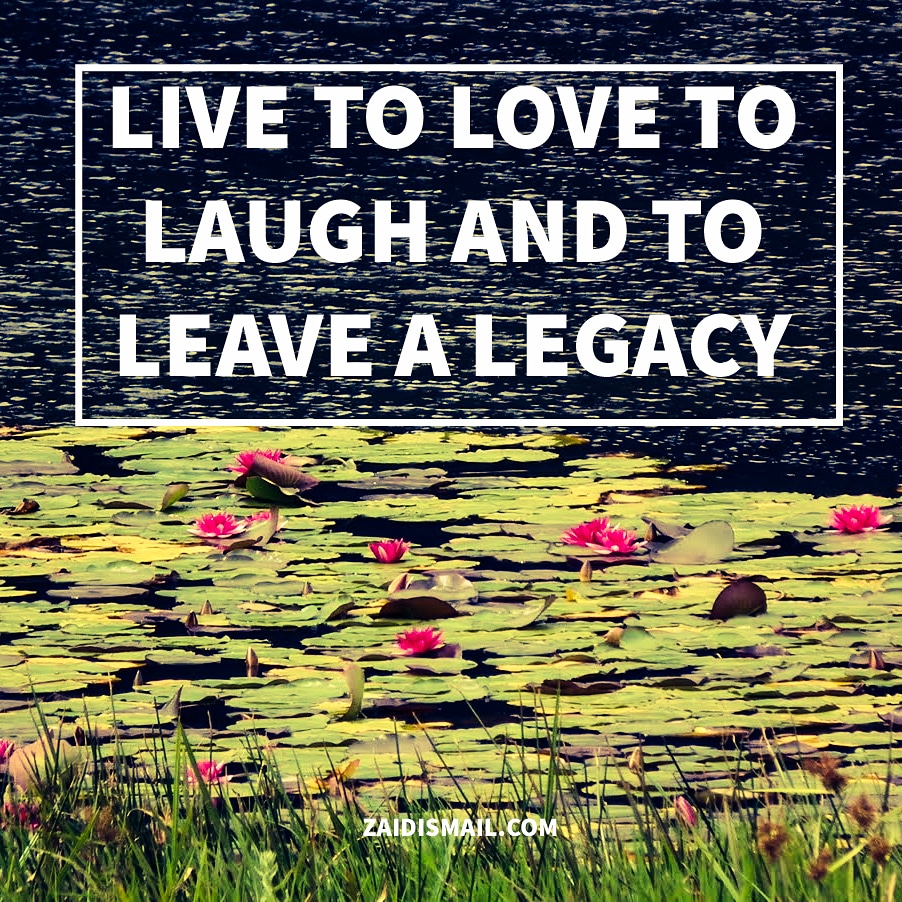
    Live to love, to laugh, and to leave a legacy. Your material success will only be celebrated after your death if it is of benefit to others. Accumulation of wealth to stroke your ego not only deprives you of the joy of human connection, it also denies you the bonds of beauty that feeds your soul. Laughter should not be sourced from a business deal that outwitted your opponent. Such laughter will mock you in your later years when you realise that your fascination with wealth was merely a drop in the ocean of joy compared to what joy you could have achieved in investing the incredible talents you have to brighten up the faces of loved ones, or even strangers. Wealth is a means to an end. Don’t get so caught up in the means that you completely lose sight of your end.

  • Bitter Sweet

    Bitter Sweet

    One thing I could never relate to was the experience of shedding tears of joy. Not the tears that are spontaneously released at the end of a harrowing experience, but the tears that fall out of joy at the sound of good news or because of an unexpected blessing unrelated to a difficulty. The release of tears as an expression of emotion has always fascinated me. Despite my general disposition of feeling things very deeply, and having a keen sense of the emotional space that others may be in, that volume of reference material, so to speak, does not appear to have informed my emotional frame of reference to allow me the ability to spontaneously shed tears of joy.

    Is it a deficiency or is it simply my nature? That has never been an easy question to answer because answering requires a definition of what normal is. For the most part, I don’t think that there is an emotional normal. Perhaps a relatable frame of reference is all that we have to work with, but we don’t engage with others around frames of reference. We engage on emotion.

    Perhaps I am jaded. Who am I kidding? Perhaps has nothing to do with it. Jaded I am, but pessimistic I am not. So I still expect good outcomes, but I’m also painfully aware of the bad outcomes just waiting to occur.

    I’m suddenly reminded of the scene from Hancock with Will Smith and Charlize Theron where they grow closer to each other and lose their immortality. Finding such comfort in each other weakened them while remaining apart strengthened them. That same threat appears to haunt the fearful romantics. The ones that cherish the thought of a perfect companionship but find every reason to believe that they are not worthy of it. The threat of being disemboweled should such perfection be ripped away causes many to recede and play it safe instead.

    I can relate to such bitter sweet moments. Moments when you look into someone’s eyes and see the comforting joy that they feel, only to see it brushed away by their fears of losing such joy if it were to be embraced. Moments when the expectations that society places on us to be perceived a certain way conflicts with what we want for ourselves. Be true to ourselves and risk isolation, or deny ourselves and enjoy an uneasy inclusion? The bitterness of such choices often snuff out the sweetness of what it offered, but we are inclined to believe in probabilities before we believe in hope.

    The bitter sweet moments are many. They’re reflected in moments when you connect with another soul but realise that you’re only a decade or more too late. Or the time that you suddenly grasped the charm of a given act, but the one who charmed you in that way left a long time ago out of frustration or rejection because you may have been distracted. Or the moment when two damaged souls connect, but pull away because neither sees the damage of the other, but only the damage within themselves and think the other to be deserving of better.

    It is safer to recede and take the path of mediocrity, even in love, because mediocrity offers a real chance of tasting happiness or comfort, or even success. It’s the acceptance of half a loaf of bread in case you end up with none. But it also limits the experience of life to half measures and half truths. The other half that is left unfulfilled demands distractions and superficial indulgences to complete you, but such indulgences only distract you from the void but never fills it.

    It’s a sure way to fade away while waiting for that perfect moment to arrive. Equally so, embracing the hope of fulfilment could kill you a thousand times before the kindred one comes along, if ever. Living with such hope is foolhardy to some, but non-negotiable for others. Bitter sweet. No guarantees. That’s life.

  • Opportune Moments

    Opportune Moments

    Tonight I was reminded of many things. Important things. Calling them things undermines the significance of it, but such is life. It turns the ordinary into elusive extraordinary moments, and turns the defining moments into passing glimpses of what was or what might have been. I was reminded of something I read on the blog of a troubled soul many years ago. It said, quite plainly, that life has been one long longing for a place I’d never been. That’s what tonight reminded me of.

    It reminded me of everything that I cherished and romanticised about, everything that is fragile but resilient, and everything that has felt like it was always meant for someone else. There is a taunting accuracy in driving around with a number plate that reminds me of the divinely ordained destinies that visit us in moments of distraction, and sometimes in moments when we are so deeply immersed in the essence of it that its passing feels akin to the ripping of thorns from the deepest recesses of my gut. But there has always been a glory in being able to experience moments so deeply.

    I look around at the oblivious that flit from moment to moment each time only looking to see if they were noticed or celebrated in that moment, but rarely allowing anything of that moment to affect them in a way that tears away at their defenses. Control is often blamed on the need to be functional or dependable, but it is most often called upon when we would muster the last breath in us to ensure that no one ventures close to the most cherished wounds of our souls. Until moments arise that remind us that control was only ever an illusion. A state that we created by blocking out everything that we could not control, and convinced ourselves that if we believed it hard enough, it would be willed into truth.

    Abandoning control in favour of feeling my humanness is an embrace I savoured a long time ago. I now convey the image of control to others, because what they see is the absence of impact of the fickle ways of others, and assume that it is in fact a control of response on my part. It is not. There is little control that is needed when you recognise the world for the fleeting annoyances that it offers. When a response is not warranted, most interpret it as restraint, simply because such a fickle occasion would have exacted much seething on their part. Not feeling any need to respond requires no control. It simply requires an awareness of the futility that any response will offer.

    Such passion for righting the wrongs that none care much about is easily subdued and eventually abandoned in favour of serving the passion that promises to oil the lamp that shines the light that makes the darkness bearable. There is nothing so bad that there is no good in it. These words have grounded me, and brought me comfort in times of despair by prompting me to recognise that there is more to life than wilting away in the darkness in memory of a past that never blossomed. Life is too short for such indulgences of the ego.

    Everyone talks about how short life is, but never about how short their memory is when it comes to remembering this sobering fact. I recall a movie whose title escapes me, in which Mini Driver screamed at her father after yet another disappointing betrayal of his trust, and complained that he keeps taking her to the top of the mountain only to show her what she can’t have. Perhaps that is what life is about. Dreams and aspirations that drop sparkles on the path for others to find their way, while the road ahead beckons you towards adventure and the promise of all things beautiful. So we willingly drop pieces of the essence of us as we travel along that path, until eventually we are spent. Those of us that are fortunate are met with our final moments at the time that we have exhausted the last shards of what we have to offer the world. The not-so-fortunate find themselves spent before their final breath approaches leaving them scurrying in their twilight moments looking for hope or purpose, finding none, and denying everything that ever tasted like reality, waiting patiently for the taunt of death to finally cease so that death itself may arrive.

    Opportune moments are most often recognised in moments of good fortune. But as always, moments that remind us of the beauty we take for granted, or the companionship that we barely recall are the moments that are most opportune. It defines who we are in provoking the responses of our true selves in its wake, while leaving us bare and vulnerable only to the eyes of those that see beyond the aesthetic. Thankfully they are in short supply so living with such brazenness is possible without attracting the attention of the distracted.

    Tonight, I was reminded that it is not loneliness but isolation that breaks our spirit. Because as they say, you are never alone if you like the one that you are alone with. Isolation is what you feel when you are in a room full of people, all of whom are close to you, but none of whom truly know or appreciate you. Isolation is felt most deeply when you feel the warmth of an embrace so close that it sets your heart racing, but it leaves without being fulfilled leaving your heart breaking.

    There was a time when such expression was reserved for anonymous posts that protected my dignity in the presence of those that have spent much time and effort in trying to prove that some humanity rested within me. Only, the humanity they sought to expose was in fact humiliation they wished to impose. It makes others feel less weak or pathetic when they are able to prove that the strong have moments of weakness just like them. Little do they know that it weakens them even more instead. These are all opportune moments. Moments that define our contribution to the world, and moments that define what we wish to finally accept the world is able to offer us.

    Shame is only felt when the opinions of others matter. When those opinions hold no weight at all, vulnerability and hope become companions that walk side by side, with optimism pretending to be the mascot, and reality being the path on which we travel. Incoherent ramblings offer solace and repose, even though after bleeding at the keyboard the gravity of what was not will once again visit a heavy heart.

    Despite all this, I would have life no other way. Living in half measures, even when surrounded by ingrates and mirages, is no life at all. Fortuitous it may be that I was reminded of a quote from Shakespeare just last night. It said, “Life is but a walking shadow that struts and frets its hour upon the stage and then is heard no more. It is a tale, told by an idiot, full of sound and fury, signifying nothing.” I think he got it right, except for the last part. It signifies everything. That everything only loses its value when we hope for it to be valued by those that don’t recognise the value in us, or sometimes, the value in themselves. Either way, rubbishing the good or chasing the bad is only ever a cry for sympathy. I pray that I will never be met with such weakness in what life remains ahead of me.

  • The one who loves less…

    I once heard that the one who loves less is the one that controls the relationship. It sounds pretty obvious at face value, but it assumes that the expression of love is as obvious as well. It also assumes that the interpretation of control is in fact control and not influence. It assumes a lot. But with most satisfied to think in the shallow end of the emotional pool only, it’s no wonder that such proclamations gain unchallenged veracity.

    Love is never monolithic in its expression. A bunch of flowers for one may be an endearing gesture, while for another it could be superficial or fake. Some prefer to see conviction in a personal gesture or investment of time and effort, while others need the flowers to believe that they were remembered at a time when they weren’t present. Whether one form of expression is better than the other is not the point. The fact that it translates into a gesture that reflects intent, and in turn, is appreciated for what it was intended to convey is significantly more important.

    Intent, therefore, is what counts. Intent, therefore, also demands sincerity. A gesture is only a gesture towards acquiring a specific desired outcome if that gesture proves to be an embrace of another, rather than the acquisition of benefits for personal gain. That seems a bit wordy, so here’s a slightly lighter take on this. If you give with the intention of receiving, you’re giving for your own benefit and not to sincerely express appreciation or endearment of another.

    We all seek to control and/or influence. That is what determines our level of significance with our significant others. Whether such control or influence is driven maliciously or not remains a question of intent, and given the above, it’s near impossible to be absolutely certain about the intent of another. At best, we are able to measure the reciprocation with which our efforts are met. The greater the reciprocation, the more likely we are to believe that there is an equal conviction on their part in responding to our efforts. The less the reciprocation, the more likely we’ll recede from the belief that we’re being taken for granted, or are simply not being appreciated at all.

    The one that controls the relationship is not always the one that loves less. Quite often, conviction in the potential outcome drives some to be controlling when they find that they are unable to subtly influence the behaviour of those they love in the direction that they truly believe will benefit them. Benefit to both the one influencing, and personal benefit to the one being influenced. Perhaps, by the same logic, I could argue that the one who controls less may love less, because in doing so, it could easily reflect a lack of conviction on their part. It could suggest a lack of belief in the innate goodness or the beautiful potential that has yet to be realised from the relationship.

    It’s all about what’s in it for us. If I aim to extract more benefit for myself than I hope to contribute for others, then definitely my efforts at controlling or influencing the outcome will be self-serving. In that case, my love for myself will be greater than my love for any wholesomeness to be achieved with another. However, if my aim is to extract a benefit for the other, without sacrificing myself in the process, then perhaps it could be argued that I am the one that loves more. If I sacrifice myself in the process, it simply means that I see myself as lacking in value to those around me, and therefore need to expend myself in their service if I ever hope to achieve any level of significance in their lives. A truly unhealthy state to be.

  • Unconditional Love

    To live life romantically is such a beautiful notion. You see the world for all that it offers and politely ignore all that it is. The lover professes unconditional love for their beloved, yet so often such undying love ends in heartache. Was it unconditional, or was it one-sided? I once heard that the one who loves less controls the relationship. I think that is mostly true.

    Unconditional. That’s a huge claim to make. Unsurprisingly I decided to test its veracity by observing those around me who often profess to uphold this claim of unconditional this and that. Love, for starters, is grossly misunderstood and overrated by most people. Obsession, infatuation, or lust (or all three) are usually at play long before love even enters the picture. Having said that, I believe that unconditional love is real. However, it probably doesn’t take the form that most assume it to be and probably shouldn’t be called love to begin with. I think commitment and sincerity are more attuned to reality than the vagueness of love.

    Too many confuse love with acceptance, and far too often that acceptance is based on the fear of rejection. We accept untoward behaviour or allow people to take us for granted under the guise of loving them unconditionally, while the truth is closer to the fact that we are usually fearful of not finding something better if we reject such treatment. Being alone is infinitely more scary to most people, more scary than dealing with an abusive or unfulfilling relationship. Having someone, to many, is better than having no one, even if that someone holds them back from being who they are capable of being. Yet they stay in such relationships believing that it’s unconditional love, more because they’re hoping to receive unconditional love in return.

    But here’s the rub. When we hope to receive unconditional love by making such sacrifices of our own peace and sanity, it implies that we have yet to unconditionally love ourselves. In the absence of that self-acceptance, we look for others to accept us first so that we can convince ourselves that we are worth the investment of love and life. We therefore fool ourselves into believing that unhealthy relationships must be endured simply because we would expect others to do the same for us if we were the unhealthy contributors to a relationship. The irony is that we are such contributors when we settle for less.

    That’s all fairly obvious for those not in denial, but it still doesn’t quite define what unconditional love really is. For me, unconditional love is not being infinitely tolerant, but instead, it is about being intolerant of anything less than what you know the person you love is capable of achieving. Apply this in a parenting scenario, or a marriage, or a romantic liaison, and you’ll see how it holds true. If you love someone, you won’t allow them to do something that you know is going to harm them, or cause an oppression against others. The moment you tolerate such behaviour from them, you prove that your love for yourself is greater than your love for them because being unpopular erodes the self-worth of the fickle.

    Stated differently, what is usually considered to be tough love is only possible from those that are confident that the acceptance or rejection of others does not define who they are, or how they see themselves. You have to be accepting of yourself as a whole person within the context of a relationship before you will be willing to push for a correction or adjustment in behaviour from the person you’re with. However, it also means that in accepting ourselves, or others, we need to recognise the weaknesses or bad habits that detract from our wholesomeness as a human being, coupled with the resolve to work at improving it. The same must be true for how we view others if we are to profess that we love them.

    It cannot be love if we enable destructive behaviour. Perhaps that needs to be rephrased. It is not love for the other that enables destructive behaviour, but a lack of love for the self that allows it to continue unchallenged. When we subject ourselves to abusive relationships, we fool ourselves into believing that if we wish to be accepted, then we need to be more accepting of others. That’s far too idealistic to be healthy. The reality is closer to having a clear conviction about what we stand for before we agree to stand for everything.

    More importantly, if our greatest fear is how we will be perceived if or when we object to something, then again, we are more concerned about ourselves than we are about making others feel judged. It feels like I’m over complicating a really simple issue. so here’s a final take on this.

    You need to know what you stand for before you can be accepting of others. If you don’t, you are not accepting, you are assimilating because of a need for inclusion. That fear of rejection or isolation is grounded in the fact that you judge yourself harshly, and have a lack of conviction in improving those traits of yours that you would rather others don’t see. To deflect attention away from such weaknesses, you embrace others without question so that you don’t give others reason to question what you’re about.

    We see this playing out in parenting all the time. Parents that won’t accept that their children are wrong or downright abusive because such acceptance confirms that they may have failed as parents. Women and even men remain in emotionally and physically abusive relationships because they’re afraid that no one else will accept the distasteful view they have of themselves, while trying to convince the world that they are only holding on because they truly believe that their partner is a good person behind all that anger, or insecurity. Or worse, they remain in the relationship because of the children that they don’t want must be raised in a broken home, not realising that they’re effectively teaching their children that it’s more important to grin and bear it than it is to stand up and do the right thing.

    We project our insecurities on those around us, and then over compensate for theirs in order to ensure that ours are not discovered. Then we wrap it up as unconditional love because that is more palatable as a concept for us, and is found to be more endearing for those from whom we seek acceptance. We do this while forgetting that unconditional love is being willing to point out what’s wrong so that we can work on making things right, rather than suffering the wrong because we don’t want to offend or be seen as unpopular. Unconditional love is what drives us to demand nothing less than what we believe is possible from those we care about, because the only time we can claim to truly love them is when we want for them what we want for ourselves. If we desire less for ourselves, then we seek to live vicariously through them instead, which once again confirms that our love, as unhealthy as it may be, is in fact for ourselves more than it is for others.